General
The AI Adoption Framework: A Consultant's Step-by-Step Guide to Enterprise Transformation
· By AIHQ Team

Too many AI initiatives stall not because the technology fails, but because the organisation was not ready for it. A leadership team agrees AI is a priority, a few teams run pilots, enthusiasm builds — and then adoption fizzles. No clear owner, no prioritised use cases, no governance, no way to measure progress.
That is the pattern most enterprises face, and it is why a structured AI adoption framework matters more than any single tool. This guide walks senior leaders through the exact framework consultants use to move organisations from scattered experimentation to structured, scaled adoption — phase by phase, with practical checklists and decision gates along the way.
Phase 1: Assess Readiness Before You Start
Readiness assessment is the most skipped — and most valuable — step in the entire journey. Before you choose tools or train teams, you need an honest picture of where your organisation actually stands.
A useful readiness review covers four dimensions:
1. Data and technology. What data do you hold, where does it live, and how reliable is it? Do you have the infrastructure to connect AI tools to your systems, or will teams be working with off-the-shelf tools first?
2. Workforce capability. Are employees confident using basic tools like ChatGPT, Gemini or Copilot? Is AI usage consistent, or concentrated in a handful of self-taught enthusiasts?
3. Leadership alignment. Is the C-suite aligned on what AI should achieve? Have you named a clear owner for adoption, or does it sit scattered across departments with no accountability?
4. Governance and risk. Do you have policies for confidential data, human oversight and acceptable use — or is usage happening informally and unmanaged?
The decision gate for Phase 1: If leadership is not aligned and no clear owner exists, address this before investing in tools or large-scale training. Leadership alignment is a precondition for everything that follows.
Phase 2: Prioritise Use Cases That Matter
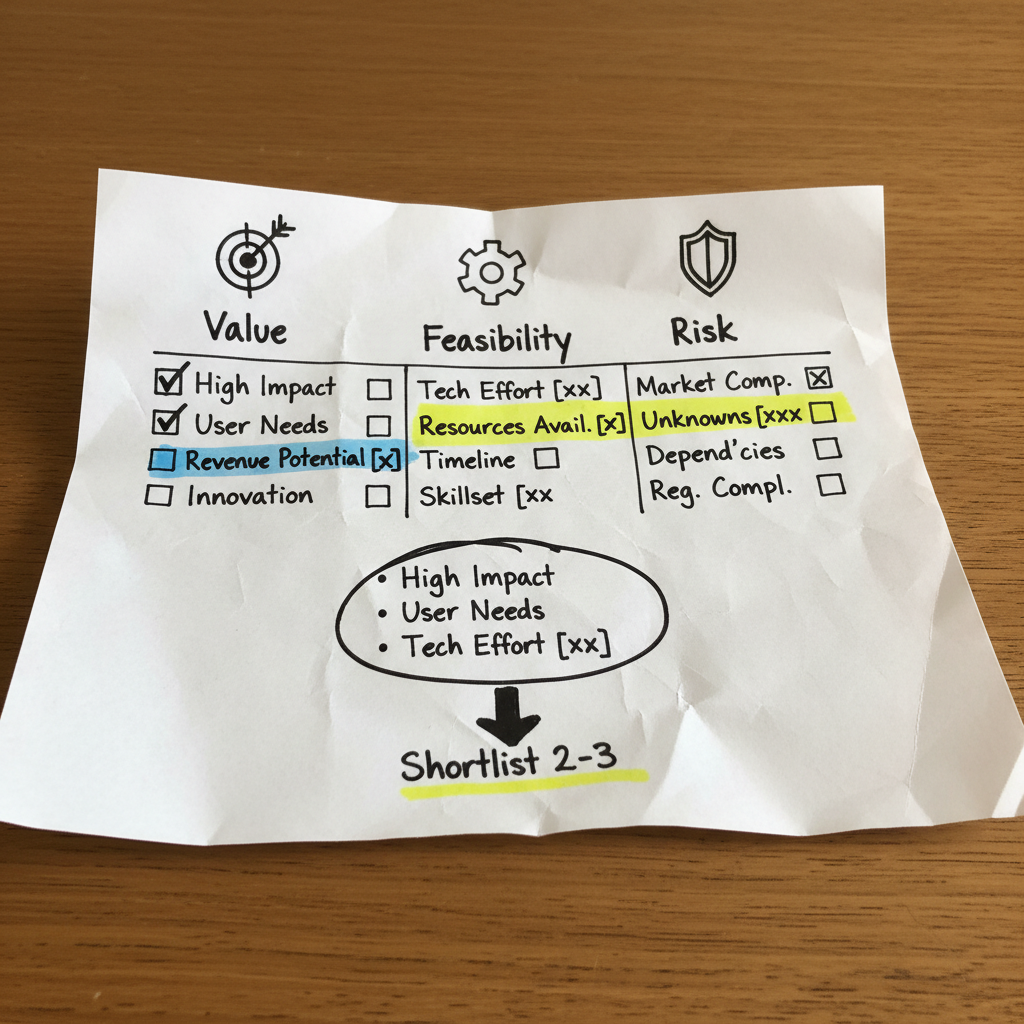
Score candidate use cases across value, feasibility and risk before piloting.
Once readiness is understood, the next step is defining where AI can create real value — not where it sounds impressive. Too many organisations start with the tool and look for problems to fit it. The far more reliable approach starts with workflow pain points.
A practical way to prioritise is to build a candidate list of use cases and score each across three filters:
- Business value. Does it reduce repetitive work, speed up a process, improve decision support or strengthen a customer outcome?
- Feasibility. Do you have the data, process clarity and capability to deliver it realistically?
- Risk and effort. Does it touch sensitive data, need integration, or require significant change management?
The goal is a short list of two or three high-value, feasible pilots — not a portfolio of twenty ambitious ideas. A structured approach like an AI innovation bootcamp can help teams identify and prioritise practical use cases worth piloting, especially when business teams and technical teams need a shared language.
The decision gate for Phase 2: Only move forward with use cases that clear a visible bar for value, feasibility and manageable risk. Kill or defer everything that does not.
Phase 3: Build Capability, Not Just Awareness
Once use cases are chosen, you need people who can actually apply AI to those workflows. This is where generic training so often falls short. A half-day workshop on "what AI can do" raises awareness but rarely changes daily working habits.
Sustainable adoption requires role-based capability — training that connects AI to the specific reporting, documentation, analysis and decision-support tasks your teams perform every day. When an HR team sees how AI fits its own processes, or a finance team practises on its own reconciliations and analyses, adoption becomes concrete rather than abstract.
Designing such a programme is itself a structured exercise. AIHQ has built role-based AI training that spans awareness, fundamentals and practical application, and has seen the difference it makes when teams work on real workflows. Training is not a one-off event; it is a progression that moves employees from curiosity to confident, responsible usage.
A genuinely useful capability plan includes:
- Clear learning outcomes tied to specific roles and workflows.
- Practical exercises using the organisation's own scenarios.
- A cohort of early champions who can model good usage.
- Follow-through and support, not a single isolated session.
The decision gate for Phase 3: If participants cannot name how they will use AI differently in their daily work within a week of training, the programme is not yet moving towards adoption.
Phase 4: Govern Responsible Use Early
Governance should be built alongside adoption, not bolted on after problems appear. For regulated organisations, professional institutions and the public sector, this is especially critical — but every organisation using AI at scale needs guardrails.
Practical governance spans a few core areas:
- Data protection. Clear rules on what can and cannot be entered into AI tools, especially for confidential or sensitive information. Organisations should set clear guardrails for responsible AI use.
- Human oversight. A policy on which outputs need human review before action — for example, anything customer-facing or decision-relevant.
- Acceptable use. A short, practical policy that translates into real employee behaviour, rather than a dense document nobody reads.
- Accountability. A named owner for AI risk who tracks issues and reviews usage as adoption scales.
Governance does not mean slowing adoption — it means making adoption safe and repeatable. For organisations scaling AI usage, responsible AI and governance workshops help teams use AI safely and appropriately rather than guessing at the rules.
The decision gate for Phase 4: If employees cannot answer how they would handle a confidential document with an AI tool, governance is not yet operational.
Phase 5: Pilot, Measure and Learn
With capability and governance in place, you are ready to pilot properly. A pilot is not a proof that AI works — it is a controlled experiment designed to show whether a specific use case creates value in your specific context.
Each pilot should have a defined owner, a clear success measure and a fixed timebox. It should also be designed to test the two things that actually matter: does it produce a better workflow, and do people keep using it?
Measure a mix of signals:
- Adoption: Are the intended users actually using it, and how often?
- Outcome: Is the process faster, more consistent or better supported by data?
- Human judgment: Are users reviewing output appropriately and flagging limitations?
Be candid about results. A pilot that fails because the use case was a poor fit is valuable information — it protects you from scaling something that would not work. The point is to learn which use cases to scale, which to refine and which to retire.
The decision gate for Phase 5: Scale only what has shown real value and sustained uptake. Do not scale on enthusiasm alone.
Phase 6: Scale and Embed Into Workflows
Scaling is where most frameworks break down, because scaling is less a technical problem than an organisational one. As adoption expands, momentum can fade without deliberate reinforcement.
Scaling well means:
- Standardising the workflows and prompts that work, so good practice becomes the default.
- Connecting adoption to visible outcomes, so leadership sees progress and teams see impact.
- Maintaining governance and support as new teams come on board.
- Knowing when off-the-shelf tools are not enough — some workflows will eventually need a custom AI solution, such as an internal copilot for your SOPs, an FAQ chatbot or workflow automation.
Scaling is also where visibility matters. Dashboards and simple adoption tracking help leaders see whether AI usage is spreading or concentrated in pockets — and where extra support is needed.
Why Most AI Initiatives Stall — and How to Avoid It
Looking across these phases, the common failure points become clear:
- Leaders treat AI adoption as a tool rollout instead of a capability journey.
- Organisations run pilots without prioritising, so effort is scattered.
- Teams get awareness training but not role-based capability.
- Governance comes too late, after risky usage has already spread.
- Nothing is measured, so there is no evidence to justify scaling.
A structured framework addresses each of these. It forces an honest readiness discussion before investment, pairs every phase with a decision gate, and keeps leadership, capability, governance and measurement moving together.
Adoption is a journey from awareness to capability, usage and outcomes. It rarely happens overnight, and it depends on your organisation's context, data, governance and follow-through. What a good framework does — and what a good partner helps you do — is give that journey structure and momentum.
Building Your Adoption Roadmap
If you are still in the awareness or experimentation stage, the most useful next step is not to buy more tools. It is to run a structured readiness and use-case discussion with your leadership and cross-functional teams.
Organisations that move fastest do not adopt every trend. They align leadership early, prioritise ruthlessly, build role-based capability, govern responsibly and measure as they go. That is the difference between scattered experimentation and an adoption roadmap that delivers real workflow impact.
To structure your own AI adoption journey, AIHQ helps organisations move beyond awareness into structured capability, practical adoption and real workflow impact — through leadership briefings, role-based training, innovation bootcamps and custom AI solutions where off-the-shelf tools are not enough. With over 9,000 professionals engaged and work across corporate, public sector, professional and regulated environments, it has practical experience translating frameworks into organisation-specific adoption.
FAQ
What is an AI adoption framework?
An AI adoption framework is a structured, phased approach for moving an organisation from AI awareness and scattered experimentation to practical, scaled usage. It typically covers readiness assessment, use-case prioritisation, capability building, governance, piloting and scaling — each with clear decision gates.
Why do most AI initiatives in enterprises stall?
Most stall because they are treated as tool rollouts rather than capability journeys. Common failure points include weak leadership alignment, unprioritised pilots, generic rather than role-based training, governance that comes too late, and no measurement to justify scaling.
Should my organisation start with a pilot or full rollout?
Start with a prioritised, timeboxed pilot run by a clear owner with a defined success measure. A well-designed pilot tells you whether a specific use case creates value in your context before you invest in broad rollout.
Do we need governance before employees use AI?
It is far easier to build guardrails early than to correct risky behaviour after it spreads. Practical governance covering data protection, human oversight and acceptable use helps make adoption safe and repeatable, especially in regulated or professional environments.
When should we consider custom AI solutions instead of off-the-shelf tools?
Off-the-shelf tools are useful for many general tasks, but some workflows require custom AI solutions, automation or structured implementation — such as an internal copilot for your SOPs, an FAQ chatbot or workflow automation. A use-case review helps identify where that is the case.