General
AI Agent Training for Business: How to Equip Your Teams for the Agentic Era
· By AIHQ Team

Every few years, a new AI capability resets the conversation about what automation can do. First it was basic chatbots that answered simple questions. Then large language models let employees draft, summarise and analyse faster. Now a quieter but bigger shift is underway: agentic AI, where systems don't just respond to a single prompt but plan, execute and, within guardrails, learn from what they do.
For most businesses, the question is no longer whether AI will touch daily work. It is how well equipped teams are to work alongside agents responsibly. That is why AI agent training for business deserves to be treated as a strategic discipline rather than an optional workshop.
This article makes the case for why agentic AI changes the capability discussion, why prompt writing alone isn't enough, and how to build agent literacy across your teams with a practical starting playbook.
What Actually Changes with Agentic AI
To understand why agent training matters, it helps to see what has actually changed versus earlier waves of automation.
Traditional automation followed rules you wrote in advance. If X happens, do Y. You could trace every step, and the system only ever did what you explicitly programmed it to do.
Early AI chatbots were more flexible but largely reactive. They answered what you asked and stopped. They didn't pursue a goal across several steps or adjust course based on new information.
Agentic AI sits somewhere new. An agent can be given a higher-level objective, break it into smaller steps, use tools and data along the way, and check its own progress. It can plan, execute and reflect. Under the right guardrails, it can iterate toward a result.
That is genuinely powerful. It is also why the old assumption—"just teach people to write better prompts"—falls short. Prompting is still useful. But people now need to understand what an agent can and cannot be trusted to do, where it fits in a workflow, and how to review its output.
Why Prompt Writing Isn't Enough
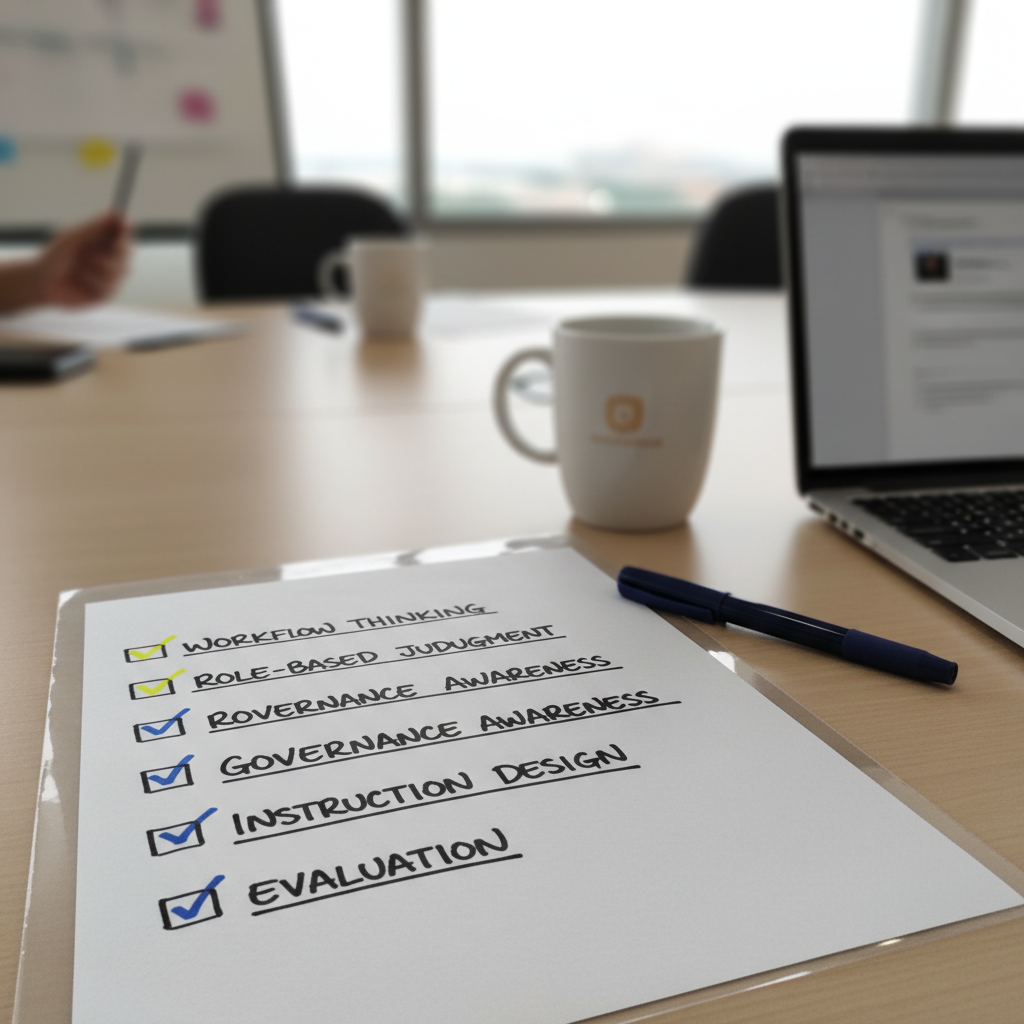
Beyond prompting: the capabilities agentic work really needs
If the only skill employees need is better prompting, then agent training is a small problem and a generic session would solve it.
The reality is more demanding. Safe, useful agentic work requires several overlapping capabilities that go beyond any single prompt:
- Workflow thinking. Teams need to identify the steps of a process that an agent could support, and where human judgment must stay in the loop.
- Role-based judgement. An accountant reviewing an agent's reconciliation is not the same as a marketer reviewing an agent's draft. Context and verification differ by role.
- Governance awareness. People need to know what data can be shared with which tools, and where sensitive or confidential information should never go.
- Instruction design. Framing a goal with the right constraints—so an agent doesn't overreach or terminate too early—is a real skill.
- Evaluation. Teams need practical ways to check whether an agent's output is accurate, relevant and aligned with the business, rather than assuming it is.
None of these are solved by memorising prompts. They are organisational capabilities built through structured training, role-specific exercises and actual workflow practice.
A Practical Starting Playbook for Agent Literacy
If you're beginning this journey, you don't need a massive transformation programme on day one. A structured, staged approach works. Here is a practical starting playbook.
Step 1: Identify High-Value Workflows First
Start with the work you already do, not with the technology. Ask each team which repetitive, multi-step tasks consume meaningful time. Good early candidates are tasks with clear steps, available data and a defined quality standard—tasks where a human review checkpoint makes sense.
An AI use-case discovery workshop helps teams surface and prioritise these opportunities rather than chasing shiny ideas. Workflow pain points, not tool features, should drive the list.
Step 2: Build Role-Based Capability
Generic training creates awareness, not adoption. Teams need exercises tied to what they actually do—a customer service agent practising escalation handling, a finance analyst reviewing automated reconciliation, an HR specialist drafting policy answers with the right guardrails.
This is where role-based AI training earns its keep. By grounding agent literacy in each department's real workflows, people learn when to trust an agent and when to override it, which is the core judgement skill of the agentic era.
Step 3: Establish Governance Before Scale
It is tempting to let a few curious teams experiment and figure out governance later. That rarely ends well, especially with more autonomous agents. Once an agent can act on multiple steps, the stakes of a mistake rise.
Set clear rules about what data agents may access, what actions they may take without human approval, and how outputs are reviewed. A responsible AI and governance session translates policy into everyday behaviour rather than leaving it as a PDF nobody reads.
Step 4: Keep Humans in the Loop with Intention
Human-in-the-loop isn't a compromise; it's a design principle. The goal isn't to remove people, but to free them to focus on higher-judgement work. An agent should handle the tedious pattern-following steps and surface a clear recommendation for a person to review, challenge and finalise.
Clarify who owns the final sign-off for each automated process. When a human owns the outcome, the agent becomes a supportive tool rather than an uncontrolled actor.
Step 5: Learn from Usage, Not Just Training
Training is a starting point, not a destination. Once teams begin using agents, track where they succeed and where they stumble. Which workflows see real traction? Which tasks need more guardrails or a different approach?
Some workflows turn out better served by custom AI solutions rather than trying to bend a general tool to fit. An off-the-shelf agent handles common cases; a tailored chatbot, copilot or automated workflow can address a specific process more reliably.
What Strong Agent Training Looks Like in Practice
Practical agent literacy training, when done well, shares a few traits:
- It is rooted in real workflows, not abstract theory.
- It is role-specific, so an accountant and a marketer learn different patterns of review and judgement.
- It covers limits and risks openly, including where agents make mistakes.
- It builds governance habits, such as classifying data before sharing it with a tool.
- It ends with a usable next step, whether that's a pilot, an adoption plan or a governance checkpoint.
At AIHQ, our focus has been on exactly this kind of practical, structured capability. We have trained and engaged over 9,000 professionals across corporate, public sector, professional and regulated environments—not by promising instant transformation, but by helping teams build real judgement with AI, one workflow at a time.
The Case for Treating Agent Training as Strategy
It is easy to see agentic AI as today's buzzword. But the businesses that benefit most won't be those that adopt it fastest. They'll be those that build the capability to use it well—with the right skills, governance and human oversight.
That capability isn't built by buying a tool or running a single session. It's built deliberately: identify workflows, train by role, set guardrails, keep humans accountable and learn from usage. Treating AI agent training for business as a strategic discipline is how organisations move from scattered experimentation to dependable, responsible automation.
The agentic era rewards organisations that are ready. The most reliable path to readiness is a workforce that understands not just how to use agents, but when to trust them, when to challenge them, and why human judgment still sets the standard.
FAQ
What is AI agent training for business?
AI agent training for business is the structured building of workforce capability to work with agentic AI—systems that plan, execute and learn across multiple steps. It covers workflow thinking, role-based judgement, governance awareness, instruction design and how to review agent output responsibly, rather than just teaching prompt writing.
How is agentic AI different from regular AI or automation?
Traditional automation follows fixed rules you program in advance, and early chatbots are mostly reactive to single prompts. Agentic AI can be given a higher-level goal, break it into steps, use tools and data, and adjust course—making it far more capable, but also demanding more governance and human oversight.
Is prompt training enough for teams to use agents safely?
No. Prompting is useful, but safe agentic work requires workflow thinking, role-based judgement, a clear understanding of what data can be shared, and practical ways to evaluate output. These are organisational capabilities best built through structured, role-specific training and real workflow practice.
Should we set up AI governance before or after staff start using agents?
Ideally before scaling. Because agents can act across multiple steps, the stakes of a mistake are higher. Clear guardrails about data access, approval points and human review help teams use agents responsibly from the start rather than fixing problems after the fact.
Can agent training benefit companies that don't have technical teams?
Yes. Agent literacy is fundamentally a human and workflow capability, not a technical one. Non-technical teams can learn to identify which multi-step tasks agents can support, what to review, and when to escalate to human judgement—with training tailored to their real daily work.