General
AI Agent Training in Malaysia: Build Enterprise-Ready Intelligent Systems
· By AIHQ Team
Interest in AI agents is growing rapidly across Malaysian enterprises. From customer enquiry systems that resolve issues without human handoff to internal assistants that pull answers from company SOPs, AI agents promise a step change in how organisations handle repetitive, knowledge-intensive work.
But building and deploying these agents requires more than downloading a tool. Teams need structured capability, practical training and a clear understanding of what AI agents can — and should — do inside a business environment.
This guide covers how Malaysian enterprises can approach AI agent training, from selecting the right programmes to building team readiness and deploying agents with appropriate governance.
What Are AI Agents and Why Do Malaysian Enterprises Need Them?
An AI agent is a system that can perform tasks autonomously or semi-autonomously — answering queries, retrieving information, making recommendations, or triggering workflows — within defined parameters. Unlike standard chatbots that respond to single prompts, agents can maintain context, follow multi-step instructions and escalate when they cannot complete a task.
For Malaysian enterprises, the practical applications are becoming clearer:
- Customer service agents that handle common enquiries in English and Bahasa Malaysia, escalating complex cases to human teams.
- Internal knowledge agents that help employees find SOPs, policies and technical documentation quickly.
- Process automation agents that trigger approval flows, follow-ups and notifications based on business rules.
- Data analysis agents that summarise reports, identify trends and prepare briefing materials.
The key word is practical. AI agents work best when they are trained on specific organisational knowledge, governed by clear rules, and deployed alongside human teams — not as replacements, but as support tools.
Choosing the Right AI Agent Training Programme in Malaysia
Not all AI agent training is created equal. Some programmes focus on technical architecture and coding. Others emphasise no-code agent builders. The right choice depends on your team's starting point and what you are trying to build.
What to Look For in a Training Programme
1. Practical, not just theoretical. Look for programmes that include hands-on exercises with real workflows. Teams learn more by building a test agent for a genuine business problem than by memorising agent architecture diagrams.
2. Role-based content. A developer team needs different training from a customer service or operations team. Strong programmes differentiate between technical agent building and non-technical agent configuration.
3. Governance built in. Responsible AI training should be part of any agent programme. Teams need to understand data boundaries, human review checkpoints, accuracy limitations and escalation rules.
4. Local context. Malaysia-specific considerations matter — multilingual support for Bahasa Malaysia, PDPA compliance awareness, and understanding the local regulatory environment for automated decision-making.
AIHQ's AI training programmes are designed with these factors in mind, helping organisations move from awareness to practical capability with structured, role-based content.
Building Team Capability for AI Agent Deployment
Training is only the first step. Sustainable AI agent adoption requires a capability-building approach that goes beyond a single workshop.
A Phased Capability Model
Phase 1 — Awareness and Fundamentals Introduce teams to what AI agents are, how they differ from standard chatbots, and what kind of organisational knowledge they need. This phase is about building curiosity and informed experimentation.
Phase 2 — Role-Based Training Different teams need different skills:
- Technical teams need training on agent architecture, API integration, data retrieval and security configurations.
- Business teams need training on configuring no-code agents, defining workflows and setting escalation rules.
- Leadership teams need to understand governance, risk and adoption strategy.
Phase 3 — Pilot and Iterate Run a small-scale pilot with one or two well-defined use cases. Measure what works, gather feedback and refine. This phase is where real learning happens.
Phase 4 — Scale with Governance Expand to additional use cases with documented governance frameworks, human review processes and performance tracking.
AIHQ supports organisations through this journey with structured approaches including role-based AI training, leadership alignment sessions and custom AI solutions when off-the-shelf tools are not enough.
Key Considerations for Deploying AI Agents in Malaysian Enterprises
1. Data Privacy and Security
AI agents often need access to internal knowledge bases, customer data or operational records. Before deployment, clarify:
- What data will the agent access?
- Where is that data stored?
- What safeguards prevent data leakage?
- How are access permissions managed?
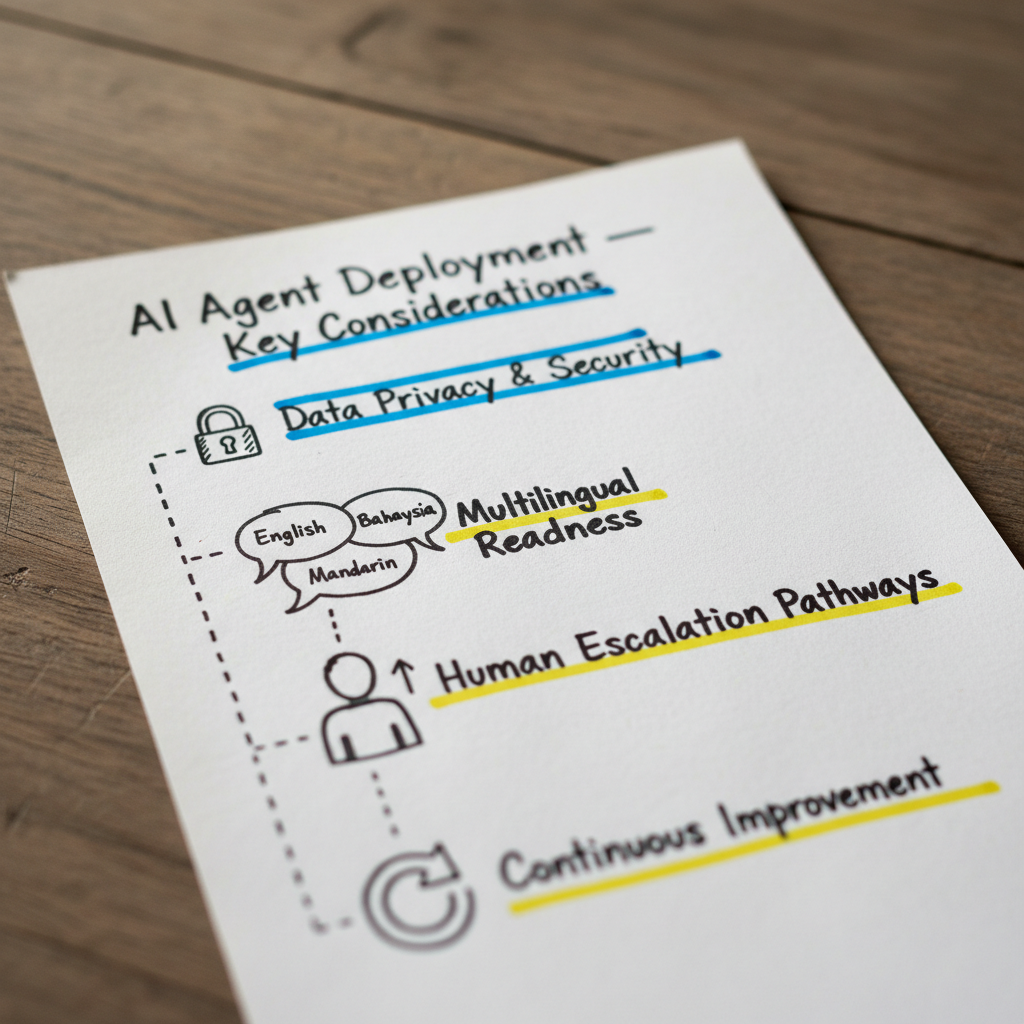
Key deployment considerations for AI agents in Malaysian enterprises
Organisations should set clear guardrails for responsible AI use, especially around confidential or sensitive information. AIHQ's responsible AI training helps teams build these guardrails early.
2. Multilingual Readiness
Malaysian enterprises operate in a multilingual environment. AI agents need to handle English, Bahasa Malaysia and often Mandarin or Tamil. Evaluate whether the agent platform supports the languages relevant to your workflows.
3. Human Escalation Pathways
AI agents should never be a black box. Every deployment needs clear escalation rules — when the agent passes a query to a human, how the handoff works, and how human reviewers verify the agent's output.
4. Continuous Improvement
Agents improve with use. Plan for ongoing monitoring, feedback collection and periodic retraining. Treat your agent as a capability that evolves, not a project that ends.
Common Pitfalls to Avoid
Treating AI agents as a plug-and-play tool. Off-the-shelf tools are useful, but some workflows require custom AI solutions, automation or structured implementation. Understand what your use case really needs before choosing a platform.
Skipping governance. Deploying agents without rules around data access, accuracy checking and human oversight creates risk. Build governance alongside capability.
Over-relying on prompts alone. Prompting is useful, but sustainable adoption requires role-based capability, workflow thinking, governance and leadership alignment.
Ignoring the human workflow. An agent that automates the wrong process just creates bad outcomes faster. Start by understanding the workflow you want to improve.
Moving Forward: Your AI Agent Training Path
AI agent adoption is not a single decision. It is a capability journey that moves from awareness to structured training, pilot deployment and continuous improvement.
For organisations ready to explore this path, the first step is understanding where your teams are today and what kind of agent makes sense for your workflows.
Frequently Asked Questions
What is the difference between an AI chatbot and an AI agent?
An AI chatbot typically responds to individual queries without maintaining multi-step context. An AI agent can follow longer workflows, retain context across interactions, make decisions within set parameters, and escalate when necessary.
Do I need coding skills to build an AI agent?
Not always. Many modern platforms offer no-code agent builders for simple workflows. However, more complex or custom agents — especially those integrating with enterprise systems — may require technical support. AIHQ offers both role-based AI training for non-technical teams and custom AI solutions for deeper implementation needs.
Can AI agents handle Bahasa Malaysia effectively?
Capabilities vary by platform. Many leading agent frameworks support Bahasa Malaysia, but accuracy depends on the quality of training data and the specific use case. It is important to test agents in the languages your team and customers actually use.
How long does it take to train a team on AI agents?
This depends on the team's starting point and the complexity of the use case. A fundamentals session can take half a day. A full capability-building programme, including hands-on pilot work, may span several weeks. AIHQ's AI innovation bootcamp can help teams identify and prioritise use cases in a structured format.
What governance do I need before deploying AI agents?
At minimum, organisations should establish data access rules, human review checkpoints, accuracy monitoring processes and escalation pathways. Responsible AI and governance training can help teams build these frameworks.
Is AI agent training HRDC claimable?
AIHQ is a registered HRD Corp training provider. Programmes can be structured to be HRDC claimable, subject to client eligibility, grant approval and HRD Corp submission requirements.
FAQ
What is the difference between an AI chatbot and an AI agent?
An AI chatbot typically responds to individual queries without maintaining multi-step context. An AI agent can follow longer workflows, retain context across interactions, make decisions within set parameters, and escalate when necessary.
Do I need coding skills to build an AI agent?
Not always. Many modern platforms offer no-code agent builders for simple workflows. However, more complex or custom agents — especially those integrating with enterprise systems — may require technical support. AIHQ offers both role-based AI training for non-technical teams and custom AI solutions for deeper implementation needs.
Can AI agents handle Bahasa Malaysia effectively?
Capabilities vary by platform. Many leading agent frameworks support Bahasa Malaysia, but accuracy depends on the quality of training data and the specific use case. It is important to test agents in the languages your team and customers actually use.
How long does it take to train a team on AI agents?
This depends on the team's starting point and the complexity of the use case. A fundamentals session can take half a day. A full capability-building programme, including hands-on pilot work, may span several weeks.
What governance do I need before deploying AI agents?
At minimum, organisations should establish data access rules, human review checkpoints, accuracy monitoring processes and escalation pathways. Responsible AI and governance training can help teams build these frameworks.
Is AI agent training HRDC claimable?
AIHQ is a registered HRD Corp training provider. Programmes can be structured to be HRDC claimable, subject to client eligibility, grant approval and HRD Corp submission requirements.