General
AI Agent Training: A Structured Guide for Malaysian Enterprises
· By AIHQ Team

Agentic AI is no longer a concept on the horizon — it is already reshaping how enterprise workflows are designed. But as organisations evaluate AI agents for tasks such as automated reporting, customer triage, internal helpdesk support and process orchestration, a critical gap emerges: most teams are not yet trained to work with agentic systems responsibly or effectively.
This guide explains what AI agent training should cover, why it differs from standard GenAI workshops, and how Malaysian enterprises can build real workforce readiness for agentic workflows.
What Is Agentic AI — and Why Does Training Matter?
Agentic AI refers to AI systems that can pursue a goal, make decisions within defined parameters, and execute multi-step tasks with limited human intervention. Unlike a single-turn chatbot that responds to a prompt, an AI agent can plan, retrieve information, use tools, check its own output and escalate when uncertain.
This shift from reactive tools to semi-autonomous agents changes what employees need to know:
- From prompt writing → to workflow design and agent orchestration
- From single outputs → to multi-step task verification
- From tool experimentation → to governance and oversight of agent behaviour
Generic AI literacy workshops do not address this depth. Organisations investing in agentic capabilities need structured AI agent training that builds both technical confidence and responsible oversight.
How AI Agent Training Differs from Standard AI Courses
Many organisations assume that an advanced ChatGPT workshop is sufficient preparation for agentic tools. In practice, agentic AI training requires a different curriculum focus:
| Standard GenAI Training | AI Agent Training |
|---|---|
| Prompting and output generation | Workflow design and agent orchestration |
| Single-turn Q&A | Multi-step task planning and verification |
| Output review | Agent behaviour monitoring and escalation handling |
| General safe use principles | Role-specific agent governance and guardrails |
Teams that skip this distinction risk deploying agents without the human oversight needed to catch errors, prevent data leaks or handle edge cases appropriately.
What a Comprehensive AI Agent Training Programme Should Cover
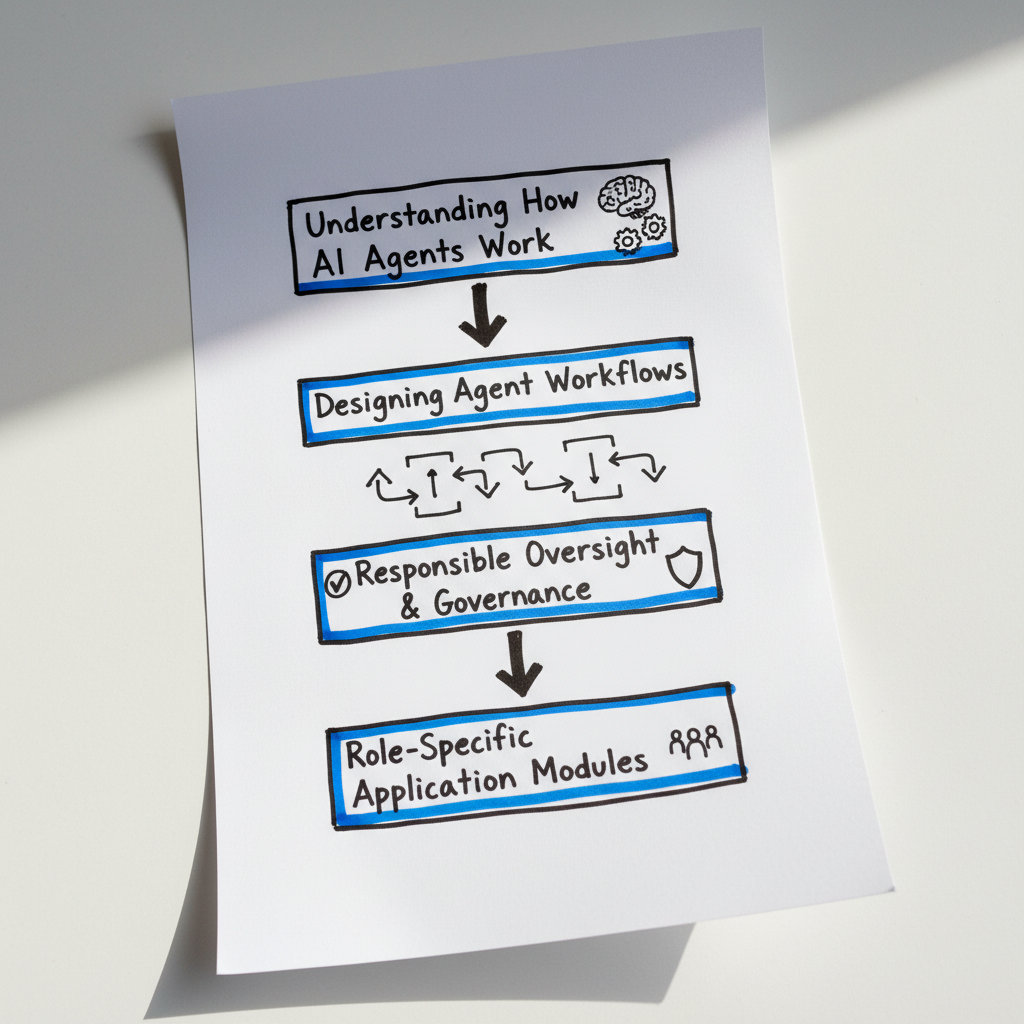
A structured four-layer curriculum for AI agent training in enterprise teams.
A well-structured agentic AI training course for enterprise teams should build capability across several layers:
1. Understanding How AI Agents Work
Before teams can manage agents, they need a practical understanding of how agentic systems function. This includes:
- The difference between chatbots, copilots and autonomous agents
- How agents use tools, memory and planning loops
- Common agent architectures (ReAct, function-calling, multi-agent patterns)
- Realistic limitations: when agents fail, hallucinate or loop
2. Designing and Configuring Agent Workflows
Teams should learn how to map business processes to agent workflows:
- Identifying tasks suitable for agentic automation versus tasks requiring human judgment
- Designing clear escalation rules and handoff logic
- Configuring agent instructions, guardrails and access boundaries
- Testing agent behaviour before deployment
3. Responsible Oversight and Governance
Agentic systems introduce new risks, especially around autonomy, data access and error propagation. Training should cover:
- Setting boundaries: what an agent can and cannot do
- Monitoring agent decisions and outputs
- Handling failures, unexpected behaviour and edge cases
- Audit trails and human-in-the-loop review processes
4. Role-Specific Application Modules
Different roles interact with agents differently. Effective AI agents training tailors content to function:
- Operations teams — configuring agents for ticket triage, status updates and escalation
- Customer service teams — managing agent-assisted responses with human override
- IT and developers — integrating agent APIs, debugging agent logic, monitoring performance
- Risk and compliance teams — auditing agent decisions, setting governance policies
Why Malaysian Enterprises Should Start Agentic AI Training Now
Agentic AI adoption is accelerating across industries. Global enterprise software platforms are embedding agent capabilities into everyday tools — from CRM systems to HR platforms to document management workflows.
For Malaysian enterprises, the practical question is not whether agents will arrive, but whether teams will be ready to use them responsibly when they do.
Starting structured AI agent training early offers several advantages:
- Workforce readiness: Teams gain familiarity before agents become embedded in critical workflows
- Risk reduction: Governance habits are built alongside capability, not retrofitted after incidents
- Competitive positioning: Organisations with trained teams can adopt agentic tools faster and with more confidence
AIHQ has trained over 9,000 professionals across corporate, public sector and regulated environments, helping organisations move beyond generic awareness toward structured capability building.
Common Pitfalls to Avoid in AI Agent Training
When designing or selecting an agentic AI training programme, watch for these common gaps:
1. Treating agent training as a one-day workshop. Agentic workflows require practice, iteration and hands-on workflow design. A single session is unlikely to build real readiness.
2. Focusing only on technical configuration. Governance, oversight and responsible use are equally important. Teams need both the "how" and the "when to pause."
3. Using generic examples unrelated to your workflows. Training is most effective when it connects to real tasks, SOPs and decision processes that teams actually handle.
4. Overlooking role-based differences. The same agent works differently for a customer service agent versus a compliance officer. Training should reflect these differences.
Building a Roadmap for Agentic AI Readiness
Organisations ready to invest in AI agent training can follow a phased approach:
- Phase 1 — Awareness and fundamentals: Leadership and teams understand what agents are, what they are not, and where they fit
- Phase 2 — Role-based capability building: Teams learn to design, configure and oversee agent workflows relevant to their function
- Phase 3 — Governance and guardrails: Risk, compliance and operations teams establish oversight protocols
- Phase 4 — Pilot and practical application: Teams apply learning to a real or simulated workflow with structured review
AIHQ can support each phase through structured role-based AI training and advisory sessions tailored to enterprise needs.
FAQ
What is the difference between AI agent training and regular AI training?
Regular AI training typically focuses on using chatbots and generative tools for content creation, summarisation and Q&A. AI agent training focuses on designing, configuring and overseeing semi-autonomous systems that execute multi-step tasks, use tools and make decisions within defined boundaries.
Who should attend AI agent training in an organisation?
It depends on role. Operations, customer service and IT teams benefit from hands-on configuration modules. Risk, compliance and legal teams benefit from governance and oversight modules. Leadership teams benefit from strategic understanding and adoption planning.
Is AI agent training suitable for non-technical teams?
Yes. Effective agentic AI training includes non-technical modules focused on oversight, escalation handling, workflow design and responsible use. Not every role needs to configure agents — but many roles need to manage or supervise them.
How long does it take to build agentic AI readiness in a team?
Readiness depends on the team's starting point and the complexity of workflows. A phased programme spanning several weeks — combining fundamentals, role-specific sessions and guided practice — tends to be more effective than a single intensive workshop.
Can agentic AI training be customised for specific industries?
Yes. Training is most effective when examples, use cases and governance scenarios reflect the sector's regulatory environment and operational context. AIHQ designs programmes that can be tailored to industry-specific workflows.
Build Agentic AI Readiness for Your Teams
Agentic AI is moving from experimental to operational. The organisations that benefit most will be those that invest in structured training now — building both capability and responsible oversight before agents reach critical workflows.
AIHQ helps enterprises design practical, role-based AI agent training programmes that prepare teams for real-world adoption. Whether you are exploring agent capabilities or planning a formal rollout, structured training can make the difference between experimentation and readiness.
To explore a structured AI agent training roadmap for your teams, speak to AIHQ about designing a programme aligned with your roles, workflows and business priorities.
FAQ
What is the difference between AI agent training and regular AI training?
Regular AI training typically focuses on using chatbots and generative tools for content creation, summarisation and Q&A. AI agent training focuses on designing, configuring and overseeing semi-autonomous systems that execute multi-step tasks, use tools and make decisions within defined boundaries.
Who should attend AI agent training in an organisation?
It depends on role. Operations, customer service and IT teams benefit from hands-on configuration modules. Risk, compliance and legal teams benefit from governance and oversight modules. Leadership teams benefit from strategic understanding and adoption planning.
Is AI agent training suitable for non-technical teams?
Yes. Effective agentic AI training includes non-technical modules focused on oversight, escalation handling, workflow design and responsible use. Not every role needs to configure agents — but many roles need to manage or supervise them.
How long does it take to build agentic AI readiness in a team?
Readiness depends on the team's starting point and the complexity of workflows. A phased programme spanning several weeks — combining fundamentals, role-specific sessions and guided practice — tends to be more effective than a single intensive workshop.
Can agentic AI training be customised for specific industries?
Yes. Training is most effective when examples, use cases and governance scenarios reflect the sector's regulatory environment and operational context. AIHQ designs programmes that can be tailored to industry-specific workflows.