General
AI Agents for HR: Automating Recruitment, Onboarding & Employee Self-Service
· By AIHQ Team

HR teams across Malaysia are spending hours every week on tasks that could be streamlined. Screening resumes, sending onboarding documents, answering repeat employee enquiries about leave policies or benefits — these are essential but time-consuming activities that pull HR professionals away from strategic work.
Enter AI agents. Unlike standalone chatbots that answer one question at a time, AI agents can perform multi-step tasks autonomously: review a resume, shortlist a candidate, trigger an email, update a system, and escalate to a human when needed.
This guide explains what AI agents for HR actually do, where they create the most value in recruitment, onboarding and employee self-service, and how HR teams can adopt them responsibly.
What Are AI Agents for HR?
An AI agent is a software system that can perceive a task, reason about the steps required, take action, and learn from outcomes — all with minimal human intervention.
In HR contexts, AI agents differ from simple chatbots or generative AI tools in three ways:
- Multi-step autonomy — They can complete a sequence of related actions, not just answer a single prompt.
- System integration — They can read from and write to HR systems, calendars, email platforms and document repositories.
- Decision support — They can evaluate candidates, flag policy exceptions or recommend actions based on rules you define.
For example, a recruitment agent doesn't just write a job description. It can post the role to multiple platforms, screen incoming applications against predefined criteria, shortlist candidates, schedule interviews and send rejection or invitation emails.
AI Agents for Recruitment: Moving Beyond Keyword Matching
Recruitment is one of the most document-heavy workflows in any organisation. HR teams often receive hundreds of applications for a single role. Manually screening each resume for relevant experience, qualifications and cultural fit is exhausting and prone to inconsistency.
How AI Agents Support Recruitment
AI agents can be configured to:
- Parse and screen resumes against role-specific criteria — not just keywords but context, seniority, industry experience and skill relevance.
- Rank shortlists by fit score, reducing the initial pile from hundreds to a manageable handful.
- Draft and send personalised communications — acknowledgements, interview invitations, rejection letters — tailored to each candidate's stage.
- Coordinate interview logistics by checking interviewer availability, sending calendar invites and sending reminders.
- Flag red flags or discrepancies such as mismatched employment dates or missing certifications.
What AI Agents Cannot Do in Recruitment
AI agents cannot assess cultural fit through conversation, read a room during an interview, or make subjective judgment calls about potential. The goal is not to replace HR recruiters but to reduce the administrative load so they can focus on the human elements of hiring — relationship building, candidate experience and team alignment.
Organisations should also set clear guardrails to avoid bias in screening criteria and ensure that final hiring decisions remain with human reviewers.
AI Agents for Onboarding: Reducing Paperwork, Improving Experience
Employee onboarding is a process that spans multiple departments — HR, IT, facilities, payroll and the hiring manager's team. An AI agent can coordinate across these touchpoints.
Common Onboarding Tasks AI Agents Can Handle
- Document collection and verification — Agent requests, receives and checks employment documents, identification, certifications and bank details.
- Automated onboarding checklists — Agent confirms each step is completed and sends reminders when something is overdue.
- System provisioning coordination — Agent triggers IT service desk tickets for email, software access, hardware setup and system permissions based on the new hire's role.
- Personalised onboarding schedules — Agent drafts a week-one schedule including orientation sessions, team introductions and training modules.
- Policy acknowledgment tracking — Agent sends company policies, collects signed acknowledgements and updates the HR system.
Why This Matters for Malaysian Organisations
Many Malaysian organisations still manage onboarding through a combination of email chains, shared spreadsheets and physical forms. An AI agent doesn't require a full HR system overhaul. It can sit on top of existing tools and coordinate the workflow, reducing the back-and-forth that typically delays new hire readiness.
The result is a smoother experience for the employee and fewer dropped balls for HR.
AI Agents for Employee Self-Service: Reducing Repeat Enquiries
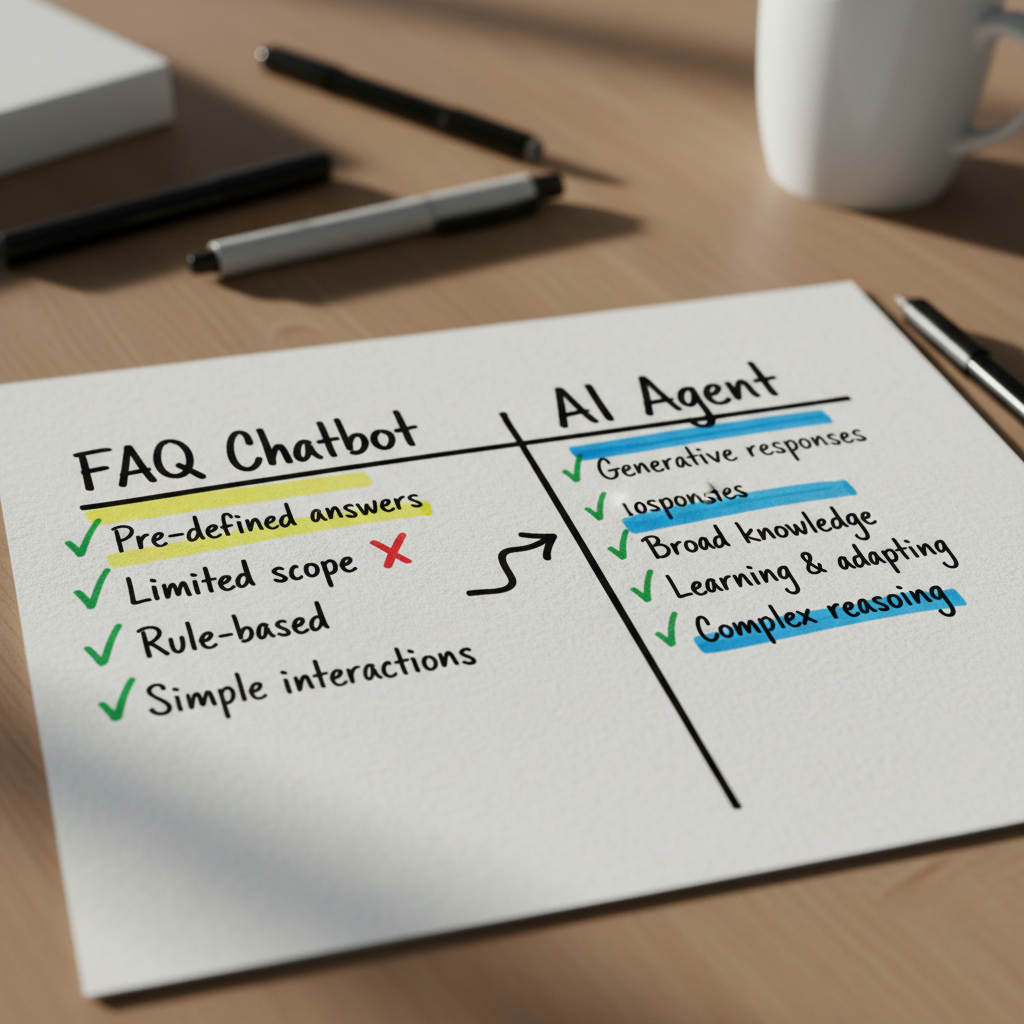
AI agents go beyond FAQ chatbots by reasoning across documents and taking actions.
HR teams spend a significant portion of their week answering the same questions: "How many annual leave days do I have?" "What is the process for medical claims?" "Who do I contact for IT support?"
An AI agent configured as an employee self-service assistant can:
- Answer policy and benefits questions by accessing your HR knowledge base, SOP documents and policy manuals.
- Process leave requests by checking balance, applying rules, routing for approval and updating the system.
- Guide employees through HR processes such as claim submissions, training enrolment, performance review cycles and promotion applications.
- Escalate complex or sensitive cases to a human HR representative when the query requires judgment, discretion or exceptions.
The Difference Between an FAQ Chatbot and an AI Agent
A standard FAQ chatbot retrieves answers from a fixed list. An AI agent can reason across multiple documents, understand context, remember the conversation, and take follow-up actions.
For example, an employee asks: "I need to apply for five days of parental leave next month. What do I do?" An AI agent can check the employee's eligibility, retrieve the correct policy document, draft the application form, pre-fill known details, route it for approval, and notify the employee of the next steps — all in one interaction.
How to Start with AI Agents for HR
Adopting AI agents in HR does not require a large technology budget or months of implementation. A structured approach works best.
Step 1: Identify the Highest-Volume Repetitive Task
Look at where your HR team spends most of its time on repeatable, rule-based work. Common starting points include recruitment screening, onboarding document collection and employee query handling.
Step 2: Set Clear Guardrails
Before deploying any AI agent, define:
- What data it can access (and what it cannot)
- Where human review is required before action is taken
- How accuracy and bias will be monitored
- How employee data privacy will be protected
Step 3: Pilot with a Single Workflow
Start with one process — for example, automating the initial screening of applications for a single role. Measure time saved, error rates and user satisfaction before scaling.
Step 4: Train Your Team on Oversight
AI agents still need human supervision. HR teams should understand how agents make decisions, how to override or adjust actions, and how to spot issues early.
The Responsible AI Dimension
AI agents in HR handle sensitive data — personal information, employment history, medical leaves, salary details and performance records. Responsible adoption is not optional.
Key considerations:
- Data governance — Ensure the AI agent only accesses data it needs for the specific task.
- Bias monitoring — Regularly review screening criteria and agent decisions for unintended bias.
- Human-in-the-loop — Keep meaningful human oversight on decisions that affect hiring, promotion, performance or employee relations.
- Transparency — Let employees know when they are interacting with an AI agent and how their data is used.
For organisations scaling AI usage, AIHQ can support responsible AI and governance sessions to help teams use AI safely and appropriately.
When Off-the-Shelf AI Agents Are Not Enough
Many HR teams start with off-the-shelf AI tools embedded in HR platforms. These work well for standard tasks. However, some organisations need more:
- Workflows that span multiple disconnected systems
- Agents that understand internal SOPs, policies and role-specific rules
- Integration with legacy HR systems that lack modern API access
In these cases, a custom AI solution such as an internal copilot or a tailored HR automation workflow may be more appropriate.
Final Thoughts
AI agents for HR are not about replacing HR professionals. They are about reducing the administrative burden so HR teams can focus on what matters most — building better employee experiences, improving hiring decisions and supporting organisational growth.
The organisations that benefit most from AI agents are those that start small, set clear guardrails, and invest in their teams' capability to work alongside these tools responsibly.
If your HR team is exploring how AI agents could support your recruitment, onboarding or employee self-service workflows, a structured conversation about your specific processes can help identify where the greatest value lies.
FAQ
What is the difference between an AI agent and a regular chatbot for HR?
A regular chatbot answers one question at a time from a fixed knowledge base. An AI agent can perform multi-step tasks — screening a resume, updating a system, sending an email, and escalating to a human — all within a single workflow. AI agents reason across steps, remember context and take action, not just respond.
Can AI agents for HR integrate with existing HR systems like HRIS or payroll software?
Yes, depending on the system's API capabilities. AI agents can be configured to read from and write to HR platforms, email systems, calendars and document repositories. For older systems without modern APIs, custom integration or middleware may be needed.
Are AI agents safe to use with employee personal data?
Safety depends on tool configuration, data governance policies and usage behaviour. Organisations should set clear guardrails on what data the agent can access, ensure compliance with data protection regulations, and maintain human oversight on decisions involving sensitive employee information.
How much does it cost to implement AI agents for HR workflows?
Costs vary depending on whether you use off-the-shelf HR platform add-ons or build a custom AI agent. Starting with a single workflow pilot can help you evaluate value before scaling. A structured consultation can clarify the options relevant to your organisation's systems and budget.
Do AI agents replace HR recruiters or onboarding specialists?
No. AI agents handle repetitive, rule-based administrative tasks so HR professionals can focus on higher-value work — candidate relationships, cultural fit assessment, employee experience and strategic workforce planning. Human judgment remains essential for hiring, policy decisions and sensitive employee matters.
What is a good first use case for AI agents in HR?
Resume screening for a high-volume role or automating employee self-service for frequently asked policy questions are common starting points. Both are rule-based, repetitive and have clear success metrics such as time saved and reduced back-and-forth.