General
AI Agents Training: How Agentic AI Is Reshaping Enterprise Workflows
· By AIHQ Team

The conversation around enterprise AI is shifting. For the past two years, most organisations focused on getting comfortable with generative AI tools — writing emails, summarising documents, generating content, analysing data. That was Phase One.
Phase Two is agentic AI.
Instead of a chatbot that answers one question at a time, agentic AI systems can follow multi-step instructions, make decisions within guardrails, use external tools, and execute workflows autonomously. For enterprise leaders, this raises an immediate question: What does AI agents training look like, and how do we prepare our teams for this shift?
This guide covers what agentic AI means for enterprise operations, where it creates value, and what to look for in AI agents training to build real workforce capability — not just buzzword familiarity.
What Is Agentic AI? A Practical Definition
Agentic AI refers to AI systems that can act autonomously toward a goal rather than simply responding to individual prompts. An AI agent can:
- Break a high-level instruction into sub-tasks
- Use external tools (databases, APIs, search, calculators)
- Remember context across a sequence of actions
- Make decisions within defined guardrails
- Escalate or pause when it encounters uncertainty
This is different from a standard ChatGPT or Copilot session where every task requires a fresh prompt and human judgment at each step. An agentic system can be given a goal — "draft a monthly compliance report by pulling data from our finance system, cross-checking it against policy documents, and flagging anomalies" — and execute the workflow independently, subject to review.
How Agents Differ from Standard GenAI Tools
| Capability | Standard GenAI (ChatGPT, Copilot) | Agentic AI System |
|---|---|---|
| Task execution | Single-turn prompt-response | Multi-step, goal-oriented execution |
| Tool use | Manual copy-paste or plugin use | Autonomous tool calling (APIs, databases) |
| Memory | Limited to conversation window | Persistent context across subtasks |
| Decision-making | User decides at every step | Agent decides within guardrails |
| Human involvement | Required throughout | Review at milestones or exceptions only |
This distinction matters because training for standard GenAI usage does not fully prepare teams for agentic workflows. Employees need different skills — workflow design, task decomposition, guardrail setting, output verification — which is why dedicated AI agents training is becoming a priority for forward-thinking organisations.
Where Agentic AI Creates Value in Enterprise Workflows
Agentic AI is not a replacement for all human work. It is most useful for workflows that are rules-heavy, repetitive, multi-step and currently require manual coordination across systems.
1. Compliance and Reporting Workflows
Organisations in regulated sectors often generate periodic compliance reports that require pulling data from multiple sources, applying business rules, and formatting outputs. An AI agent can orchestrate this process — subject to human review — reducing the manual effort involved in data gathering and cross-checking.
2. Customer Service Escalation Handling
Simple FAQ responses are well served by basic chatbots. But complex customer enquiries often require checking order status, reviewing policy terms, calculating eligibility and drafting a personalised response. Agentic systems can handle these multi-step workflows while keeping a human in the loop for approvals.
3. Internal Process Automation
HR policy queries, IT access requests, procurement approvals — these often follow predictable paths with branching logic. AI agents can triage, gather required information, check eligibility rules and route decisions to the right person, reducing the back-and-forth that slows internal processes.
4. Data Preparation and Analysis Pipelines
Teams that regularly prepare reports or dashboards often spend significant time cleaning data, joining datasets, applying filters and formatting outputs. An AI agent, given access to defined data sources and rules, can automate these preparation steps so analysts focus on interpretation rather than manipulation.
Off-the-shelf tools are useful for many workflows, but some require custom AI solutions, automation or structured implementation to handle complex decision logic and system integration.
What AI Agents Training Should Cover
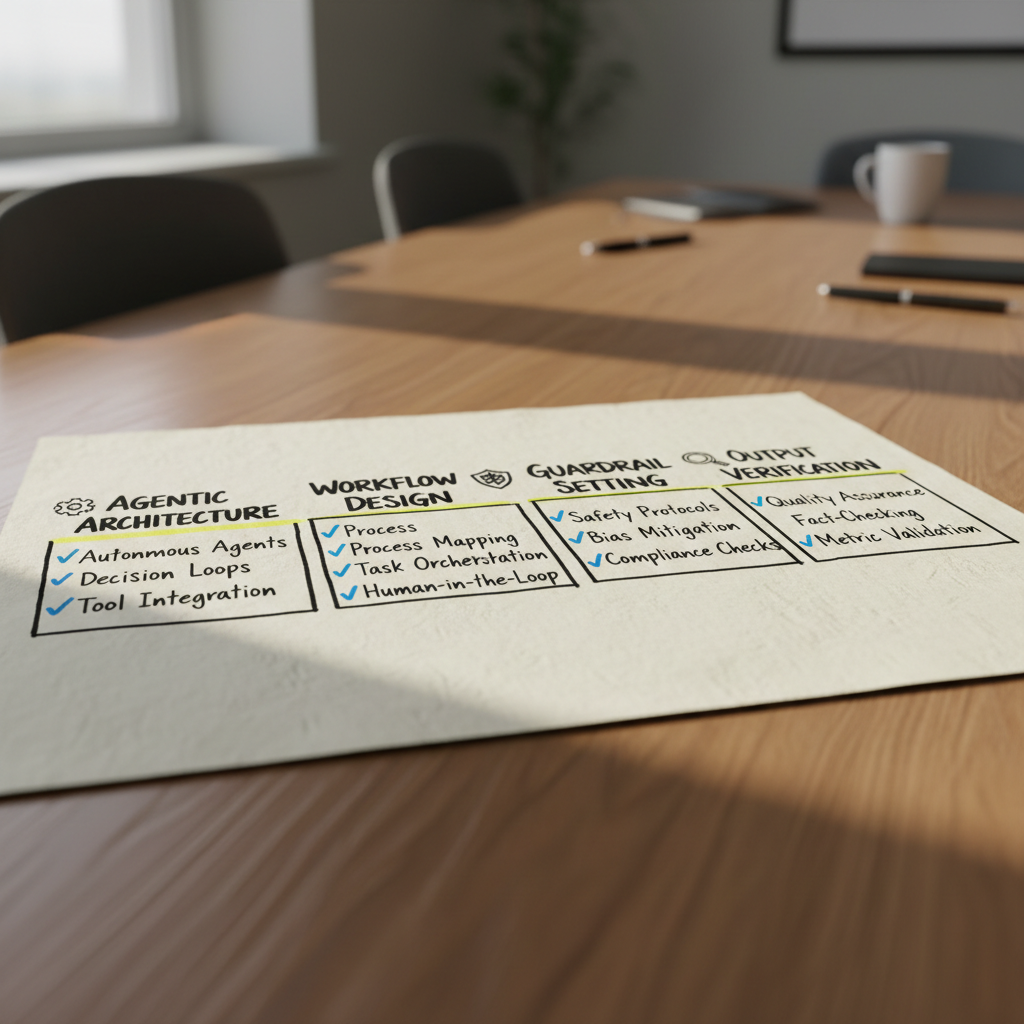
AI agents training should cover architecture, workflow design, guardrails and output verification
If your organisation is exploring agentic AI, the training approach matters. Generic AI fundamentals — prompting, tool familiarity, responsible use — remain important. But AI agents training needs to go further.
1. Understanding Agentic Architecture and Capabilities
Teams need a clear, non-technical understanding of what agents can and cannot do. Training should cover:
- How agents break down tasks into sub-steps
- The role of orchestration in multi-agent workflows
- When autonomy is useful and when it is risky
- How agents use external tools and data sources
2. Workflow Design and Task Decomposition
One of the most valuable skills in agentic AI is the ability to take a business process and break it into steps that an agent can execute. This is not a technical skill — it is a workflow thinking skill. Training should help participants:
- Map existing manual workflows
- Identify steps suitable for autonomous execution
- Define decision points where human review is needed
- Structure instructions so agents can follow them reliably
3. Guardrail Setting and Human Oversight
Agentic autonomy requires guardrails. Without them, agents may make decisions that are technically correct but contextually inappropriate. Training should address:
- Defining clear boundaries for agent decision-making
- Setting escalation rules for ambiguous or high-risk situations
- Building human review checkpoints into workflows
- Monitoring agent outputs for drift or unexpected behaviour
4. Output Verification and Quality Control
Agents can generate outputs quickly, but speed does not equal accuracy. Teams need structured methods for verifying agent outputs, especially in compliance, finance and customer-facing scenarios. Training should include:
- Spot-checking and sampling strategies
- Automated validation rules
- Handling edge cases and exceptions
- When to trust and when to investigate agent outputs
5. Responsible Use and Governance of Agentic AI
Agentic AI introduces new governance considerations. An agent that acts autonomously may produce results the organisation did not explicitly approve. Training should equip teams to:
- Understand data privacy implications of autonomous tool use
- Document agent workflows for auditability
- Apply the same governance standards as human decision-making
- Escalate governance gaps before deployment at scale
AIHQ supports organisations building responsible AI capability through structured governance training and workshops designed for regulated environments and risk-aware teams.
How AI Agents Training Differs from Standard GenAI Training
Many organisations already run GenAI training programmes focused on prompting, tool usage and safe adoption. AI agents training builds on that foundation but shifts the emphasis.
| Focus Area | Standard GenAI Training | AI Agents Training |
|---|---|---|
| Core skill | Prompting and tool use | Workflow design and orchestration |
| Human role | Active at every step | Reviewer at milestones and exceptions |
| Risk profile | Incorrect outputs | Incorrect autonomous decisions |
| Governance need | Usage policy | Workflow-level guardrails and audit trails |
| Best suited for | Individual productivity | Process automation and cross-system workflows |
Organisations that have already invested in GenAI capability building are better positioned to adopt agentic AI because their teams understand AI strengths and limitations. Organisations starting from scratch may need foundational training before moving into agentic workflows.
Questions to Ask Before Investing in AI Agents Training
Before commissioning an AI agents training programme, consider these questions:
Do we have clear workflows suitable for agentic automation? Agentic AI works best when processes are well-defined, rules-driven and repeatable. If your workflows are unstructured or highly variable, agentic systems may not be the right starting point.
Do our teams have basic GenAI capability? Jumping straight to agentic AI training without foundational AI literacy may leave participants overwhelmed. A phased approach — from awareness to practical usage to agentic workflows — often produces stronger outcomes.
Do we have governance frameworks in place? Agentic systems can amplify governance gaps. Before training teams on agent design, ensure your organisation has baseline policies for responsible AI use, data privacy and human oversight.
Are we solving a real problem or chasing a trend? Agentic AI is compelling, but not every workflow needs an agent. Training should start with pain points, not technology capabilities.
AIHQ helps organisations work through these questions through structured advisory sessions and use-case discovery workshops before committing to large-scale training programmes.
Building a Practical AI Agents Training Pathway
For organisations ready to build agentic AI capability, a phased training pathway can help teams move from awareness to practical application.
Phase 1: Foundation
- AI and GenAI fundamentals
- Practical tool usage for daily workflows
- Responsible AI and safe use principles
Phase 2: Practical Application
- Role-specific GenAI use cases
- Workflow mapping and improvement
- Advanced prompting and output verification
Phase 3: Agentic Workflows
- Understanding agentic AI capabilities and limitations
- Workflow design for autonomous execution
- Guardrail setting, escalation rules and human oversight
- Governance and auditability for agentic systems
AIHQ designs role-based training programmes that help organisations move through these phases at their own pace, aligned with business priorities and workforce readiness.
Final Thoughts
Agentic AI represents a significant shift in how organisations think about automation — from individual productivity tools to systems that can execute complete workflows autonomously within defined boundaries. But this shift requires more than new tools. It requires new skills: workflow thinking, guardrail design, output verification and responsible governance.
AI agents training is not about teaching everyone to build agents. It is about equipping teams with the mindset and methods to design, deploy and oversee autonomous workflows safely. For organisations already investing in AI capability, agentic AI is the next logical step. For those still building foundational awareness, the pathway starts with structured, role-based training that connects AI to real work.
The organisations that prepare their teams now for agentic workflows will be better positioned to adopt the technology responsibly when it matures further. The work starts with capability.
FAQ
What is the difference between AI agents and standard chatbots?
Standard chatbots respond to individual prompts one at a time. AI agents can execute multi-step workflows autonomously — breaking tasks into sub-steps, using external tools, remembering context and making decisions within defined guardrails. An agent can be given a goal and work toward it with minimal human intervention, whereas a chatbot requires a prompt for every action.
Do we need AI agents training if our team already uses ChatGPT?
Foundational GenAI training is useful preparation, but it does not fully cover agentic workflows. AI agents training focuses on workflow design, task decomposition, guardrail setting and output verification — skills that go beyond prompting. Teams with strong GenAI capability will find the transition easier, but dedicated agentic training is still valuable.
What types of workflows are best suited for AI agents?
Agentic AI works best for workflows that are rules-heavy, multi-step, repeatable and currently require manual coordination across systems. Good candidates include compliance reporting, customer service escalation handling, internal process triage (HR, IT, procurement) and data preparation pipelines.
Is agentic AI safe for enterprise use without human oversight?
Agentic AI should not operate without human oversight, especially in regulated or customer-facing contexts. Effective agentic systems include guardrails, escalation rules, human review checkpoints and audit trails. Governance frameworks and responsible use training are essential before deploying agentic workflows at scale.
How long does it take to train a team on agentic AI?
Timelines depend on existing AI capability. Teams with strong GenAI foundations may need 1–2 days of focused agentic training. Teams starting from scratch benefit from a phased approach — beginning with AI fundamentals and practical usage before moving into agentic workflows over several weeks.
Do we need technical teams to implement AI agents?
Some agentic workflows require technical integration with existing systems (APIs, databases), which may need IT or developer support. However, workflow design, task decomposition and guardrail setting are business-side skills. Effective agentic AI adoption requires both business and technical teams working together.