General
AI Automation Course for Enterprises: Building a Scalable Workforce Upskilling Program
· By AIHQ Team

Most organisations today are not short of AI enthusiasm. Employees are experimenting with ChatGPT, trying Copilot, and testing Gemini. What most enterprises lack is a structured, scalable curriculum that turns sporadic tool usage into consistent workflow automation and measurable efficiency gains.
This guide is for HR leaders, L&D teams, department heads, and transformation leaders who need to design an AI automation course for enterprises — not a one-day workshop, but a capability programme that works across functions, respects governance requirements, and connects directly to operational outcomes.
Why Generic AI Training Falls Short for Enterprise Automation
Many organisations start with a broad "AI awareness" session. A trainer walks through ChatGPT features, demonstrates a few prompts, and sends everyone back to their desks. Within weeks, most participants have reverted to their old workflows.
Generic training fails for three reasons:
- It is tool-focused, not workflow-focused. Employees learn what a chatbot can do, but not how to integrate it into their specific daily processes.
- It ignores role differences. A finance analyst, a customer service agent, and a marketing writer use AI very differently. A single curriculum cannot serve all.
- It skips adoption support. Training without follow-up, practice frameworks, or peer support rarely changes behaviour.
An enterprise AI automation course must address all three gaps. It needs structure, role specificity, and an implementation pathway.
The Core Architecture of an Enterprise AI Automation Course
A scalable curriculum follows a layered approach. Think of it not as a single course but as a capability ladder with four tiers:
Tier 1: AI Literacy and Responsible Use (Everyone)
Before anyone automates anything, they need to understand what AI can and cannot do, and how to use it safely in an enterprise context.
Core modules:
- How large language models work (plain language, no technical jargon)
- AI capabilities and limitations in business contexts
- Responsible use principles: data privacy, accuracy, human oversight
- Organisational AI policy and guardrails
- Safe prompt practices for confidential information
Who attends: All staff, from executives to frontline teams Duration: Half-day foundation session
Tier 2: Role-Based AI Automation Skills (Department Teams)
This is where an AI automation course becomes enterprise-relevant. Each department receives training aligned with its actual workflows, reporting needs, and automation opportunities.
Example modules by function:
| Department | Focus Areas |
|---|---|
| Finance | Automated reporting, reconciliation summaries, variance analysis, invoice data extraction |
| HR | Policy Q&A automation, onboarding documentation, recruitment screening support, employee self-service |
| Customer Service | Enquiry triage, response drafting, escalation routing, knowledge base retrieval |
| Marketing & Comms | Content drafting, multilingual translation support, social media scheduling, performance summarisation |
| Operations | SOP retrieval, process documentation, status reporting, workflow trigger identification |
| Legal & Compliance | Contract summarisation, policy comparison, regulatory research support, risk flagging |
Who attends: Department-specific cohorts Duration: One to two full-day workshops per department, with practice exercises using real (sanitised) work materials
Tier 3: Workflow Automation and Process Design (Power Users and Champions)
This tier moves participants from using AI tools to designing automated workflows. It is designed for team leads, process owners, and AI champions who will drive adoption in their areas.
Core modules:
- Identifying automation-ready workflows: repetitive, rules-based, high-volume tasks
- Mapping manual processes to AI-supported flows
- Prompt engineering for reliable, repeatable outputs
- Building simple internal copilots or chatbots for specific functions
- Quality review and human-in-the-loop design
Who attends: Nominated champions from each department, plus innovation and transformation team members Duration: Two-day workshop plus one-month guided practice period
Tier 4: Measurement, Governance and Continuous Improvement (Leadership)
Enterprise automation without measurement is guesswork. Leaders need visibility into adoption, efficiency gains, and risk.
Core modules:
- Defining automation metrics: time saved, error reduction, throughput improvement
- Adoption tracking and team feedback loops
- Governance review cadence and policy updates
- Escalation pathways for AI errors or edge cases
- Planning the next phase of automation investment
Who attends: HODs, transformation leads, governance and risk teams Duration: Half-day strategy session, quarterly review check-ins
How to Sequence Delivery for Maximum Adoption
Rolling out all four tiers simultaneously rarely works. A phased approach builds momentum and allows course correction.
Phase 1 — Leadership alignment and policy setup (Weeks 1–2)
Begin with Tier 4 leadership content to secure strategic buy-in and define governance parameters. Without this, downstream training risks misalignment.
Phase 2 — Organisation-wide literacy (Weeks 3–4)
Run Tier 1 sessions for all staff. Establish a shared language about AI capabilities, limitations, and safe use.
Phase 3 — Departmental automation workshops (Weeks 5–8)
Deliver Tier 2 modules to individual departments, using real workflow examples. Each department identifies its top three automation priorities during the session.
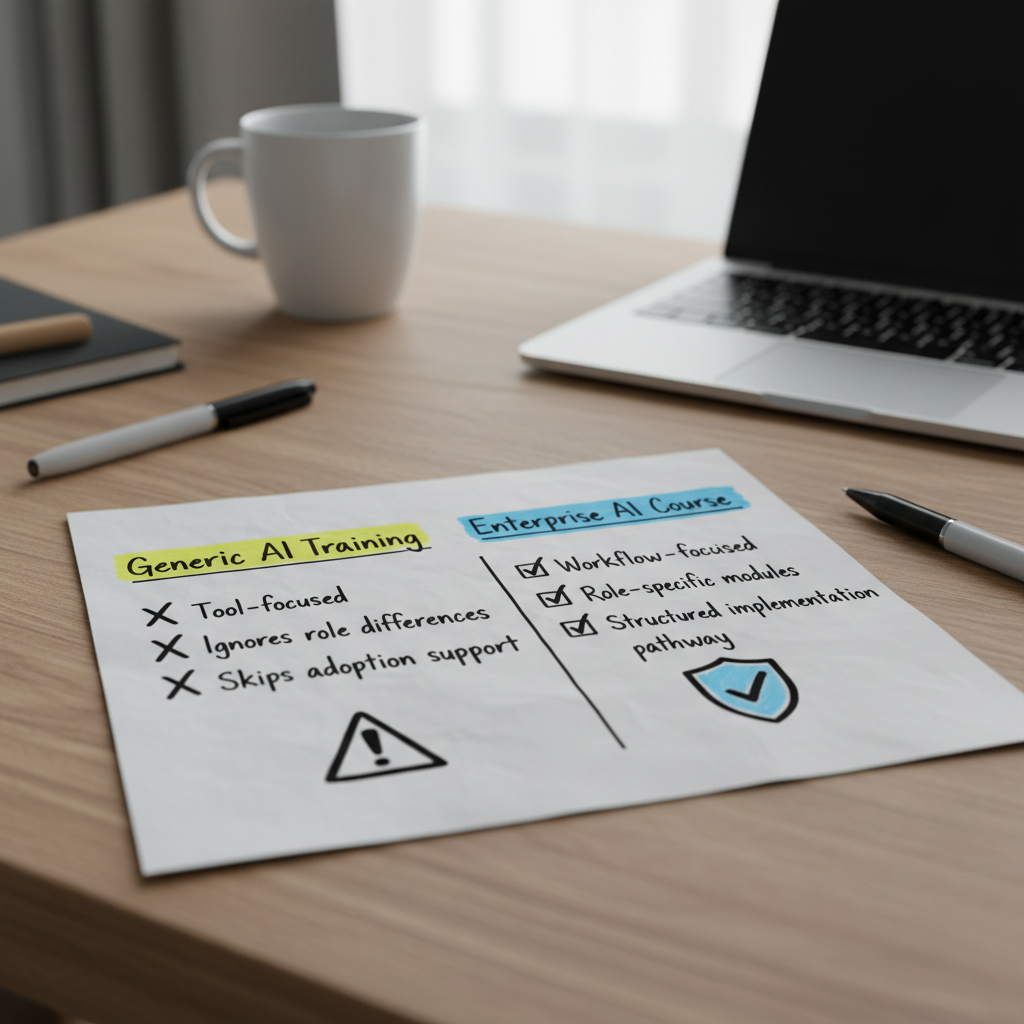
Enterprise training succeeds where generic workshops fail — workflow focus, role specificity and ongoing support.
Phase 4 — Champion development and workflow piloting (Weeks 9–12)
Train nominated champions through Tier 3. They begin piloting automated workflows in their teams with structured support and review.
Phase 5 — Measurement and iteration (Ongoing)
Leadership tracks metrics from Tier 4, reviews outcomes, and decides where to deepen automation or expand to new departments.
Measuring Outcomes from an Enterprise AI Automation Course
Enterprises that invest in structured capability programmes can track progress across several dimensions. The key is defining what success looks like before training begins.
Common tracking areas:
- Time saved on repetitive tasks. Teams document hours previously spent on manual reporting, data entry, or documentation before and after adopting AI-supported workflows.
- Error reduction. For processes involving data transfer, summarisation, or compliance checks, compare error rates before and after training.
- Adoption consistency. Track the percentage of team members who continue using AI tools in daily workflows after 30, 60, and 90 days.
- Task completion speed. Measure end-to-end cycle time for common tasks such as drafting reports, responding to enquiries, or processing documents.
AIHQ helps organisations identify practical use cases and adoption pathways that can support measurable outcomes. Training outcomes vary by organisation, role, adoption and measurement approach.
Common Pitfalls When Building an Enterprise AI Automation Curriculum
1. Starting with tools instead of workflows.
Organisations often ask "Which AI tool should we use?" before asking "Which manual process needs automation first?" Curriculum design should always begin with workflow analysis.
2. Training everyone the same way.
A finance team's automation needs differ completely from a marketing team's. Role-specific modules produce far higher adoption than one-size-fits-all sessions.
3. Neglecting governance until after rollout.
When employees learn AI tools without clear guardrails, data privacy risks increase. Governance training should run alongside capability training, not after it.
4. No post-training support structure.
A two-day workshop without follow-up support rarely changes behaviour. Peer practice groups, office hours with trainers, and workflow templates all improve long-term adoption.
5. Treating training as a one-off event.
AI tools, capabilities, and organisational needs evolve. An enterprise AI automation course should be designed as a repeatable programme with refresh cycles, not a single event.
What a Scalable Curriculum Looks Like in Practice
A financial services organisation with 500 employees might structure its AI automation course as follows:
- Month 1: Executive briefing and policy setup (Tier 4 + Tier 1 for leadership)
- Month 2: Foundation literacy for all staff (Tier 1, delivered in cohorts of 30)
- Month 3: Finance, compliance, and customer service workshops (Tier 2)
- Month 4: Operations, HR, and marketing workshops (Tier 2)
- Month 5: Champion cohort training (Tier 3) and first workflow pilots
- Month 6: Metrics review, governance update, and planning for next cycle
This phased approach builds capability progressively, embeds automation into real workflows, and creates visible outcomes that justify continued investment.
How to Get Started
Building an enterprise AI automation course requires more than selecting a curriculum off a shelf. It starts with understanding your organisation's current capability level, the workflows that are ripe for automation, and the governance boundaries your teams need to operate within.
AIHQ works with enterprises across Malaysia and Singapore to design structured, role-based AI training programmes that connect capability to real workflow outcomes. Whether you need leadership alignment, department-specific workshops, or a full enterprise curriculum, the starting point is a conversation about your current context and goals.
Frequently Asked Questions
What is an AI automation course for enterprises?
An AI automation course for enterprises is a structured training programme designed to help cross-functional teams apply AI tools to automate repetitive workflows, improve decision support, and achieve measurable efficiency gains. Unlike generic workshops, it is role-specific, workflow-aligned, and includes governance and measurement components.
How is an enterprise AI automation course different from a general AI workshop?
General AI workshops focus on tool features and basic prompting skills. An enterprise course addresses department-specific workflows, automation design, responsible use within organisational policy, and outcome tracking. It is built for scalability across teams, not just individual learning.
Which departments benefit most from enterprise AI automation training?
Departments with high-volume repetitive tasks typically see the fastest impact: finance, HR, customer service, operations, marketing, compliance, and legal. However, any function with documentation, reporting, data processing, or enquiry handling workflows can benefit.
How long does it take to implement an enterprise AI automation curriculum?
A phased rollout across a mid-sized enterprise typically spans three to six months. The timeline depends on the number of departments involved, existing AI capability levels, and governance readiness. A focused pilot with one or two departments can begin within weeks.
Should governance training come before or after AI skills training?
Governance principles should be introduced at the same time as AI skills training, ideally during Tier 1 foundation sessions. This ensures that responsible use, data privacy, and human oversight are built into workflows from the start, not added as an afterthought.
FAQ
What is an AI automation course for enterprises?
An AI automation course for enterprises is a structured training programme designed to help cross-functional teams apply AI tools to automate repetitive workflows, improve decision support, and achieve measurable efficiency gains. Unlike generic workshops, it is role-specific, workflow-aligned, and includes governance and measurement components.
How is an enterprise AI automation course different from a general AI workshop?
General AI workshops focus on tool features and basic prompting skills. An enterprise course addresses department-specific workflows, automation design, responsible use within organisational policy, and outcome tracking. It is built for scalability across teams, not just individual learning.
Which departments benefit most from enterprise AI automation training?
Departments with high-volume repetitive tasks typically see the fastest impact: finance, HR, customer service, operations, marketing, compliance, and legal. However, any function with documentation, reporting, data processing, or enquiry handling workflows can benefit.
How long does it take to implement an enterprise AI automation curriculum?
A phased rollout across a mid-sized enterprise typically spans three to six months. The timeline depends on the number of departments involved, existing AI capability levels, and governance readiness. A focused pilot with one or two departments can begin within weeks.
Should governance training come before or after AI skills training?
Governance principles should be introduced at the same time as AI skills training, ideally during Tier 1 foundation sessions. This ensures that responsible use, data privacy, and human oversight are built into workflows from the start, not added as an afterthought.