General
AI Chatbot in Malay: A Practical Guide to Using ChatGPT in Bahasa Malaysia
· By AIHQ Team

For operations teams in Malaysia, the biggest cause of poor Malay-language AI output is not the model. It is undetected code-switching plus register mismatch — the prompt has already drifted into English, or into a formal written register nobody actually speaks in, before the model answers.
That is a process problem, not a language problem. And it is fixable with the same tools you already use to fix any process: naming the defect, setting a standard, and checking the output.
This guide is for operations and process owners who need written and spoken Bahasa Malaysia that holds up in front of customers, regulators or an internal service desk — not perfect linguistic theory, and not a promise that any tool gets it right every time. AIHQ has trained and engaged over 9,000 professionals, including a 12-month structured capability programme with Media Prima, and the pattern below comes from working on real Malay-language workflows rather than demo prompts.
Situation: what actually breaks in a Malay-language workflow
Say your contact centre handles roughly 40% Bahasa Malaysia enquiries. Your team starts using an AI assistant to draft first-response replies. Three weeks in, the QA reviewer flags a pattern.
- Replies are structurally correct but read like translated English — "Kami ingin memaklumkan bahawa permintaan anda telah diterima" where a customer would write "Kami dah terima permintaan anda."
- Product names, system terms and internal acronyms come back hyphenated or half-translated.
- Mixed prompts produce mixed output: ask in Malay, paste an English SOP, and the reply flips register mid-paragraph.
The operations owner sees a workflow problem. The prompt was never specified, the register was never defined, and nobody wrote down what "good" looks like. So there is nothing to measure and nothing to correct.
This is the same failure mode we see in English-language rollouts, just more visible. A general-purpose assistant will mirror the language and style it detects. If your input is messy, your output is messy — in any language.
Intervention: a structured capability journey, not a one-off prompt pack
You do not fix this with a folder of 50 Malay prompts. Prompts decay the moment your products, policies or systems change. What held up was a structured journey: awareness, fundamentals, role-based practice, then workflow standardisation.
Step 1 — Name the defects before you name the tools
Start with a workflow audit, not a tool selection. Take the three highest-volume Bahasa Malaysia writing tasks in your operation — commonly enquiry responses, internal notices, and summarisation of long documents. For each, collect ten real examples your team considers good and ten they consider poor. The gap between them is your specification.
In our experience this takes a half-day workshop and produces more value than any prompt library, because it forces agreement on register. Do you write formally, or conversationally? Do you use anda or awak? Do you translate product names or keep them?
Step 2 — Set the register contract
A register contract is a one-page standard that sits above any individual prompt. It answers: who is the reader, what is the tone, which terms stay in English, and what must never be machine-translated.
| Element | Weak default | Register contract |
|---|---|---|
| Prompt language | Mixed English and Malay | Single language, stated explicitly |
| Greeting | "Dear valued customer" translated literally | "Salam sejahtera" or "Hai" per channel |
| Pronouns | Inconsistent anda / awak | One choice per channel, written down |
| Product and system names | Auto-translated | Locked list, never translated |
| Numbers and dates | Ambiguous formats | Stated format, e.g. 12 Mac 2026 |
| Sign-off | Generic English closing | Approved Malay closing per team |
The table is deliberately unglamorous. It is also the single highest-leverage artefact an operations owner can own, because it survives tool changes, model updates and staff turnover.
Step 3 — Build role-based practice, not generic literacy
Generic AI literacy gets people curious. It does not get them consistent. In the Media Prima programme, which ran across awareness, fundamentals, intermediate LLM skill-building and advanced application workshops over 12 months, the advanced stage was where language-specific workflow standards took hold. Reported outcomes for that programme included 98% satisfied participants, 90% reporting increased practical knowledge and skills, and 92% finding the training relevant and applicable to work.
Those figures are specific to that engagement — they are not a general promise, and outcomes vary by organisation, role and adoption. The transferable lesson is structural: language quality improved when practice was tied to the actual documents a role produces, not to abstract demos.
Tool-by-tool: where Malay-language quality differs
No single tool solves every Malay-language workflow. Test against your own register contract rather than trusting any general ranking.
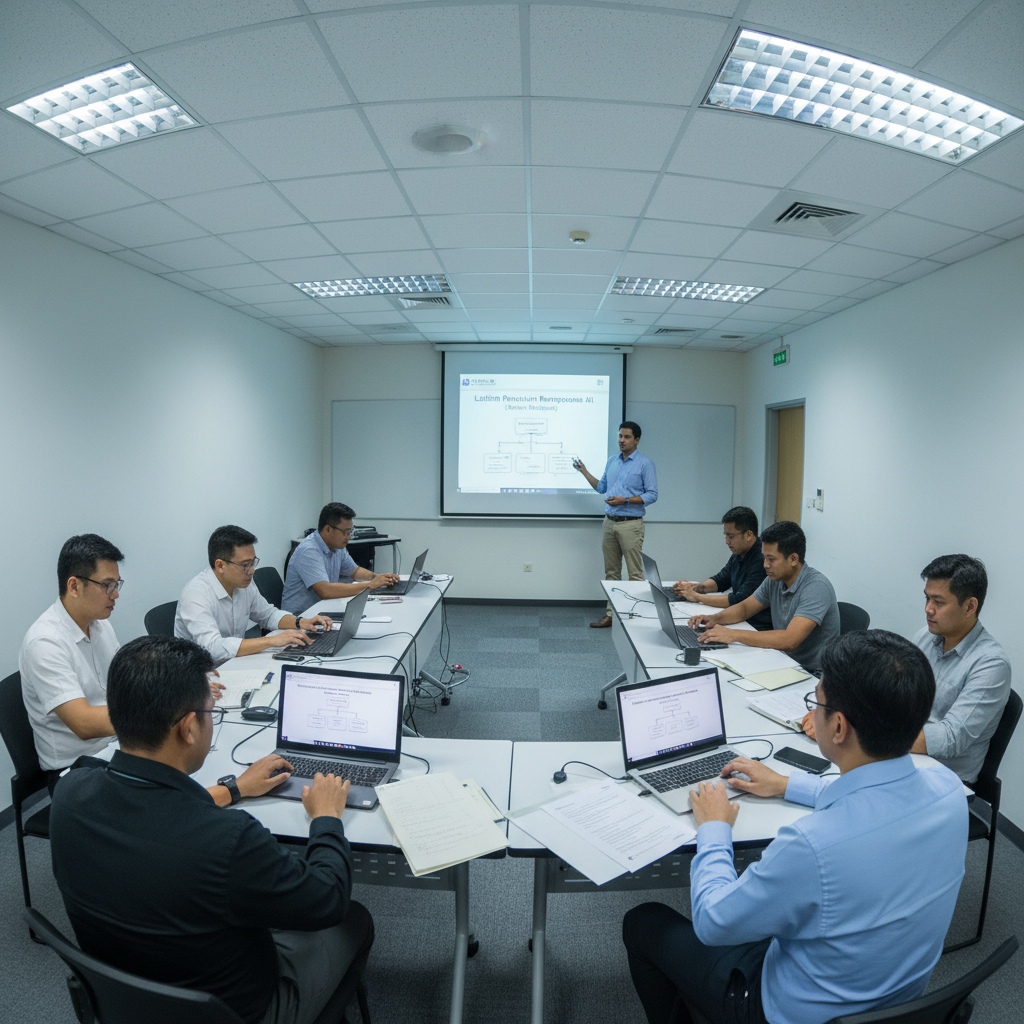
Language quality held when practice was tied to real documents, not abstract demos.
| Tool | Practical strength in Bahasa Malaysia | Where operations teams should watch it |
|---|---|---|
| ChatGPT | Strong across summarisation, drafting and tone adjustment; accepts long instructions well | Drifts towards translated-English register unless the register contract is pasted in; may over-formalise colloquial input |
| Gemini | Handles mixed Malay-English input reasonably; useful inside Google Workspace-adjacent workflows | Register consistency varies between runs; spreadsheet and document context can override tone instructions |
| Microsoft Copilot | Convenient when the source material already lives in Microsoft 365 documents and email threads | Behaviour depends heavily on the underlying document language; internal jargon often passes through untouched |
| General-purpose chatbots (free tiers) | Fine for drafting and rewriting single paragraphs | Limited instruction-following over long documents; weaker at holding a term list consistently |
Two cautions worth stating plainly. First, off-the-shelf tools are genuinely useful, but some workflows need a custom AI solution, automation or structured implementation before language consistency becomes reliable. Second, no tool is automatically safe for company data — data safety depends on settings, policies, the data type and how people actually use it. For any workflow touching customer records or confidential material, agree the guardrails before rollout, not after.
Where Malay-language chatbots belong — and where they do not
You do not need a custom build for everything. Use this to decide.
Keep it off-the-shelf when: the task is drafting, rewriting, summarising or tone adjustment on non-confidential content; volumes are manageable; and a human reads the output before it leaves the team.
Consider a custom build when: the same 20 questions arrive every day with slightly different wording; the correct answer depends on your own SOPs, policies or product catalogue; you need consistent tone across a large team; or you need escalation paths and an audit trail.
That second category is a process problem with a tooling answer. A custom AI chatbot grounded in your own documents — with a locked term list, a defined register, and a human escalation route — addresses question one and question four in the same build. It also removes the biggest single source of variation: each staff member writing their own prompts.
Role-by-role impact on Malay-language output
Language quality is not evenly distributed across a team. Here is where the work lands.
- Customer service and contact centre. Highest exposure. First-response drafting, complaint acknowledgement and follow-up. Needs the tightest register contract and the clearest escalation rule for anything involving commitments.
- HR and internal communications. Notices, policy summaries, onboarding material. Risk is over-formalisation — output that reads like a statute where employees expect plain speech.
- Operations and process owners. SOP summaries, incident write-ups, shift handover notes. The real value is consistency across shifts, not speed.
- Finance and procurement. Vendor correspondence and document summarisation. Term lists matter most here; a mistranslated contractual term is not a style issue.
- Marketing and communications. Malay-language campaign copy, social replies and community management. Needs human review for idiom, not just grammar.
- Legal and compliance. Review-heavy by default. AI can summarise and organise; it should not be the source of a regulatory position.
- IT and technical teams. Documentation and internal support answers. Acronyms and system names must be locked before any translation layer touches them.
Notice that only two of those roles genuinely need advanced prompting skill. The rest need a standard, a term list, and a review habit. That is why insisting on a generic prompting course across the whole workforce tends to produce interest without adoption.
Measurable outcome: what to actually track
Do not start with a productivity number. Start with quality, because quality is what a customer experiences.
- Rework rate. Percentage of drafted Malay responses edited before sending beyond typos.
- Register compliance. Sampled responses that match the register contract on tone, pronouns and sign-off.
- Term consistency. Sampled documents using the locked term list correctly.
- Escalation accuracy. How often drafted commitments reached a human before going out — target is 100%.
- Time to first response. Track it, but treat it as a lagging indicator, not the goal.
A well-run pilot on two roles over eight to twelve weeks will give you enough signal to decide whether to expand. If your organisation can structure the programme to meet HRD Corp requirements, it may be claimable — subject to client eligibility, grant approval and HRD Corp submission requirements. Eligibility and approval are decided by HRD Corp, not by us, and should be confirmed before you commit a training budget.
Lessons that survived contact with real workflows
Plain text beats clever prompts. The standard your team maintains matters more than the prompt anyone wrote.
Register is a decision, not a default. Somebody senior needs to choose formal or conversational, once, in writing.
Prompting is useful, but sustainable adoption requires role-based capability, workflow thinking, governance and leadership alignment. This is where most rollouts quietly stall.
Governance belongs early. Agree what may never be pasted into a public tool before you scale usage, and revisit it when tools change.
Training ends, implementation sometimes begins. When the workflow needs a grounded chatbot, an internal copilot or automated routing, that is an implementation decision rather than another workshop.
If you want a structured starting point rather than another prompt pack, speak to AIHQ about mapping your Malay-language workflows and where capability building should stop and implementation should start.
FAQ
Is ChatGPT reliable enough for Bahasa Malaysia customer replies?
It is useful for drafting, rewriting and summarising, and quality is generally workable when you supply a register contract and a locked term list. Reliability drops when prompts mix English and Malay, when internal jargon is left to the model, or when output is sent without human review. Treat drafts as drafts, and keep a human on anything involving commitments.
Do we need to translate our internal terms and product names into Malay?
Usually not. Most operations teams get better results by keeping product names, system names and regulated terms in their original form, and writing them down as a locked list. Translation creates ambiguity in the places where precision matters most — contracts, pricing and compliance language.
What is the difference between an off-the-shelf chatbot and a custom Malay-language chatbot?
An off-the-shelf tool works well for drafting and revising content a person will review. A custom chatbot grounded in your own SOPs, policies and product catalogue is more appropriate when the same questions repeat, when answers must reflect your documents, and when you need consistent tone, escalation paths and an audit trail across a large team.
How long does a Malay-language AI workflow pilot take?
An eight to twelve week pilot across two roles is usually enough to produce meaningful signal on rework rate, register compliance and escalation accuracy. Expanding beyond the pilot should follow the data, not the enthusiasm.
Can AIHQ training for this be HRDC claimable?
AIHQ is a registered HRD Corp training provider, and programmes can be structured to be HRDC claimable, subject to client eligibility, grant approval and HRD Corp submission requirements. We do not guarantee approval — eligibility and approval rest with HRD Corp, so confirm those details before committing budget.
Should we start with leadership alignment or with team training?
If you have no agreed position on register, data handling and which workflows are in scope, start with leadership alignment, because those decisions shape every prompt and every review habit downstream. If those decisions already exist, start role-based training on your two highest-volume workflows.