General
AI Chatbot Malaysia Enterprise: Build a Smarter Customer Experience Strategy
· By AIHQ Team

Malaysian enterprises are increasingly turning to AI chatbots to handle customer enquiries, support enquiries and service workflows. But deploying an AI chatbot in a Malaysian enterprise context is not as simple as plugging in a generic tool and switching it on.
Organisations need to navigate data privacy regulations under the Personal Data Protection Act (PDPA), support multilingual interactions across Bahasa Malaysia, English and Mandarin, integrate with existing enterprise systems, and measure whether the chatbot is actually improving customer experience — not just reducing costs.
This guide covers what Malaysian enterprises should consider when building an AI chatbot strategy that balances compliance, cultural fit, customer experience and measurable business outcomes.
Why AI Chatbots Are Gaining Traction in Malaysian Enterprises
Customer expectations in Malaysia have shifted. Consumers expect fast, accurate responses outside business hours, across multiple channels, and in the language they are most comfortable using.
For enterprises handling thousands of monthly enquiries — across customer service, HR support, student enquiries or after-sales service — an AI chatbot can help by:
- Handling routine queries instantly, 24/7
- Reducing response time during peak periods
- Freeing human agents to focus on complex or high-value cases
- Providing consistent answers across teams and shifts
But the value depends on how well the chatbot is designed, trained and governed. A poorly implemented chatbot that misunderstands Bahasa Malaysia, gives inconsistent answers, or mishandles customer data can damage trust faster than it builds efficiency.
Malaysian Regulatory Context: PDPA and Data Sovereignty
Any enterprise deploying an AI chatbot in Malaysia must consider the Personal Data Protection Act (PDPA). Customer data shared through chatbot conversations may include names, contact details, identification numbers, transaction histories and service records.
Key PDPA considerations for AI chatbots
- Data minimisation: Only collect and process the data the chatbot actually needs to handle the enquiry
- Purpose limitation: Customer data should be used only for the intended service purpose, not for unrelated model training
- Storage and retention: Where is the conversation data stored? How long is it kept? Is it stored within Malaysia or transferred overseas?
- Consent and disclosure: Customers should know they are interacting with an AI chatbot and understand how their data will be used
- Human escalation: Customers should have a clear path to speak with a human agent when needed
Organisations should also evaluate whether their chosen chatbot platform stores data on Malaysian servers or relies on overseas infrastructure. Some global platforms process data outside Malaysia, which may raise data sovereignty concerns for regulated industries.
AIHQ can support organisations through responsible AI and governance sessions that help teams understand these requirements and build appropriate guardrails.
Multilingual Capability: Bahasa Malaysia, English and Mandarin
Malaysia's multilingual environment is one of the biggest differentiators between a generic chatbot and one that genuinely serves Malaysian users.
An enterprise chatbot in Malaysia should be able to:
- Understand and respond accurately in Bahasa Malaysia, including common colloquial variations
- Switch seamlessly between English and Bahasa Malaysia within the same conversation
- Handle Mandarin queries, especially for sectors like banking, property and education
- Recognise mixing of languages (e.g., "Saya nak check status my order") without breaking the conversation flow
Not all off-the-shelf AI chatbot tools handle code-switching or Malaysian colloquial language well. Testing the chatbot with real Malaysian user inputs before deployment is essential.
If your customer base includes significant Mandarin-speaking users, evaluate whether the platform handles Simplified Chinese and Traditional Chinese accurately, particularly for financial terms, product names or policy language.
Vendor Selection: What to Look for in an Enterprise AI Chatbot Platform
Not all AI chatbots are built for enterprise-scale deployment. When evaluating vendors and platforms for your AI chatbot Malaysia enterprise strategy, consider these criteria:
1. Customisation and training
Can the chatbot be trained on your specific product catalogue, policy documents, SOPs and FAQ data? A generic knowledge base will produce generic answers.
2. Integration with existing systems
Does the chatbot integrate with your CRM, ticketing system, knowledge base or ERP? An isolated chatbot creates more work, not less.
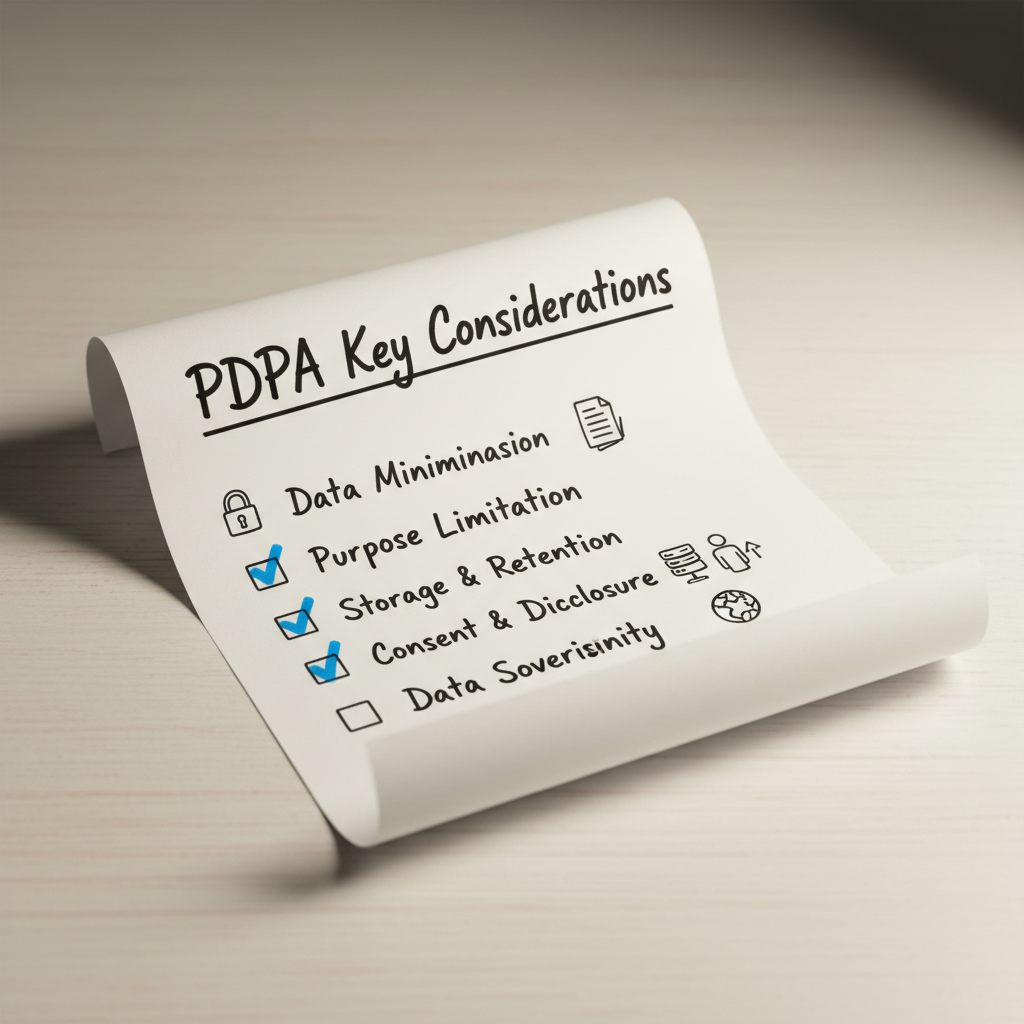
Hand-drawn PDPA compliance checklist for AI chatbot data privacy considerations.
3. Escalation workflows
Can the chatbot intelligently hand off conversations to a human agent when needed, including passing context so the customer does not repeat themselves?
4. Analytics and reporting
Does the platform provide conversation analytics, customer satisfaction tracking, query resolution rates and escalation patterns?
5. Security and compliance
Does the platform offer enterprise-grade security? Is data encrypted in transit and at rest? Does it support role-based access control?
6. Language support
Does the platform handle Bahasa Malaysia, English and Mandarin accurately out of the box, or does it require custom training for each language?
Some workflows require more than an off-the-shelf chatbot. When off-the-shelf tools are not enough, AIHQ can help explore whether a custom AI chatbot is more appropriate for your organisation's specific needs.
Deployment Models: Cloud, On-Premises or Hybrid
Enterprises in Malaysia have several deployment options depending on data sensitivity, compliance requirements and infrastructure preferences.
| Deployment Model | Best For | Considerations |
|---|---|---|
| Cloud / SaaS | General customer service, lower data sensitivity | Faster setup, regular updates, but data may reside outside Malaysia |
| On-Premises | Regulated sectors, high data sensitivity | Full data control, higher upfront cost, internal IT maintenance required |
| Hybrid | Organisations with mixed sensitivity levels | Sensitive queries handled internally, general queries go to cloud |
For regulated industries such as banking, insurance and healthcare, an on-premises or hybrid model may be necessary. For general customer service in retail, education or property, a well-configured cloud chatbot can be sufficient if data handling complies with PDPA requirements.
Measuring Success: Beyond Cost Savings
Many organisations measure chatbot success only by cost savings — how many human enquiries were deflected. But a more complete picture includes customer experience metrics:
- First response time: How quickly does the chatbot respond?
- Resolution rate: What percentage of queries are resolved without human escalation?
- Customer satisfaction score (CSAT): Are customers satisfied with the chatbot interaction?
- Language accuracy: Does the chatbot handle code-switching and multilingual queries correctly?
- Escalation quality: When a human takes over, is context preserved?
AIHQ helps organisations identify practical use cases and adoption pathways that can support these measurable outcomes, including designing chatbot pilot programmes with clear success criteria.
When a Custom AI Chatbot Makes Sense
Off-the-shelf chatbot platforms work well for standard FAQ-style interactions. But some enterprise use cases require a custom approach:
- Internal SOP and policy copilots that need access to confidential internal documents
- Complex multi-step workflows such as loan applications, claims processing or student enrolment
- Industry-specific terminology such as legal, medical or financial language that generic models handle poorly
- High-volume multilingual support where accuracy across Bahasa Malaysia, English and Mandarin is critical
A custom AI chatbot can be trained on your specific data, integrated with your internal systems and configured to follow your business rules. AIHQ's custom AI solutions help organisations build chatbots, internal copilots and automation workflows designed for their specific operational context.
Building a Practical AI Chatbot Roadmap for Your Enterprise
If your organisation is evaluating AI chatbots for customer experience, here is a structured approach:
- Audit your current enquiry volume and types — Which queries are repetitive? Which require human judgment?
- Define success criteria — What does a good chatbot outcome look like for your customers?
- Evaluate compliance requirements — Map PDPA obligations and data sovereignty needs early
- Test multilingual accuracy — Run real Malaysian user inputs through the platform before committing
- Run a controlled pilot — Start with one department or one service line before scaling
- Measure, iterate and improve — Use analytics to refine responses, escalation logic and language handling
AIHQ can help teams identify and prioritise practical AI use cases through a structured AI innovation bootcamp, including chatbot-specific discovery and pilot planning.
Conclusion
AI chatbots can meaningfully improve customer experience for Malaysian enterprises when deployed with the right strategy. Success depends on choosing a platform that handles Malaysia's multilingual environment, complies with PDPA requirements, integrates with your existing systems, and supports the customer outcomes that matter to your organisation.
The goal is not to replace your customer service team. It is to give them better tools — and to give your customers faster, more accurate answers in the language they prefer.
If your organisation is exploring an AI chatbot strategy, AIHQ can support you through advisory, capability building and custom solution design.
FAQ
Is it legal to use AI chatbots for customer service in Malaysia?
Yes, but organisations must comply with the Personal Data Protection Act (PDPA) regarding data collection, storage, consent and purpose limitation. It is important to disclose to customers that they are interacting with an AI chatbot and provide a clear path to human escalation.
Can AI chatbots handle Bahasa Malaysia and English in the same conversation?
Some platforms can handle code-switching between Bahasa Malaysia and English, but accuracy varies. Enterprises should test platforms with real Malaysian user inputs — including colloquial language — before committing to a solution. Mandarin support may require additional configuration or custom training.
What is the difference between an off-the-shelf chatbot and a custom AI chatbot?
Off-the-shelf chatbots work well for standard FAQ interactions and require minimal setup. Custom AI chatbots are trained on your specific data, integrated with your internal systems, and configured to follow your business rules — making them more suitable for complex workflows, confidential data and industry-specific language.
How much does an enterprise AI chatbot cost in Malaysia?
Costs vary significantly depending on the platform, deployment model (cloud vs on-premises), level of customisation, and integration requirements. Enterprise organisations should evaluate total cost including setup, training, maintenance, hosting and ongoing optimisation rather than only upfront pricing.
How do I measure whether my AI chatbot is improving customer experience?
Key metrics include first response time, query resolution rate, customer satisfaction score (CSAT), language accuracy, escalation quality and reduction in repeat enquiries. Measuring these alongside operational metrics gives a more complete picture of customer experience impact.
When should an enterprise consider a custom AI chatbot instead of a platform tool?
Custom AI chatbots are worth considering when your organisation needs access to confidential internal data, supports complex multi-step workflows, requires high accuracy in industry-specific terminology, or needs robust multilingual support that generic models handle poorly.