General
AI Chatbots for Malaysian Businesses: A Complete Guide to Boosting Customer Engagement & Automation
· By AIHQ Team

Malaysian businesses are increasingly turning to AI chatbots to handle customer enquiries, automate repetitive support tasks, and improve response times. But with so many options — from simple rule-based bots to advanced conversational AI platforms — how do you choose the right solution for your organisation?
This guide walks through what AI chatbots can actually do for Malaysian businesses, where they create real value, what to look for when evaluating platforms, and when an off-the-shelf tool may not be enough.
What Is an AI Chatbot and How Is It Different From a Standard FAQ Bot?
A standard FAQ bot follows pre-written scripts. It can answer "What are your business hours?" but will likely fail if the question is phrased differently or falls outside its scripted paths.
An AI chatbot — built on large language models (LLMs) — can understand varied phrasing, hold contextual conversations, and generate responses based on your business data. It learns from interactions and improves over time.
For Malaysian businesses, this means:
- Customers can ask questions in natural language, including Bahasa Malaysia or mixed English-Bahasa
- The bot understands intent, not just keywords
- Responses feel more natural and less robotic
- Escalation to human agents happens only when needed
Where AI Chatbots Create Real Value for Malaysian Businesses
1. Customer Service and Enquiry Handling
The most common use case. An AI chatbot can handle up to 70-80% of routine enquiries — business hours, pricing, product availability, order status — freeing your human team for complex cases.
2. Lead Qualification and Sales Support
AI chatbots can ask qualifying questions, capture contact details, and route qualified leads to your sales team — even outside business hours.
3. Internal Employee Support
HR teams use internal AI chatbots to answer policy questions, leave balances, and SOP queries. Employees get instant answers without opening a ticket.
4. Education and Training Support
Training providers and educational institutions deploy AI chatbots to handle enrolment enquiries, course information, and student support — reducing administrative load.
5. After-Hours Availability
Malaysian businesses serving global customers or operating outside standard hours benefit from 24/7 chatbot availability without adding headcount.
Key Features to Evaluate When Choosing an AI Chatbot
Not all AI chatbots are built the same. Here is what to look for:
| Feature | Why It Matters |
|---|---|
| Bahasa Malaysia support | Your customers speak BM. The bot should understand it accurately. |
| Data privacy and sovereignty | Where is your data stored? Does the provider offer Malaysian or regional hosting? |
| Human escalation | Can the bot seamlessly hand off to a human agent when it cannot help? |
| Integration with your tools | Does it connect to your CRM, WhatsApp, website, or helpdesk? |
| Customisation | Can you train the bot on your specific products, policies, and workflows? |
| Analytics and reporting | Can you track conversations, resolution rates, and customer satisfaction? |
| Security and access controls | Can you set who can see what data, especially for internal use? |
Popular AI Chatbot Options for Malaysian Businesses
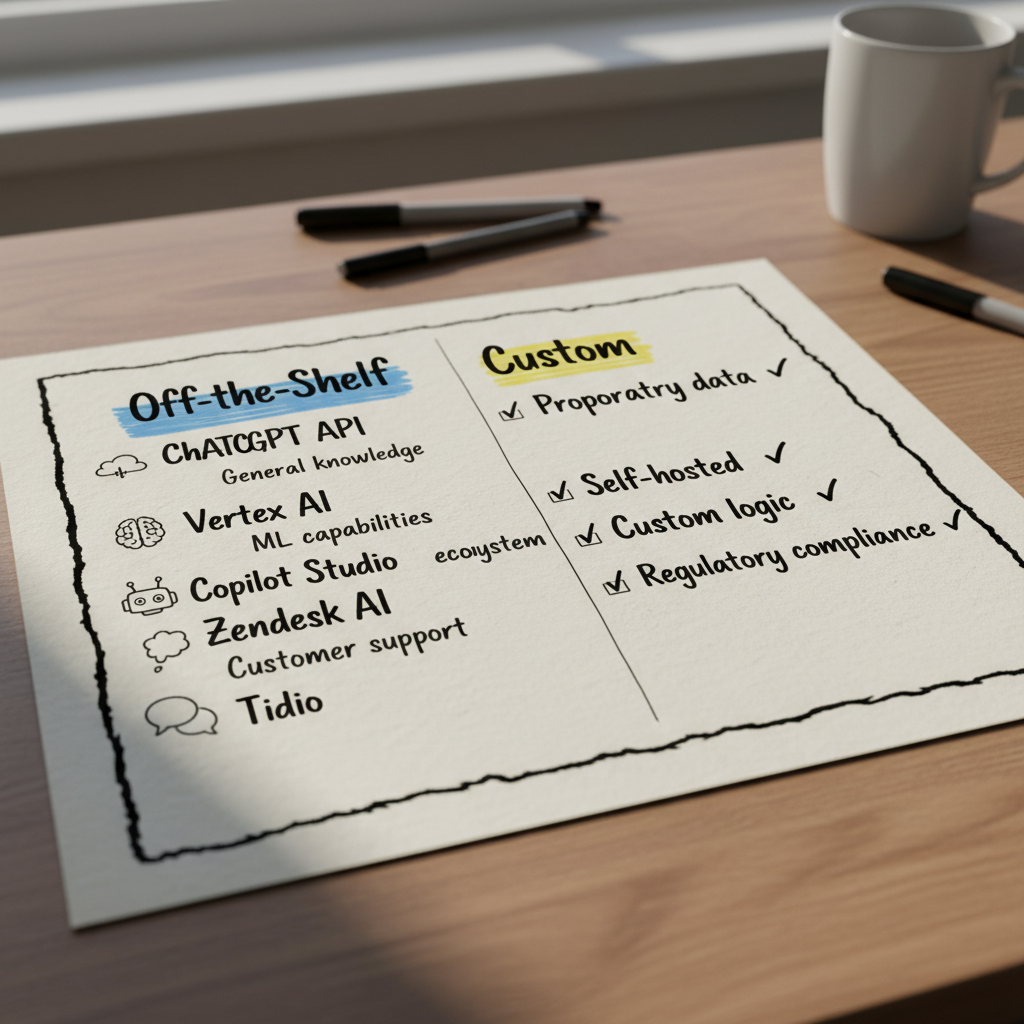
Off-the-shelf vs. custom AI chatbots: which approach fits your business needs?
Several platforms serve the Malaysian market. Here is a practical overview:
Off-the-Shelf AI Chatbot Platforms
- ChatGPT (via API or Teams) — Strong conversational ability. Can be customised with instructions and documents. Requires technical setup for production use.
- Google Vertex AI Chat — Enterprise-grade, good for organisations already using Google Cloud. Strong Bahasa Malaysia support through Gemini models.
- Microsoft Copilot Studio — Integrates with Microsoft 365, Teams, and Dynamics. Suitable for organisations already in the Microsoft ecosystem.
- Zendesk AI / Intercom Fin — Purpose-built for customer service. Good escalation workflows and analytics. Subscription-based.
- Tidio / ManyChat — Affordable options for SMEs. Good for website and WhatsApp integration. Less customisable for complex workflows.
Custom AI Chatbots
When off-the-shelf platforms cannot handle your specific workflows, data structures, or compliance needs, a custom AI chatbot may be more appropriate. Custom solutions allow:
- Training on your proprietary documents, SOPs, and product catalogues
- Hosting within your own infrastructure for data sovereignty
- Custom escalation logic and integration with internal systems
- Role-based access for internal use cases
Organisations in regulated sectors — finance, healthcare, insurance, government — often prefer custom solutions because data control and compliance requirements are higher.
How to Evaluate an AI Chatbot for Your Malaysian Business
Step 1: Define the Use Case
Start with one clear workflow. Do not try to automate everything at once.
- Which questions do your team answer most often?
- Which enquiries are repetitive and rule-based?
- Where do response delays frustrate customers or employees?
Step 2: Map the Customer or User Journey
Map out the conversation flow from first interaction to resolution. Where should the bot handle the conversation? Where should a human take over?
Step 3: Check Language Support
Test the platform with real Bahasa Malaysia queries, including industry-specific terms, local expressions, and mixed-language sentences. Not all AI models handle BM equally well.
Step 4: Review Data Privacy and Hosting
Ask where conversation data is stored. For customer-facing chatbots handling personal data, Malaysian or regional hosting may be preferred. Check whether the provider complies with your internal data governance policies.
Step 5: Pilot Before Scaling
Run a controlled pilot with one department or one customer segment. Measure response accuracy, escalation rate, customer satisfaction, and team workload impact before rolling out organisation-wide.
Responsible AI Chatbot Adoption: What Malaysian Businesses Should Know
AI chatbots are not set-and-forget tools. Responsible adoption includes:
- Clear escalation paths — Customers should always be able to reach a human
- Transparency — Let users know they are speaking to an AI, not a person
- Accuracy monitoring — Regularly review responses for errors or inappropriate outputs
- Data governance — Ensure sensitive customer data is not used to train public models
- Human review — For high-stakes interactions (complaints, billing disputes, legal enquiries), route to human agents
Organisations should set clear guardrails for responsible AI use, especially around confidential or sensitive information. An AI governance workshop can help teams adopt AI safely and appropriately.
When a Custom AI Chatbot Makes More Sense Than an Off-the-Shelf Tool
Consider a custom approach when:
- Your workflows involve complex business logic or multiple internal systems
- You need strict data sovereignty and on-premise hosting
- Off-the-shelf platforms cannot handle your industry-specific terminology
- You need deep integration with legacy systems or proprietary databases
- Your organisation operates in a regulated sector with compliance requirements
AIHQ helps organisations explore whether a custom AI chatbot, internal copilot, or automation workflow is appropriate for their specific needs.
Getting Started With AI Chatbots in Your Organisation
If your team is evaluating AI chatbots, a structured approach helps avoid wasted time and poor adoption:
- Build AI literacy first — Ensure your team understands what AI can and cannot do through practical, role-based AI training.
- Identify one real workflow — Pick a repetitive enquiry or support process that creates the most friction.
- Map the conversation design — Plan the flow, escalation points, and fallback options before choosing a tool.
- Pilot with clear metrics — Measure resolution rate, customer satisfaction, and team workload changes.
- Plan for governance — Set guidelines for accuracy review, data handling, and human oversight from day one.
AIHQ has supported organisations including Media Prima, Prudential BSN Takaful, and Selangor State Government through structured AI adoption journeys. With over 9,000 professionals trained across corporate, public sector, and regulated environments, AIHQ combines training capability with practical implementation experience.
Conclusion
AI chatbots can help Malaysian businesses improve customer engagement, reduce response times, and automate repetitive enquiries — but only when adopted with the right strategy, use case, and governance in place. Whether you choose an off-the-shelf platform or a custom solution, the key is starting with a clear workflow, piloting before scaling, and keeping human oversight at the centre.
For organisations ready to move beyond AI awareness into structured capability and practical implementation, AIHQ can help evaluate the right path forward.
FAQ
What is the difference between an AI chatbot and a rule-based chatbot?
A rule-based chatbot follows pre-written scripts and can only answer questions within those paths. An AI chatbot uses large language models to understand varied phrasing, hold contextual conversations, and generate responses based on your business data. AI chatbots can handle more complex and varied enquiries but require careful setup, monitoring and governance.
Can AI chatbots handle Bahasa Malaysia enquiries?
Yes, but the quality depends on the underlying AI model and how well it has been trained on Bahasa Malaysia. Some platforms handle BM, mixed English-BM, and local expressions better than others. It is important to test any platform with real BM queries relevant to your industry before committing.
How much does an AI chatbot cost for a Malaysian business?
Costs vary widely. Off-the-shelf platforms like Tidio or ManyChat start at lower monthly subscriptions for basic features. Enterprise platforms like Zendesk AI or Microsoft Copilot Studio are more expensive but offer deeper integration and analytics. Custom AI chatbots involve development and setup costs but provide greater control and specificity.
Is customer data safe when using an AI chatbot?
Data safety depends on the platform's settings, policies, hosting location, and your usage behaviour. Organisations should check where conversation data is stored, whether it is used to train public models, and whether the platform offers Malaysian or regional hosting. Setting clear guardrails for responsible AI use is essential, especially for sensitive customer information.
Do AI chatbots replace customer service agents?
No. Well-designed AI chatbots handle repetitive and routine enquiries so that human agents can focus on complex, high-value, or sensitive conversations. Customers should always have a clear path to escalate to a human. The goal is to support teams, not replace them.
When should my business consider a custom AI chatbot instead of an off-the-shelf platform?
Consider a custom chatbot when your workflows involve complex logic or multiple internal systems, when you need strict data sovereignty and on-premise hosting, when off-the-shelf platforms cannot handle your industry-specific terminology, or when your organisation operates in a regulated sector with compliance requirements.