General
AI Consultancy Services: Inside AIHQ's End-to-End Client Journey
· By AIHQ Team

Most SME founders we meet have already tried AI. Someone on the team bought a subscription, wrote a few prompts, used it for two weeks, and then it quietly stopped. The honest diagnosis isn't that AI doesn't work — it's that ad-hoc tool access doesn't survive contact with a real business week.
AI consultancy services are worth paying for only when they change what happens on a Tuesday afternoon — which means the scope has to cover five stages, not just a strategy deck or a training day. Here is what that looks like end to end when AIHQ runs it.
Why SME AI Projects Stall at Week Three
When we look at stalled internal AI efforts, the pattern is remarkably consistent. Interest is high. Capability is thin. Usage is improvised. Nobody defined what a good outcome looks like, so nobody can tell whether it happened.
The failure usually isn't technical. It's that a tool was installed somewhere in the org chart instead of being attached to a workflow with a named person, a defined task and a way to check the output.
This is also why buying more licences rarely fixes it. Off-the-shelf tools are genuinely useful, but some workflows need custom AI solutions, automation or structured implementation support before they produce anything worth measuring.
Stage 1: Leadership Alignment (Weeks 1–3)
We start with the people who control budget and risk — usually the founder, one or two directors, and whoever owns operations.
The output of this stage isn't a glossy strategy document. It's a short, agreed position on four questions:
- Where will AI plausibly help, and where won't it? We push back on ideas that sound impressive but don't map to a bottleneck.
- What is off-limits? Which data, clients, documents or decisions should never go into a public AI tool.
- Who decides? Naming one accountable owner prevents the classic situation where everyone experiments and no one is responsible.
- What does "working" look like in 90 days? A number, a time saving, or a quality threshold — not a feeling.
This is where an executive AI briefing earns its place. Leadership alignment before rollout tends to be far cheaper than retrofitting governance after staff have already pasted a client contract into a chatbot.
Stage 2: AI Use-Case Discovery (Weeks 2–5)
Once leadership has set the boundaries, we get into the actual work. An AI innovation bootcamp or use-case discovery workshop puts a cross-functional group — sales, finance, ops, HR, admin — in one room to map where time and quality actually leak.
Typical SME findings look like this:
- Quotation and proposal drafting that takes a senior person 3–4 hours each time
- Monthly management reporting assembled manually from three spreadsheets
- Customer enquiry responses that get answered inconsistently across staff
- SOP and policy questions that route through one overloaded admin
- Recruitment screening and interview note consolidation for a lean HR function
We score each candidate on frequency, time cost, risk and how easy it is to verify the output. A task that happens 200 times a month and takes 20 minutes is a different proposition from one that happens twice a year and takes a day.
The stage ends with a ranked shortlist — usually three to five use cases — and a decision on which one gets piloted first.
Stage 3: Capability Building (Weeks 4–12)
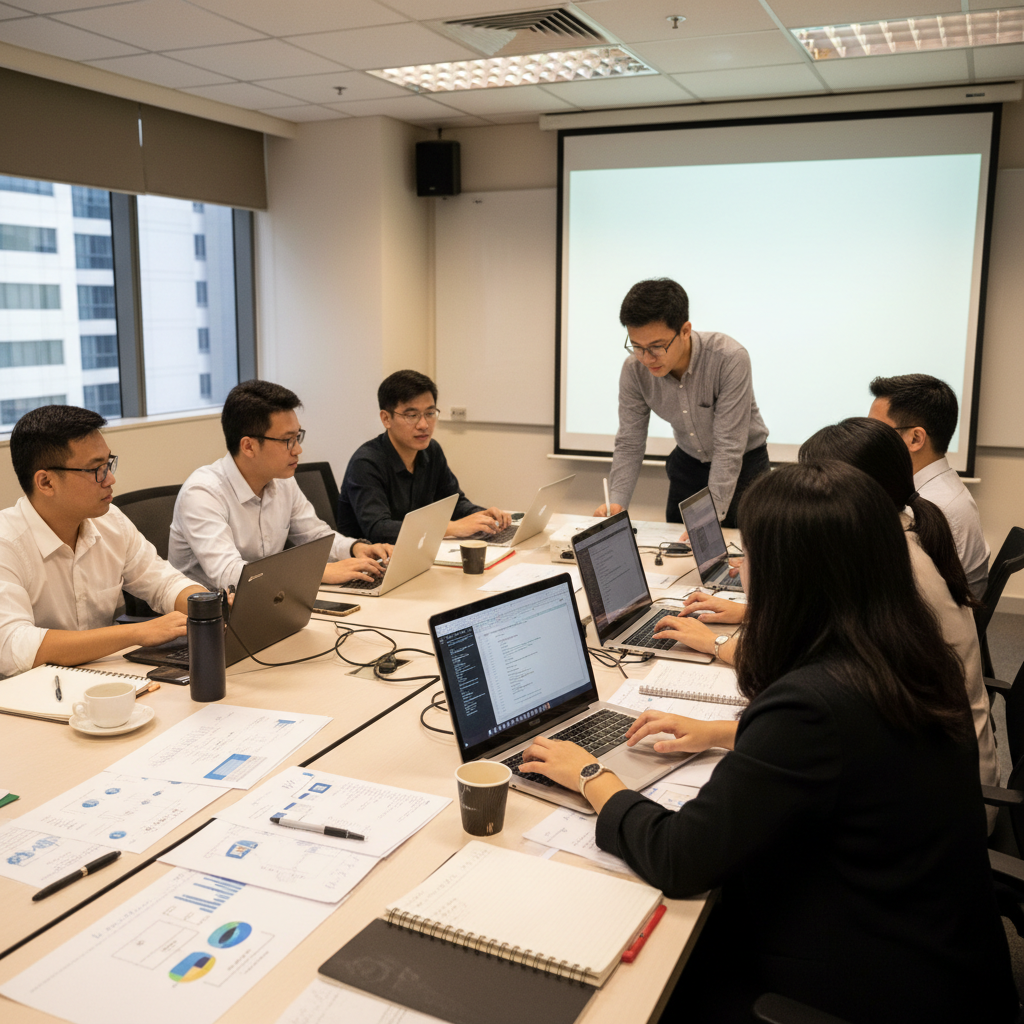
Role-based sessions: each function works on its own live tasks, not generic prompt demos.
This is where most AI consultancy engagements stop being advice and start being work. Training is not a nice-to-have add-on; it's the mechanism that converts a shortlist into daily behaviour.
AIHQ focuses on role-based AI training rather than generic prompt workshops, because the person drafting quotations needs different habits from the person consolidating management accounts. HRDC-registered provider status applies here: AIHQ programmes can be structured to be HRDC claimable, subject to client eligibility, grant approval and HRD Corp submission requirements.
A realistic sequence for an SME:
- Foundations (half day, whole cohort): what the tools do, what they don't, and the data rules your leadership agreed in Stage 1.
- Role-based sessions (one per function): each team works on its own live tasks — a real quotation, a real month-end pack, a real enquiry thread.
- Champion track: two or three power users get custom AI solutions-oriented previews on workflow design, so they can extend what they've learned between engagements.
In the Media Prima engagement, a structured capability journey ran across 12 months through awareness, fundamentals, intermediate LLM skill-building and advanced application workshops. Reported outcomes included 98% satisfied participants, 90% reporting increased practical knowledge and skills, and 92% finding the training relevant and applicable to work. Those figures belong to that programme — training outcomes vary by organisation, role and adoption — but they show what a multi-stage journey can produce when it isn't a one-off event.
Stage 4: First Workflow Pilot (Weeks 6–16)
Rather than rolling AI across the business, we pick one workflow and run it properly.
A concrete example pattern from SME engagements: a services company prioritised quotation drafting. The pilot involved a prompt-and-template library for the sales team, a defined review step where a senior person still signs off before anything reaches the client, and a simple log tracking how long drafts took before and after.
Where a workflow can't be solved with the browser tab, this is the point where AI implementation support is scoped — for example an internal copilot that answers staff questions from your actual SOP documents, or a customer enquiry chatbot that handles tier-one questions and escalates sensitive ones to a human. That's a different kind of project with its own timeline, and it's usually justified only after the simpler pilot proves the workflow matters.
Stage 5: Governance, Measurement and Handover (Ongoing)
An SME doesn't need a 40-page AI policy. It needs four pages staff will actually follow — and consistent reinforcement.
Under Malaysia's PDPA, if AI tools touch personal data (customer records, employee information, candidate CVs), your obligations around collection, use, disclosure and retention still apply. AI adoption doesn't create a new exemption from them. In practice that means agreeing which categories of data are permitted in which tools, and making that visible rather than tribal knowledge.
A short AI governance workshop with leadership, HR and whoever owns compliance is usually enough for an SME to produce a workable usage policy: approved tools, prohibited data types, human review requirements for anything client-facing, and a simple escalation path when someone isn't sure.
Measurement stays deliberately light. We track adoption (how many people are actually using the workflow weekly), cycle time on the piloted task, and a quality check on output. That's enough to decide whether to extend, adjust or stop.
The engagement ends with handover, not dependency: internal champions who can onboard new joiners, templates your team owns, and a shortlist of the next use cases already ranked.
What Kinds of SMEs Get the Most From This
Based on AIHQ's work across corporate, public sector, professional and regulated environments, plus 9,000+ professionals trained and engaged, three profiles consistently move fastest:
- Services firms with heavy document output — proposals, reports, client communication. High repetition, clear quality checks.
- Operations-led businesses with visible bottlenecks — one person or one team that everything routes through.
- Teams with a willing internal champion — someone credible who will carry the habit between sessions.
The slower profile is an organisation looking for a tool purchase to solve an undefined problem. That conversation usually ends with us recommending discovery before procurement.
Before You Brief an AI Consultancy
Bring four things to the first meeting and the engagement will be sharper from day one:
- Your top three time-consuming workflows, with rough frequency numbers
- The names of the people who do them
- Your data boundaries — what absolutely cannot leave the organisation
- A budget range, and whether HRDC claimability is part of the plan
AIHQ helps organisations structure their AI adoption and move toward practical workflow impact — the scope, pace and results depend on your context, adoption and follow-through. If you want a clear picture of which stage you're stuck at, speak to AIHQ and we'll map it against this journey.
FAQ
How long does an AI consultancy engagement with an SME typically run?
The pattern described here runs roughly 12–16 weeks from leadership alignment through to first workflow pilot, with governance and measurement continuing afterward. Scope varies by organisation size, decision speed and how much internal capability already exists.
Do we need to buy AI tools before starting?
No. Most SMEs start with tools the team already has access to. Custom AI solutions — copilots, chatbots, automation — are scoped only after a workflow pilot shows there's a case for them.
Is AIHQ training HRDC claimable?
AIHQ is a registered HRD Corp training provider, and programmes can be structured to be HRDC claimable, subject to client eligibility, grant approval and HRD Corp submission requirements. We can walk through the process, but final approval sits with HRD Corp.
What does AI consultancy cost for a Malaysian SME?
Cost depends on scope: a leadership briefing and discovery workshop is a very different engagement from a multi-month capability programme plus a custom workflow build. The practical approach is to scope stage by stage rather than committing to the full journey upfront.
How do we handle customer data under PDPA when using AI?
Personal data obligations under PDPA still apply when AI tools are involved. In practice this means defining which data categories are permitted in which tools, restricting confidential documents to approved environments, and keeping human review on anything client-facing. Governance should be set before staff use AI at scale, not after.
What if our team has no AI experience at all?
That's the common starting point. The foundations session assumes no prior exposure, and role-based sessions work on real tasks rather than abstract exercises. Willingness and a champion matter more than existing technical skill.