General
AI Consultancy Services in Malaysia: A Practical Guide for SME Transformation
· By AIHQ Team

Many Malaysian SMEs do not lack AI ideas. They run pilot projects, experiment with a few tools, and then stall. The webinar happened. A couple of departments tried ChatGPT. Someone built a basic chatbot. Yet six months later, little has changed in how the business actually runs.
The reason is usually not a bad tool. It is the absence of a structured path. That is where AI consultancy services in Malaysia can help — but only if you engage them the right way.
This guide walks you through a step-by-step roadmap: why SMEs stall, how to scope the right engagement, how to select a consultant, how to measure value, and how to manage change for Malaysian business realities.
Why SMEs Get Stuck in Pilot Limbo
The "pilot limbo" pattern looks roughly the same across organisations. Leadership approves a small experiment. A team runs it with enthusiasm. Then the project ends, the learnings stay with two or three people, and the business moves on.
Three things usually cause this:
- No ownership. Nobody is accountable for taking the pilot beyond the experiment.
- No workflow connection. The AI use case was tested in isolation rather than plugged into a real daily process.
- No measurement. Because value was never defined, nobody can prove the pilot was worth expanding.
AI adoption is not mainly about tools, and it is certainly not about learning a few prompts. Sustainable adoption depends on role-based capability, workflow thinking, governance and leadership alignment. A good AI consultancy in Malaysia should help you structure all of it — not just hand you a licence.
What an AI Consultancy Actually Does
Before engaging anyone, it helps to be clear on the difference between a training provider, a tool vendor and a consultancy.
An AI consultancy helps you decide what to adopt, where it adds value, who should build capability, and how to do it responsibly. That typically involves:
- A readiness discussion and strategy session
- A workflow audit to find real pain points
- Use-case discovery and prioritisation
- Role-based training for the teams involved
- Governance and responsible-use guidance
- Implementation support where off-the-shelf tools are not enough
The best engagements pair capability building with implementation awareness. Training alone rarely creates adoption, and a purely tool-focused rollout ignores the people side of change.
Step 1: Define the Business Problem Before the Tool
Start with the outcome, not the technology. Ask your leadership and department heads: which workflows are slow, repetitive, or error-prone?
Examples Malaysian SMEs often raise include:
- Customer service teams answering the same questions repeatedly
- Operations staff manually copying data between systems
- Finance teams compiling repetitive monthly reports
- HR and admin staff drafting endless policy documents and emails
Once you have a short list of pain points, you can talk to a consultant about which ones AI could genuinely support. This framing keeps the conversation practical and ensures you are adopting AI to improve workflows — not adopting AI for its own sake.
Step 2: Identify Use Cases Worth Piloting
Not every workflow is worth an AI pilot. Good use cases tend to share a few traits:
- High frequency — the task happens often enough to matter
- Clear input and output — you know what goes in and what should come out
- Low to moderate risk — a mistake is not catastrophic without human review
- Sensible to automate or assist — the task is repetitive but still benefits from oversight
A structured AI innovation bootcamp can help teams identify and prioritise these use cases rather than guessing. The goal is to move from a scattered list of AI ideas to a short, defensible set of pilots worth testing.
Step 3: Select the Right AI Consultant
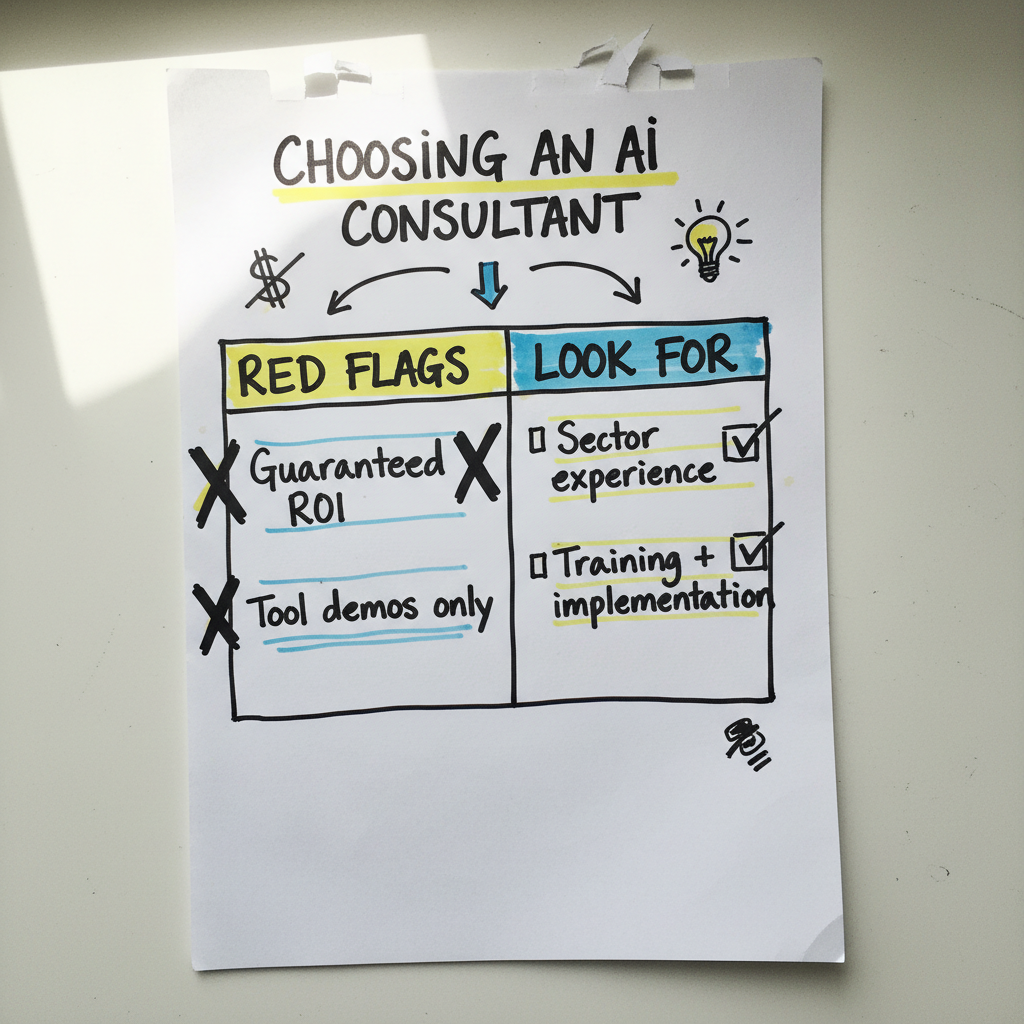
Selecting a consultancy is about governance, sector fit and pairing training with implementation.
Choosing an AI consultancy in Malaysia is more than comparing price lists. Practical guidance on choosing an AI business consultant often comes down to a few checks:
- Do they understand your sector? A consultancy that has worked with corporate, public sector, professional and regulated environments will adapt faster than one that only sells tool demos.
- Do they pair training with implementation? Capability without a path to implementation stalls; implementation without capability leaves teams dependent on outsiders. You want both.
- Are their claims realistic? Be wary of anyone who promises guaranteed transformation or guaranteed ROI. Both depend on your data, adoption, governance and follow-through.
- Do they address governance and responsible use? A responsible partner will raise data privacy, human oversight and guardrails before rollout, not after.
Look for a partner who has actually engaged professionals. AIHQ, for example, has trained and engaged over 9,000 professionals across corporate organisations, government agencies, public sector bodies and regulated sectors — a track record that matters when the conversation turns to real adoption.
Step 4: Measure Value From the Start
One reason pilots stall is that nobody defined what success looks like. Before you launch, agree on the measures.
Keep them simple and practical:
- Time saved on a specific recurring task (e.g. hours per week on report drafting)
- Turnaround improvement (e.g. response time to customer enquiries)
- Quality metrics (e.g. fewer errors in data entry, more consistent documents)
- Adoption (e.g. how many staff in the piloted role actually use the workflow)
Where HRDC-claimable training is relevant, note that programmes can be structured to be claimable subject to client eligibility, grant approval and HRD Corp submission requirements. Never treat approval as guaranteed.
AIHQ designs practical training to help teams apply AI to real workflows and move toward measurable outcomes. The metrics should be your own, defined against your own baseline.
Step 5: Manage Change, Not Just Tools
The hardest part of AI adoption in Malaysian SMEs is usually people, not technology. Staff worry about their roles, leadership is unsure how to set direction, and no one owns the rollout.
Practical change management looks like this:
- Leader alignment first. A leadership brief should come before large rollout, so executives agree on goals, risks and priorities. Explore an AI leadership briefing for senior teams.
- Train by role, not by generic workshop. An accountant, a marketer and a customer service agent use AI differently. Role-based AI training creates far better adoption than a generic afternoon session.
- Appoint an owner. Give one person or team accountability for moving the pilot to scale.
- Set guardrails. Establish clear boundaries for what can be shared with AI tools, especially around confidential company data. Responsible use should be built in early.
Step 6: Decide What Scales — and What Needs Custom Work
Not every workflow should scale as a prompt-based tool. Some become genuinely valuable only with a custom AI solution.
For example, an off-the-shelf chatbot might answer basic customer questions. But a custom AI chatbot trained on your own products, policies and quality standards—and wired to escalate to human staff—tends to serve customers far more reliably.
Similarly, internal knowledge systems can help HR and operations teams find SOP answers, reduce repetitive requests, and turn long documents into usable answers. The right threshold is: use off-the-shelf tools where they are good enough, and consider custom solutions where they are not.
A Realistic Path Forward
There is no guaranteed, overnight AI transformation. But there is a structured path that works: define the business problem, identify valuable use cases, choose the right partner, measure from the start, manage change deliberately, and scale what works.
For Malaysian SMEs, the difference between a stalled pilot and real workflow impact usually comes down to structure and follow-through. The right AI consultancy helps you build both.
If you are ready to move beyond AI awareness into structured capability and practical adoption, speak to AIHQ about designing a plan aligned with your roles, workflows and business priorities.