General
AI Consultant for Enterprise Transformation: How to Choose the Right Expert
· By AIHQ Team

Enterprise AI transformation is rarely a tool-buying exercise. It is an organisational shift that touches strategy, workforce capability, workflow design, governance and, in many cases, custom implementation.
Many organisations start by hiring an AI consultant for enterprise transformation — but the quality of advice varies significantly. Some consultants offer deep strategic thinking. Others focus heavily on tools. A few overpromise what AI can do.
This guide covers what to look for when evaluating an AI consultant, common red flags, and how to choose a partner who matches your organisation's stage, sector and goals.
Why Enterprise AI Transformation Needs Expert Guidance
AI adoption in a mid-sized or large organisation is not the same as an individual learning ChatGPT. Enterprises face:
- Workforce readiness gaps — Not everyone has the same baseline understanding of AI.
- Data and privacy concerns — Sensitive business data requires clear guardrails.
- Governance requirements — Regulated sectors need policies before usage.
- Integration complexity — Off-the-shelf tools may not connect to existing systems.
- Leadership alignment — Without executive consensus, AI efforts remain fragmented.
A qualified AI consultant for enterprise transformation helps organisations navigate these layers. The challenge is distinguishing genuine expertise from surface-level familiarity with AI tools.
Key Credentials to Look for in an AI Consultant
When evaluating an AI consultant, look beyond impressive-sounding titles. Consider these indicators of real enterprise capability.
1. Demonstrated Cross-Sector Experience
AI works differently across industries. A consultant who has delivered programmes across corporate, public sector, professional and regulated environments brings a broader perspective.
AIHQ, for example, has worked with organisations including ACCA, Media Prima Group, Prudential BSN Takaful, Selangor State Government, MDEC, SME Corp Malaysia, and leadership teams from Lion Group and MTD Group. This cross-sector range signals adaptability across different regulatory and operational contexts.
2. A Structured Approach to Adoption
The best AI consultants do not jump straight into tool demos. They start with:
- Leadership alignment — Ensuring executives share a common understanding of AI's value, risks and limitations.
- Readiness assessment — Understanding the organisation's current AI maturity.
- Role-based capability planning — Different teams need different AI skills.
- Governance frameworks — Guidelines before scaling.
- Pilot design — Small, measurable projects before enterprise-wide rollout.
If a consultant proposes a one-size-fits-all training session or a single tool rollout, that is a signal to ask deeper questions.
3. Trainer and Facilitator Depth
Enterprise AI adoption is not just about having a lead consultant. It often requires a team with different specialisations. Look for:
- A strategy lead who can speak to business leaders about value and risk.
- A technical trainer who understands applied AI, LLMs and implementation.
- A governance specialist who can address responsible use, data privacy and compliance.
- Role-specific facilitators who can translate AI into real departmental workflows.
AIHQ's team includes Pang Sern Yong (leadership alignment and business-first AI adoption), Firdaus Khairi (applied AI and technical implementation), Jean Ng (responsible AI and governance), Hazwan bin Azma (workflow productivity and data analysis) and Arif (operational AI applications).
4. Track Record with Measurable Outcomes
No credible consultant guarantees transformation or ROI — too many variables depend on the client's context. But they should be able to reference specific programmes, participant satisfaction levels and capability improvements.
For example, AIHQ supported Media Prima through a structured 12-month AI capability journey. The programme achieved 98% satisfied participants, 90% increased practical knowledge and skills, and 92% finding training relevant and applicable to their work.
These are specific, verifiable outcomes — not generic promises.
5. Awareness of When Off-the-Shelf Tools Are Not Enough
A good AI consultant knows when ChatGPT, Copilot or Gemini is sufficient — and when a custom solution is needed. Pushing custom development for every problem is a red flag. But ignoring real workflow gaps and recommending only tool training is equally limiting.
AIHQ's positioning distinguishes off-the-shelf tools from custom AI solutions such as internal copilots, AI chatbots, workflow automation and knowledge systems — applied only when a genuine need exists.
Red Flags When Hiring an AI Consultant
Avoid these warning signs during evaluation.
🚩 Guarantees Transformation or ROI
No serious consultant guarantees outcomes they cannot control. Transformation depends on client context, adoption, governance, implementation and follow-through. Replace "we guarantee X" with "we help organisations work toward X."
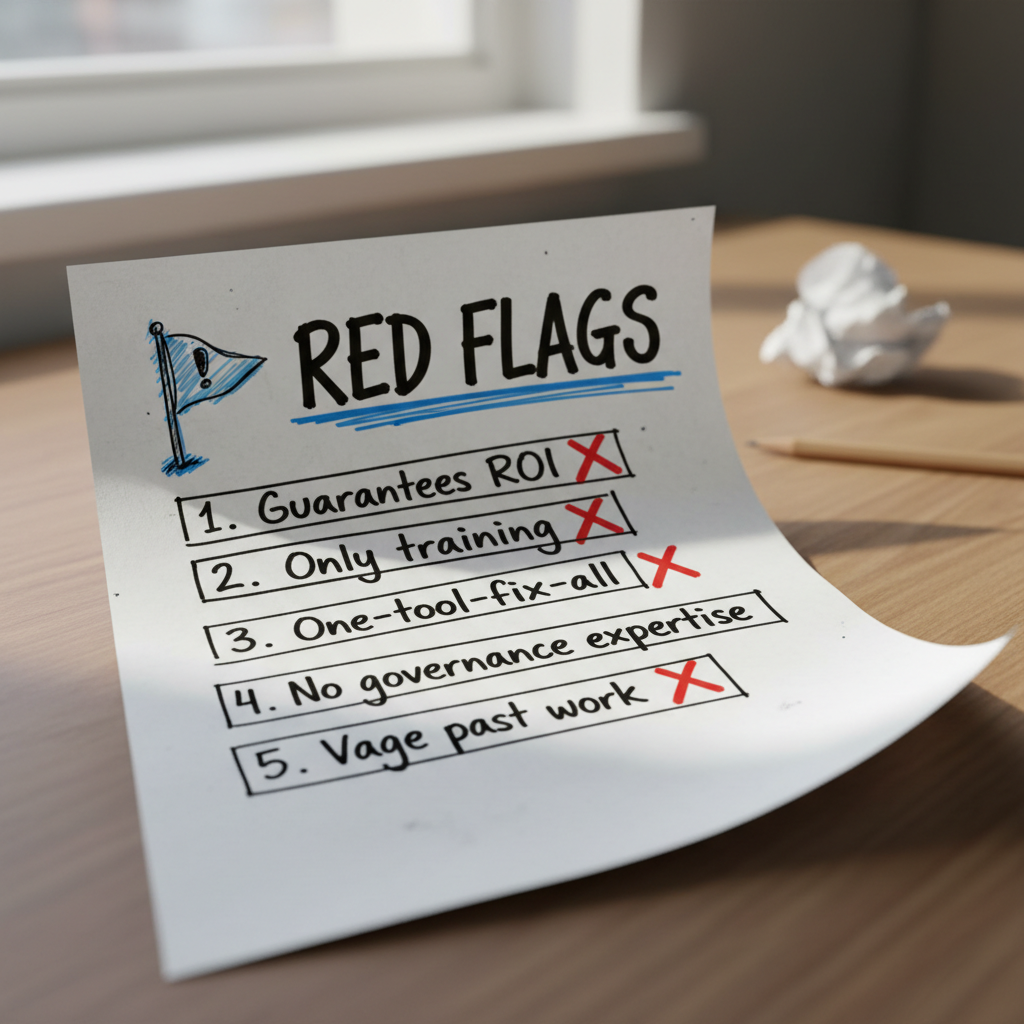
Watch for red flags like guaranteed ROI or missing governance expertise in an AI consultant.
🚩 Treats AI Adoption as Only a Training Problem
If the proposal is a single generic workshop with no follow-through, it is unlikely to create lasting change. Sustainable adoption requires leadership alignment, workflow integration, governance and sometimes custom implementation.
🚩 Claims Single Tools Solve All Problems
"ChatGPT can handle everything" or "Copilot will fix your workflows" are oversimplifications. Off-the-shelf tools are useful, but some workflows require custom AI solutions, automation or structured implementation.
🚩 No Governance or Responsible AI Expertise
Any consultant working with enterprises should address data privacy, accuracy, human oversight and responsible use. If these topics are absent from the conversation, the consultant may not be prepared for real-world organisational constraints.
🚩 Vague Claims About Past Work
"We've worked with major organisations" without naming any is a warning. Look for specific, named engagements where available — or at minimum, detailed descriptions of the types of organisations and programmes delivered.
How to Evaluate an AI Consultant in Practice
Step 1: Clarify Your Own Needs First
Before engaging anyone, understand what your organisation actually needs:
- Do you need leadership alignment before rolling out AI?
- Do you need workforce upskilling across multiple departments?
- Do you need governance frameworks for responsible use?
- Do you need custom solutions because off-the-shelf tools do not fit your workflow?
- Do you need all of the above in a phased approach?
AIHQ offers structured entry points depending on what stage an organisation is at:
- Executive AI briefings for leadership alignment.
- Role-based AI training for department-specific capability.
- AI innovation bootcamps for use-case discovery and pilot planning.
- Governance workshops for responsible AI adoption.
- Custom AI solutions for workflows where off-the-shelf tools are insufficient.
Step 2: Ask Specific Questions
During interviews, ask:
- What is your approach to AI adoption in an enterprise setting?
- Can you share examples of cross-sector work, particularly in our industry?
- How do you handle data privacy and governance concerns?
- What happens after training or advisory sessions — do you support follow-through?
- How do you measure whether a programme is working?
Step 3: Check for Structured Methodology
A good consultant should describe a clear methodology, such as:
- Awareness — Building foundational understanding across the organisation.
- Capability — Role-based training aligned to actual workflows.
- Practical Usage — Moving from learning to daily application.
- Measurable Outcomes — Tracking adoption, satisfaction and workflow impact.
- Optional Implementation — Custom solutions where gaps remain.
This is essentially AIHQ's core approach: Interest → Capability → Practical Usage → Measurable Outcomes → Optional Implementation.
Step 4: Verify Credibility
Look for:
- Awards and recognition — AIHQ received 2025 recognition including AI Project of the Year — Winner, and was named Top Course Provider during National Training Week 2024.
- Registered provider status — AIHQ is a registered HRD Corp training provider, and programmes can be structured to be 100% HRDC claimable, subject to client eligibility, grant approval and HRD Corp submission requirements.
- Number of professionals engaged — AIHQ has trained and engaged over 9,000 professionals across corporate, public sector, professional and regulated environments.
When You Need More Than Training
Some organisations discover during their AI adoption journey that off-the-shelf tools cannot address specific workflows. Common scenarios include:
- Customer service teams needing a custom AI chatbot with escalation logic.
- HR teams wanting an internal copilot for SOP and policy queries.
- Operations teams needing workflow automation for approval and notification flows.
- Leadership wanting a dashboard or knowledge system for visibility and documentation access.
A good AI consultant for enterprise transformation will help you recognise when training is sufficient and when a custom solution is worth exploring.
Final Thoughts: Choose a Partner, Not a Sales Pitch
The right AI consultant brings practical experience, structured methodology, cross-sector credibility and honest advice about what AI can and cannot do. They help you move beyond awareness into capability, usage and meaningful workflow impact — without overpromising results.
If your organisation is exploring AI adoption and would benefit from an experienced partner, AIHQ can support leadership alignment, workforce upskilling, governance readiness and custom solutions where needed.
FAQ
What does an AI consultant for enterprise transformation actually do?
An AI consultant helps organisations plan and execute AI adoption at scale. This typically includes leadership alignment, workforce training, governance guidance, use-case discovery, and in some cases, custom solution design. They bridge the gap between AI tools and real organisational workflows.
How is an AI consultant different from an AI trainer?
An AI trainer focuses on building workforce capability through workshops and courses. An AI consultant covers a broader scope — strategy, governance, workflow design, implementation planning and sometimes custom solutions. Many consultants also deliver training, but training alone is rarely enough for enterprise transformation.
What should I ask before hiring an AI consultant for my organisation?
Ask about their cross-sector experience, their structured approach to adoption, how they handle governance and data privacy, and what happens after the engagement ends. Also ask for specific examples of past work — not just client names but what was delivered and what the outcomes were.
How long does enterprise AI transformation typically take?
There is no fixed timeline because transformation depends on the organisation's starting point, workforce readiness, governance requirements and implementation scope. A structured approach — starting with leadership alignment and moving through capability building, practical usage and optional implementation — typically takes months rather than weeks.
Can AIHQ help with both training and custom AI solutions?
Yes. AIHQ provides leadership briefings, role-based training, innovation bootcamps, governance workshops and custom AI solutions including chatbots, internal copilots, workflow automation and knowledge systems. The approach depends on the organisation's readiness and specific needs.
Is AIHQ suitable for organisations outside Malaysia?
AIHQ primarily works with organisations in Malaysia and Singapore, and has delivered programmes across both markets. If your organisation operates in these regions or has similar regulatory and operational contexts, a discussion would help determine fit.