General
AI Consultant vs AI Training Provider: Which Does Your Enterprise Need?
· By AIHQ Team

You have heard the pitch from both sides.
The AI consultant promises strategy, roadmaps and transformation guidance. The AI training provider promises to upskill your teams and make them AI-ready. Both sound necessary. And honestly — for most enterprises — both probably are.
But the question is not which one is better. It is which one you need first, and how to combine them effectively without doubling your budget or spinning your wheels.
This article breaks down the distinct roles an AI consultant and an AI training provider play in enterprise adoption, when to hire each, and how smart organisations use both to accelerate AI maturity.
What an AI Consultant Actually Delivers
An AI consultant focuses on strategy, discovery and architecture. They help you answer the "what" and "why" before you jump into the "how."
Typical Scope of an AI Consultant
- AI strategy and roadmap: Defining where AI fits into your business objectives, not just your IT budget
- Use-case discovery and prioritisation: Identifying which workflows are worth automating or augmenting
- Technology assessment: Evaluating whether off-the-shelf tools like ChatGPT, Copilot or Gemini fit, or whether you need a custom solution
- Governance and risk framework: Helping set policies for responsible AI use, data privacy and human oversight
- Pilot planning: Designing small, measurable experiments before committing to large-scale rollouts
When You Need an AI Consultant
An AI consultant adds the most value when:
- Your organisation has fragmented AI experiments across departments with no central strategy
- Leadership is unsure where AI actually creates value versus where it is just hype
- You need to assess risk, governance and data implications before rolling out tools
- You are considering custom AI solutions — chatbots, internal copilots or workflow automation — and need architectural guidance
- Your teams are stuck in "analysis paralysis" and need structured use-case prioritisation
AIHQ, for example, supports organisations through AI leadership briefings and structured AI innovation bootcamps that help leadership teams move from fragmented experimentation to a clear adoption roadmap.
What an AI Training Provider Actually Delivers
An AI training provider focuses on capability building, role-based upskilling and practical workflow integration. They help your workforce move from awareness to confident, responsible daily usage.
Typical Scope of an AI Training Provider
- AI literacy and fundamentals: Helping the broader workforce understand what AI and GenAI can and cannot do
- Role-based training: Department-specific sessions that connect AI tools to real workflows — finance, HR, marketing, operations, customer service and more
- Advanced AI usage: Workshops for power users, champions and technical teams on advanced prompting, workflow design and AI-assisted coding
- Responsible AI and governance training: Teaching teams how to use AI safely, review outputs critically, and protect sensitive data
- Measurable learning outcomes: Structured programmes with practical exercises, not just lecture-style overviews
When You Need an AI Training Provider
An AI training provider adds the most value when:
- Your workforce has low AI confidence and inconsistent usage patterns
- Employees are using AI tools without clear guidance, creating data risks or reliance on unverified outputs
- You need department-specific capability — for example, finance teams who need AI for reporting analysis or HR teams who need AI for policy drafting
- You want to build internal AI champions who can sustain momentum after the programme ends
- You need HRDC claimable programmes that align with structured workforce upskilling goals
AIHQ has trained and engaged over 9,000 professionals across corporate, public sector and regulated environments through role-based AI training programmes designed for practical workflow impact.
The Key Differences at a Glance
| Area | AI Consultant | AI Training Provider |
|---|---|---|
| Primary focus | Strategy, architecture, roadmap | Capability, skills, daily usage |
| Output | Roadmaps, use-case priorities, governance frameworks, pilot plans | Trained teams, confident users, workflow habits, safer adoption |
| Who engages them | CEOs, boards, transformation leads | HR, L&D, department heads, team managers |
| When to engage | Before major investment or when strategy is unclear | After strategy is set, or when workforce readiness lags behind tool adoption |
| Duration | Often shorter — strategy sessions or phased advisory | Often ongoing — staged training across teams and roles |
| Measured by | Clarity of direction, quality of use-case selection, pilot outcomes | Learner confidence, adoption rates, workflow integration, responsible usage |
Why Most Enterprises Need Both
The mistake many organisations make is treating these roles as substitutes when they are actually complementary.
Here is a common scenario:
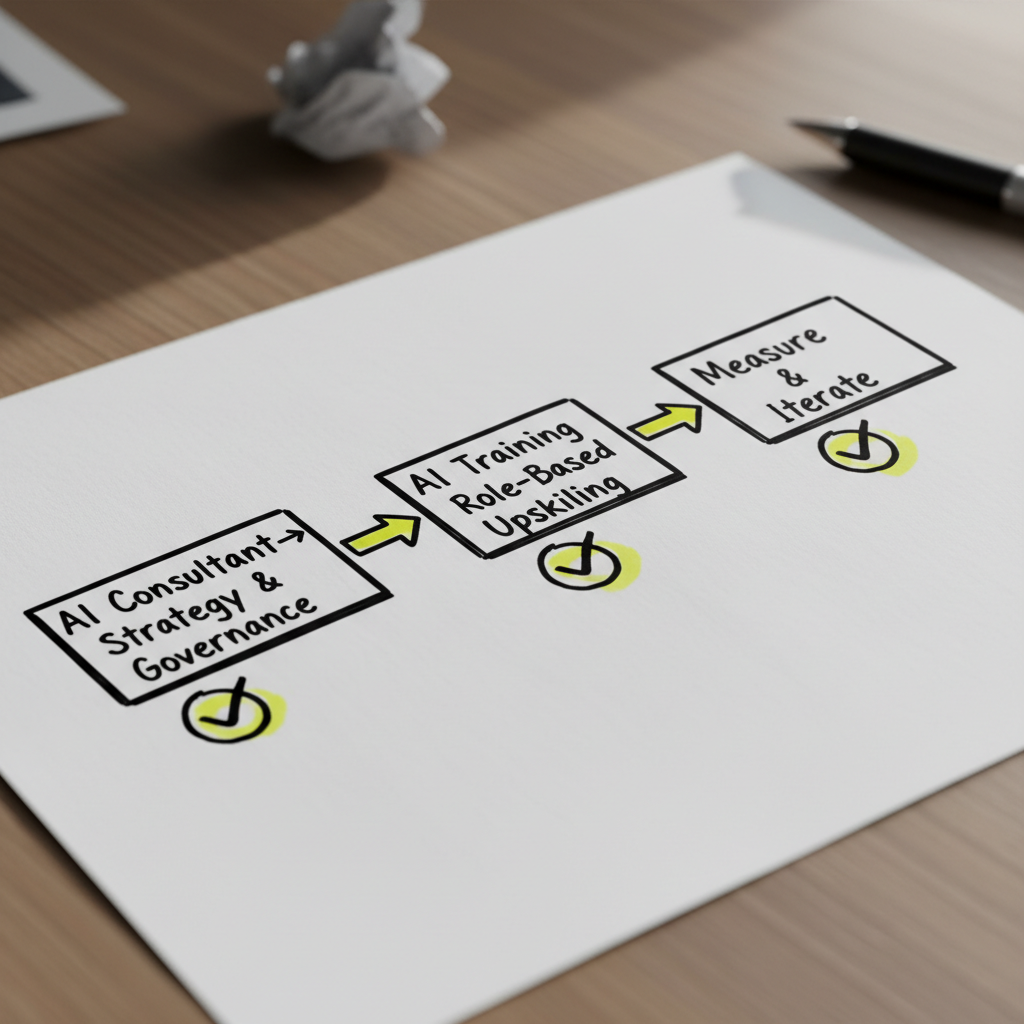
Smart organisations start with strategy, follow with training, then measure and iterate adoption.
An enterprise buys ChatGPT Enterprise subscriptions for 500 employees, expecting productivity gains. Six months later, usage is low, most employees are still using spreadsheets and email manually, and a few team members have accidentally pasted customer data into public tools.
What went wrong?
They skipped both the consultant (to define use cases and governance) and the training provider (to build capability and safe usage habits). The tool alone did not create adoption.
A better path looks like this:
- Start with an AI consultant or structured leadership session to align on use cases, risk and a phased roadmap
- Follow with role-based training that builds practical skills aligned to the workflows identified in the strategy phase
- Measure and iterate — track adoption, gather team feedback and adjust both strategy and training as usage matures
- Add custom solutions only when needed — some workflows benefit from a custom AI chatbot or internal copilot rather than a generic tool
This structured path avoids the budget waste of buying tools or training that does not connect to actual work.
How to Decide Where to Start
Ask these questions with your leadership team:
Start with an AI consultant if:
- You do not have a clear AI strategy or use-case priority list
- You are unsure whether off-the-shelf tools or custom solutions are the right path
- You have governance, risk or data privacy concerns that need structured guidance
- Different departments are running AI experiments with no coordination
Start with an AI training provider if:
- Your strategy is clear but your workforce lacks the skills to execute it
- Employees are using AI inconsistently or without responsible use habits
- You need department-specific capability — your finance, HR and operations teams each need different practical workflows
- You want to build sustainable internal momentum rather than depend on external support forever
Start with both if:
- You are planning a major AI initiative and need both strategic direction and workforce readiness
- Your leadership and workforce are at different maturity levels
- You want to accelerate adoption without the usual cycle of strategy → confusion → stalled rollout
What to Look for When Choosing a Partner
Whether you engage an AI consultant, an AI training provider or a firm that offers both, evaluate them against these criteria:
For AI Consultants
- Do they ask about your specific workflows before proposing solutions?
- Do they acknowledge that off-the-shelf tools may be sufficient for some use cases?
- Do they address governance, data privacy and human oversight — or only talk about opportunity?
- Can they show experience across sectors similar to yours?
For AI Training Providers
- Do they offer role-based training or only generic "AI for everyone" workshops?
- Do they include practical exercises tied to real work scenarios?
- Do they cover responsible use, data safety and output verification?
- Can they structure programmes that are HRDC claimable (subject to eligibility and approval)?
AIHQ works across both advisory and capability-building, helping organisations from leadership alignment through to role-based training and, where needed, custom AI implementation.
Final Thoughts
The question is not "AI consultant or AI training provider?"
The real question is: What does your organisation need to move from AI curiosity to structured, practical impact?
Some enterprises need strategic direction first. Others have the direction but lack workforce capability. Most need both — but the sequencing matters.
A thoughtful approach that pairs the right strategic guidance with practical, role-based capability building will consistently outperform the shortcut of buying tools and hoping for adoption.
If you are unsure where your organisation stands, a structured conversation can help you map the right starting point.
FAQ
What is the main difference between an AI consultant and an AI training provider?
An AI consultant focuses on strategy, use-case discovery, governance and technology roadmaps. An AI training provider focuses on building workforce capability through role-based upskilling, practical workflow training and responsible AI usage. The consultant helps you decide what to do; the training provider helps your teams learn how to do it.
Can one company provide both AI consulting and AI training?
Yes. Some organisations, like AIHQ, offer both advisory services — such as leadership alignment sessions and AI innovation bootcamps — and structured role-based training programmes. This can help ensure strategic direction and workforce capability are aligned under a consistent approach.
Should I hire an AI consultant before investing in AI training?
It depends on your organisation’s maturity. If your AI strategy is unclear or your use cases are undefined, starting with an AI consultant can help you avoid training on workflows that may not be priorities. If your strategy is already clear but your teams lack skills, starting with a training provider may be the right move.
How do I know if my organisation needs custom AI solutions instead of off-the-shelf tools?
Off-the-shelf tools like ChatGPT, Copilot and Gemini are useful for general productivity tasks. If your workflows require specific data integration, compliance boundaries, branded interfaces or multi-step process automation, a custom AI solution such as an internal copilot or workflow automation may be more appropriate. An AI consultant can help assess this.
Is AI training HRDC claimable in Malaysia?
AIHQ programmes can be structured to be HRDC claimable, subject to client eligibility, grant approval and HRD Corp submission requirements. It is best to confirm your organisation’s levy status and discuss programme design with the training provider.
How long does it take to see results from AI training or consulting?
Outcomes vary by organisation. Leadership alignment sessions typically provide clarity in days or weeks. Role-based training can show capability improvements within weeks. Sustainable adoption and measurable workflow impact usually emerge over several months when strategy, training and governance are addressed together.