General
AI for Business Consulting: A Practical Guide for Malaysian Enterprises
· By AIHQ Team

What AI Business Consulting Actually Means for Malaysian Enterprises
In the past two years, many Malaysian organisations have moved from asking "Should we use AI?" to "How do we use AI properly?" The first question leads to ChatGPT subscriptions. The second question leads to something more structured — and that is where AI for business consulting becomes relevant.
AI business consulting is not the same as buying a tool licence or sending a few employees to a ChatGPT workshop. It involves assessing an organisation's workflows, capability gaps, data readiness, governance needs, and strategic priorities — then building a roadmap that connects AI usage to real business outcomes.
Unlike generic technology consulting, AI business consulting requires a working understanding of what current AI tools can and cannot do, how they behave with different data types, and where human oversight remains essential.
AIHQ has trained and engaged over 9,000 professionals across corporate organisations, government agencies, professional institutions, and regulated environments — and the most consistent pattern we observe is this: organisations that start with structured consulting tend to adopt AI more sustainably than those that start with tools.
Why AI Consulting Differs from AI Training
A common point of confusion among Malaysian decision-makers is the difference between AI consulting and AI training. Both are valuable, but they serve different purposes.
| Focus | AI Training | AI Business Consulting |
|---|---|---|
| Primary goal | Build workforce capability | Shape strategy, roadmap and implementation approach |
| Typical output | Skilled employees | Adoption framework, use-case priorities, governance structure |
| Best for | Teams ready to learn | Leaders deciding what to do next |
| Duration | Days to weeks | Weeks to months |
Many organisations need both. Training without strategy can lead to capable employees working without direction. Strategy without training can produce reports that never reach daily workflows.
AIHQ's approach integrates both. Our leadership alignment sessions help senior teams clarify priorities and risks, while role-based AI training ensures employees in each function — HR, finance, customer service, operations — can apply AI to their actual work.
Common Pitfalls When Engaging AI Consultants
Malaysian enterprises engaging AI consultants for the first time tend to encounter similar challenges. Being aware of these upfront can save time and budget.
Treating AI Consulting as a Vendor Demo
Some consulting engagements are shaped around a specific tool. A consultant paid by or partnered with a tool vendor may recommend solutions that fit the product rather than the problem. Effective AI consulting stays tool-agnostic during the discovery phase and only recommends specific solutions after understanding the workflow.
Skipping the Workflow Audit
Organisations sometimes jump straight to "Which AI tool should we buy?" without first auditing the workflows they want to improve. This risks automating inefficient processes or buying tools that do not match actual pain points. A structured AI innovation bootcamp or workflow audit should come before any technology decision.
Expecting Consulting to Replace Implementation
A consulting engagement typically produces a roadmap, use-case priorities, and governance recommendations. It does not always include building the solution. Clarify upfront whether the engagement stops at recommendations or includes implementation support through custom AI solutions where needed.
Overlooking Governance Early
Many organisations begin consulting focused on productivity gains and only consider governance after employees start using AI with company data. By then, usage patterns are already established and harder to reshape. Responsible AI and governance workshops are more effective when scheduled early in the adoption journey.
A Practical Framework for AI Business Consulting
When done well, AI business consulting follows a structured progression. AIHQ uses a phased approach that connects interest to measurable outcomes, with implementation optional at each stage.
Phase 1: Leadership Alignment
Before any detailed planning, leadership teams need a shared understanding of what AI can and cannot do. This includes:
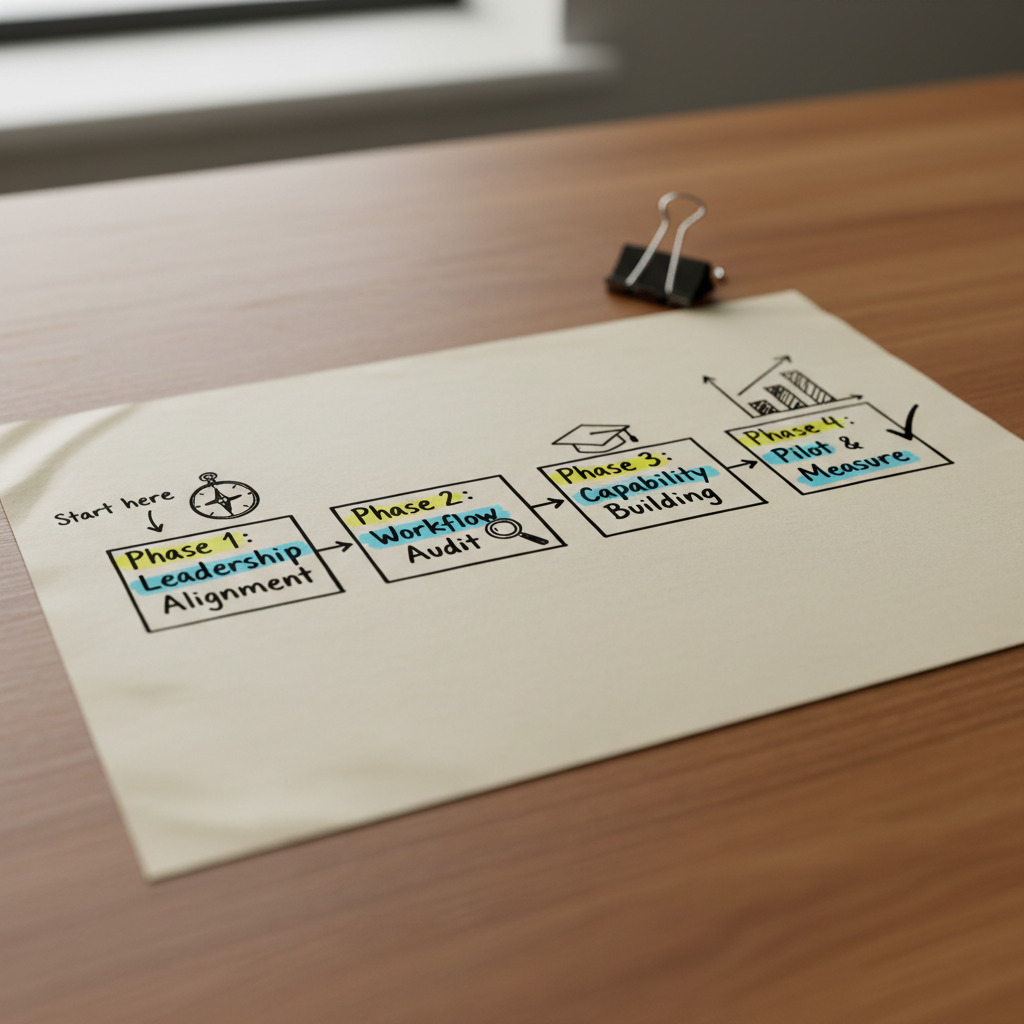
A phased consulting framework moves from alignment through to measurable pilots
- Current AI capability across the organisation
- Key risks, including data privacy, accuracy, and governance
- Strategic priorities and where AI fits
- Decision rights for adoption, tools and budget
An AI leadership briefing or executive alignment session helps ensure that the consulting work that follows has clear direction and sponsorship.
Phase 2: Workflow Audit and Use-Case Discovery
This phase maps actual workflows — not idealised processes — to identify where AI can reduce repetitive work, improve decision support, or strengthen service delivery.
Teams identify pain points, rank them by impact and feasibility, and prioritise the use cases worth piloting. This is where off-the-shelf tools like ChatGPT or Copilot may suffice for some workflows, while others may require custom AI solutions such as internal copilots, chatbots, or automation workflows.
Phase 3: Capability Building
Once priorities are clear, the organisation needs people who can execute. This means moving beyond generic AI awareness into role-based AI training where employees learn to apply AI within their specific function and workflow context.
At this stage, organisations also begin establishing usage guidelines, review processes, and safe experimentation norms.
Phase 4: Pilot and Measure
Selected use cases move into small, contained pilots with clear success criteria. The goal is not immediate organisation-wide rollout — it is learning what works, what does not, and what adjustments are needed before scaling.
Phase 5: Scale or Adjust
Based on pilot outcomes, organisations decide whether to scale the approach, adjust the use case, or revisit earlier phases. This is also when implementation support — such as building a production-ready chatbot or automation workflow — becomes relevant.
What Malaysian Enterprises Should Look for in AI Consulting
Not all AI consulting engagements offer the same depth. Here are practical indicators to evaluate:
- Industry and sector experience: Has the consulting team worked with organisations similar to yours? AIHQ has engagements spanning corporate, government, public sector, professional institutions, and regulated environments.
- Tool-agnostic discovery: Does the consultant start with your workflows or their preferred tools? The former indicates genuine consulting; the latter indicates a sales process.
- Capability-building component: Does the engagement include upskilling your team, or does it produce a report you cannot execute? Sustainable consulting should leave your organisation more capable, not more dependent.
- Governance awareness: Does the consultant raise governance, privacy, and responsible use without being prompted? This is especially important for regulated sectors.
- Clear scope boundaries: Does the engagement clearly state what is included — strategy, training, pilot support, implementation — and what requires separate scope?
Real Adoption, Not Just Recommendations
AI business consulting is most valuable when it helps organisations move from fragmented experimentation to structured, practical adoption. The best consulting engagements produce not only a roadmap but also a workforce that can execute it and a governance framework that keeps usage safe.
AIHQ has supported organisations including Media Prima, Lion Group, MDEC, and Selangor State Government through structured AI capability journeys — from leadership alignment to role-based training and practical implementation.
For leadership teams evaluating their next step, the question is not whether AI can help. The question is whether the organisation is ready to adopt it in a way that is structured, responsible, and aligned with real business priorities.
Frequently Asked Questions
What is AI for business consulting? AI business consulting helps organisations assess their workflows, data readiness, capability gaps, and strategic priorities — then build a structured adoption roadmap. It differs from training, which focuses on building individual skills, and from implementation, which builds the actual solutions.
How does AI business consulting differ from AI training? Consulting focuses on strategy, use-case prioritisation, governance frameworks, and adoption roadmaps. Training focuses on building employee capability. Many organisations need both, typically starting with consulting to provide direction and then layering training for execution.
When should a Malaysian enterprise hire an AI business consultant? When leadership is unsure where to start, when AI experiments remain fragmented across departments, when governance and data privacy concerns need structured attention, or when the organisation needs a roadmap before investing in tools or training.
Does AI business consulting include implementation? It depends on the engagement scope. Some consulting stops at recommendations and roadmaps. Others include pilot support, custom solution building, or automation implementation. Clarify scope boundaries before engaging.
Can AI business consulting help with HRDC-claimable AI training? AIHQ programmes can be structured to be HRDC claimable, subject to client eligibility, grant approval and HRD Corp submission requirements. Consulting engagements that include a training component may be structured accordingly.
FAQ
What is AI for business consulting?
AI business consulting helps organisations assess their workflows, data readiness, capability gaps, and strategic priorities — then build a structured adoption roadmap. It differs from training, which focuses on building individual skills, and from implementation, which builds the actual solutions.
How does AI business consulting differ from AI training?
Consulting focuses on strategy, use-case prioritisation, governance frameworks, and adoption roadmaps. Training focuses on building employee capability. Many organisations need both, typically starting with consulting to provide direction and then layering training for execution.
When should a Malaysian enterprise hire an AI business consultant?
When leadership is unsure where to start, when AI experiments remain fragmented across departments, when governance and data privacy concerns need structured attention, or when the organisation needs a roadmap before investing in tools or training.
Does AI business consulting include implementation?
It depends on the engagement scope. Some consulting stops at recommendations and roadmaps. Others include pilot support, custom solution building, or automation implementation. Clarify scope boundaries before engaging.
Can AI business consulting help with HRDC-claimable AI training?
AIHQ programmes can be structured to be HRDC claimable, subject to client eligibility, grant approval and HRD Corp submission requirements. Consulting engagements that include a training component may be structured accordingly.