General
AI Training and Consultancy in Malaysia: Moving Beyond ChatGPT Subscriptions for Real Business ROI
· By AIHQ Team

Many Malaysian organisations have taken a logical first step toward AI adoption: they purchased ChatGPT subscriptions, gave teams access, and hoped for productivity gains. Some ran a half-day workshop. A few appointed an AI "champion" from the marketing department.
Months later, the results are often underwhelming. Usage is fragmented. No one is sure what is safe to share with public AI tools. Departments experiment in isolation. And no one can point to measurable business outcomes.
This pattern is not uncommon — and it is not a failure of the tools. It reflects a gap between access and capability.
AI training and consultancy in Malaysia must move beyond tool subscriptions and generic workshops. Sustainable business value comes when organisations treat AI adoption as a capability-building and strategy-alignment exercise, not a software rollout.
Why ChatGPT Subscriptions Alone Fall Short
ChatGPT, Gemini, Microsoft Copilot and similar tools are powerful. But off-the-shelf tools cannot solve every workflow problem on their own. When organisations treat a subscription as the full adoption strategy, several things typically happen:
- Inconsistent usage — Some employees use it daily; others tried it once and stopped.
- Unclear governance — Staff paste confidential business data into public tools because no policy was set.
- No workflow integration — Teams use AI in isolation without adapting their processes.
- Unmeasurable outcomes — No baseline, no tracking, no way to connect AI usage to business results.
Prompting is useful, but sustainable adoption requires role-based capability, workflow thinking, governance and leadership alignment — which is where structured AI training and consultancy partnerships become essential.
What Structured AI Training and Consultancy Actually Means
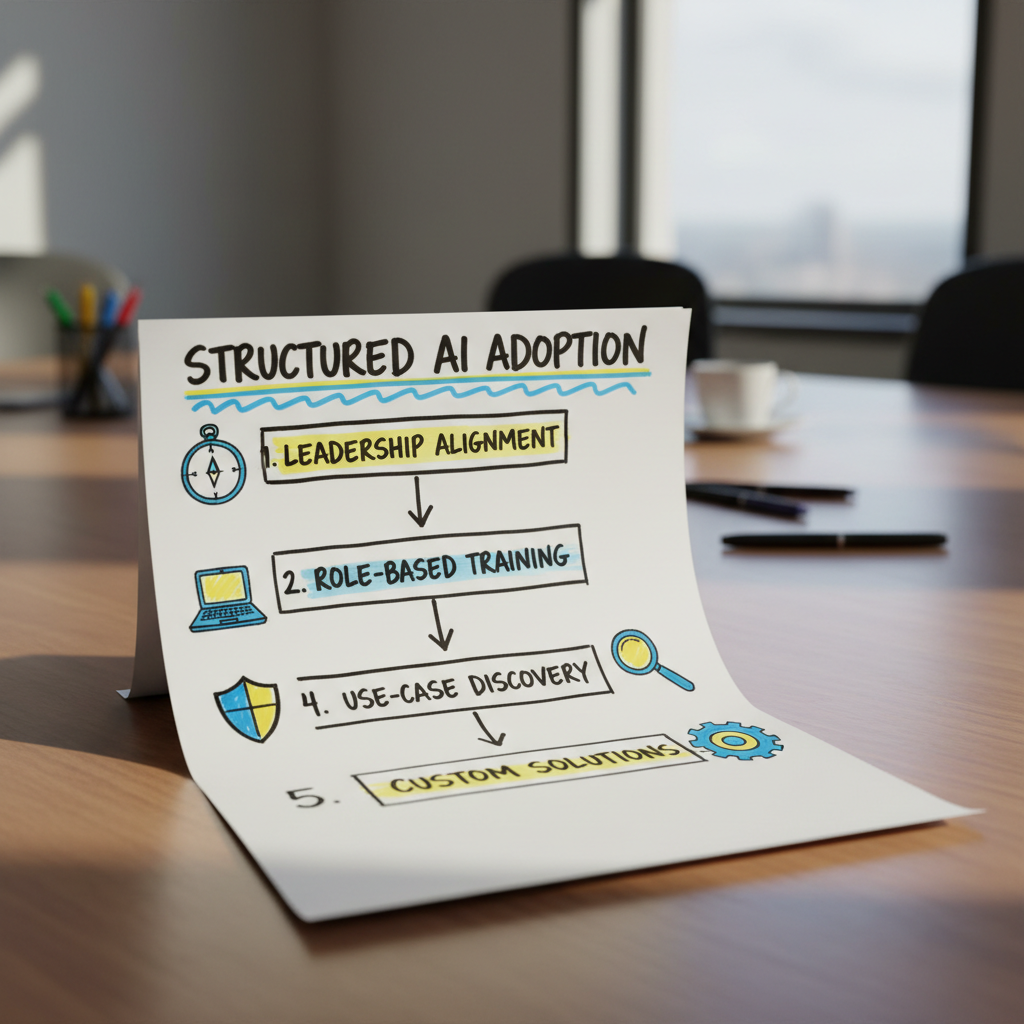
Real structured AI adoption moves through five capability stages.
For Malaysian businesses, the phrase "AI training and consultancy" often conjures a one-day workshop followed by a PDF of prompt templates. Real structured adoption looks different.
1. Leadership Alignment Before Rollout
Before any training programme begins, the leadership team needs to understand what AI means for their organisation — not at a technical level, but at a strategic one. An executive AI briefing or leadership alignment session helps decision-makers agree on priorities, risks, governance expectations and adoption principles before teams start building habits.
2. Role-Based Training, Not Generic Workshops
A finance team needs different AI skills than a customer service team or an HR department. Generic "AI 101" workshops rarely translate into daily workflow changes. Role-based AI training designs exercises and use cases around the actual work people do — reporting, documentation, client communication, data analysis, policy interpretation and so on.
3. Governance and Responsible Use Built Early
Organisations scaling AI usage should set clear guardrails — especially around confidential or sensitive information. A responsible AI and governance workshop helps teams understand what safe adoption looks like, how to review AI output, and what policies support practical behaviour rather than restrict it.
4. Use-Case Discovery and Prioritisation
Not every workflow needs an AI solution. An AI innovation bootcamp helps teams identify where AI creates real value, prioritise use cases worth piloting, and separate hype from practical opportunity — before investing in development or rollout.
5. Custom Solutions When Off-the-Shelf Tools Are Not Enough
Some workflows — especially those involving internal knowledge, SOP queries, customer enquiry handling or process automation — benefit from custom AI solutions such as an internal copilot, AI chatbot or workflow automation. AIHQ helps organisations explore whether a custom approach is appropriate when off-the-shelf tools fall short.
The Business Case for Consultancy-Led AI Adoption
Many Malaysian businesses ask, "Why should we invest in AI consultancy when we already have ChatGPT?" The answer lies in moving from fragmented experimentation to structured, measurable outcomes.
AIHQ has trained and engaged over 9,000 professionals across corporate organisations, government agencies, public sector bodies, professional institutions and regulated environments. The pattern is consistent: organisations that pair training with consultancy support achieve stronger, more sustainable adoption than those relying on tool access alone.
Consider the difference:
| Approach | Typical Outcome |
|---|---|
| ChatGPT subscription + no training | Fragmented usage, no governance, unmeasurable |
| Generic half-day workshop | Low follow-through, inconsistent habits |
| Structured role-based training + consultancy | Aligned leadership, capable teams, clear use cases, governance in place |
This is not about choosing between training and consultancy. It is about recognising that capability building and strategy support work together.
What to Look for in an AI Training and Consultancy Partner
If your organisation is evaluating AI training and consultancy in Malaysia, here are practical factors to consider:
- Does the partner offer role-based programmes or only generic workshops? Role-specific content drives real workflow change.
- Do they address governance and responsible use? A partner that only teaches prompts misses the bigger picture.
- Can they support leadership alignment? Adoption succeeds when leadership is aligned before teams begin.
- Do they distinguish between off-the-shelf tools and custom solutions? Some problems need tool training; others need implementation support.
- Do they have experience across sectors? Public sector, financial services and media organisations each have distinct adoption needs.
AIHQ works across corporate, public sector, professional and regulated environments — from leadership briefings for organisations including Lion Group, MTD Group and Parkland Group to structured 12-month capability journeys for teams such as Media Prima.
Programme outcomes from the Media Prima engagement included 98% satisfied participants, 90% reporting increased practical knowledge and skills, and 92% finding the training relevant and applicable to their work.
A Practical Path Forward for Malaysian Businesses
Moving beyond ChatGPT subscriptions does not mean abandoning them. It means building a structured approach around them.
A practical path typically includes:
- Leadership alignment — An executive briefing to set direction, governance and expectations.
- Capability assessment — Understanding current AI maturity across teams.
- Role-based training — Department-specific sessions tied to real workflows.
- Governance setup — Policies, guardrails and responsible use guidance.
- Use-case prioritisation — Identifying which workflows benefit most from AI or automation.
- Implementation support — Building or deploying solutions where needed.
AIHQ can help organisations design this path. Programmes can be structured to be HRDC claimable, subject to client eligibility, grant approval and HRD Corp submission requirements.
Frequently Asked Questions
What is the difference between AI training and AI consultancy?
AI training focuses on building workforce capability — teaching people how to use AI tools, apply them to workflows and adopt responsible practices. AI consultancy provides strategic guidance — leadership alignment, use-case discovery, adoption roadmaps, governance frameworks and implementation support. Most organisations benefit from both.
Does my organisation need consultancy if we already have ChatGPT?
Many organisations find that ChatGPT subscriptions alone do not create consistent, measurable adoption. Consultancy helps align leadership, identify the right use cases, set governance and build a roadmap — creating the conditions for tools to actually deliver value.
How do I choose the right AI training provider in Malaysia?
Look for a provider that offers role-based, not generic, programmes; addresses governance and responsible use; can support leadership alignment; and has experience across your sector or industry.
Can AI training be HRDC claimable?
AIHQ is a registered HRD Corp training provider. Programmes can be structured to be HRDC claimable, subject to client eligibility, grant approval and HRD Corp submission requirements.
What if off-the-shelf tools do not meet our workflow needs?
Some workflows — such as internal SOP retrieval, customer enquiry handling or process automation — require custom AI solutions. AIHQ helps organisations explore whether a custom chatbot, internal copilot or automation workflow is appropriate.
How long does it take to see measurable outcomes from AI adoption?
Timelines vary by organisation. Organisations that begin with leadership alignment, structured training and clear use-case prioritisation typically see stronger adoption within 3–6 months than those relying on tool access alone. Outcomes depend on implementation, adoption, data, workflows and measurement.
Moving Forward with Structured AI Adoption
AI adoption in Malaysia is entering a new phase. The organisations that lead will not be those with the most subscriptions — they will be those that invest in structured capability, strategic alignment and practical implementation.
If your organisation is ready to move beyond ChatGPT subscriptions and explore what structured AI training and consultancy looks like, AIHQ can help.
FAQ
What is the difference between AI training and AI consultancy?
AI training focuses on building workforce capability — teaching people how to use AI tools, apply them to workflows and adopt responsible practices. AI consultancy provides strategic guidance — leadership alignment, use-case discovery, adoption roadmaps, governance frameworks and implementation support. Most organisations benefit from both.
Does my organisation need consultancy if we already have ChatGPT?
Many organisations find that ChatGPT subscriptions alone do not create consistent, measurable adoption. Consultancy helps align leadership, identify the right use cases, set governance and build a roadmap — creating the conditions for tools to actually deliver value.
How do I choose the right AI training provider in Malaysia?
Look for a provider that offers role-based, not generic, programmes; addresses governance and responsible use; can support leadership alignment; and has experience across your sector or industry.
Can AI training be HRDC claimable?
AIHQ is a registered HRD Corp training provider. Programmes can be structured to be HRDC claimable, subject to client eligibility, grant approval and HRD Corp submission requirements.
What if off-the-shelf tools do not meet our workflow needs?
Some workflows — such as internal SOP retrieval, customer enquiry handling or process automation — require custom AI solutions. AIHQ helps organisations explore whether a custom chatbot, internal copilot or automation workflow is appropriate.
How long does it take to see measurable outcomes from AI adoption?
Timelines vary by organisation. Organisations that begin with leadership alignment, structured training and clear use-case prioritisation typically see stronger adoption within 3–6 months than those relying on tool access alone. Outcomes depend on implementation, adoption, data, workflows and measurement.