General
AI Training and Consultancy in Malaysia: Bridging Strategy with Practical Adoption
· By AIHQ Team

What "AI Training and Consultancy" Actually Means for Malaysian Enterprises
Many organisations in Malaysia are searching for AI training and consultancy — but what they find often falls into two extremes.
On one side, there are generic AI workshops that teach prompt engineering but don't change how teams actually work. On the other, there are expensive consultancies that deliver strategic slide decks but leave nobody capable of executing.
The middle ground is where real AI adoption happens. That middle ground combines strategic alignment with hands-on capability building — and it's where AIHQ operates.
Why Malaysian Enterprises Need More Than Training Alone
AI training without strategy leads to scattered experimentation. Employees attend sessions, learn a few prompts, and return to their desks without any change in workflow. Within weeks, the training is forgotten.
Conversely, strategy without training creates beautiful roadmaps that nobody knows how to implement. Leadership approves an AI initiative, but teams lack the practical skills to execute.
AI training and consultancy in Malaysia needs to address both layers simultaneously:
- Leadership layer: Alignment on what AI means for your organisation, where value exists, and what governance is needed.
- Capability layer: Role-based training that helps each team apply AI to actual daily work.
- Implementation layer: Custom solutions where off-the-shelf tools cannot solve the workflow.
This three-layer approach is what separates real adoption from one-off experiments.
The AIHQ Approach: Structured AI Adoption
AIHQ has trained and engaged over 9,000 professionals across corporate organisations, government agencies, professional bodies and regulated sectors. This cross-sector experience has shown us one consistent pattern: organisations succeed when they treat AI adoption as a capability-building journey, not a training event or a consulting deliverable.
Phase 1: Leadership Alignment
Before any large-scale rollout, leadership teams need clarity. AIHQ supports this through leadership AI briefings and strategy sessions that cover:
- What AI and GenAI mean for your specific industry and roles
- Governance, risk and privacy considerations
- How to separate genuine value from hype
- A practical adoption roadmap aligned with business priorities
This phase ensures that when training begins, it connects to a clear strategic direction — not a vague instruction to "use AI more."
Phase 2: Role-Based AI Training
Generic AI workshops teach the same content to every employee regardless of role. That is why they rarely stick. AIHQ designs role-based AI training that helps each team apply AI to their actual workflows:
- HR teams learn how AI supports recruitment, policy Q&A and employee communications
- Finance teams explore AI for reporting, reconciliation support and data analysis
- Customer service teams practise using AI for response drafting and escalation workflows
- Operations teams identify automation opportunities within their processes
Training is practical, hands-on and structured around the tasks employees already do.
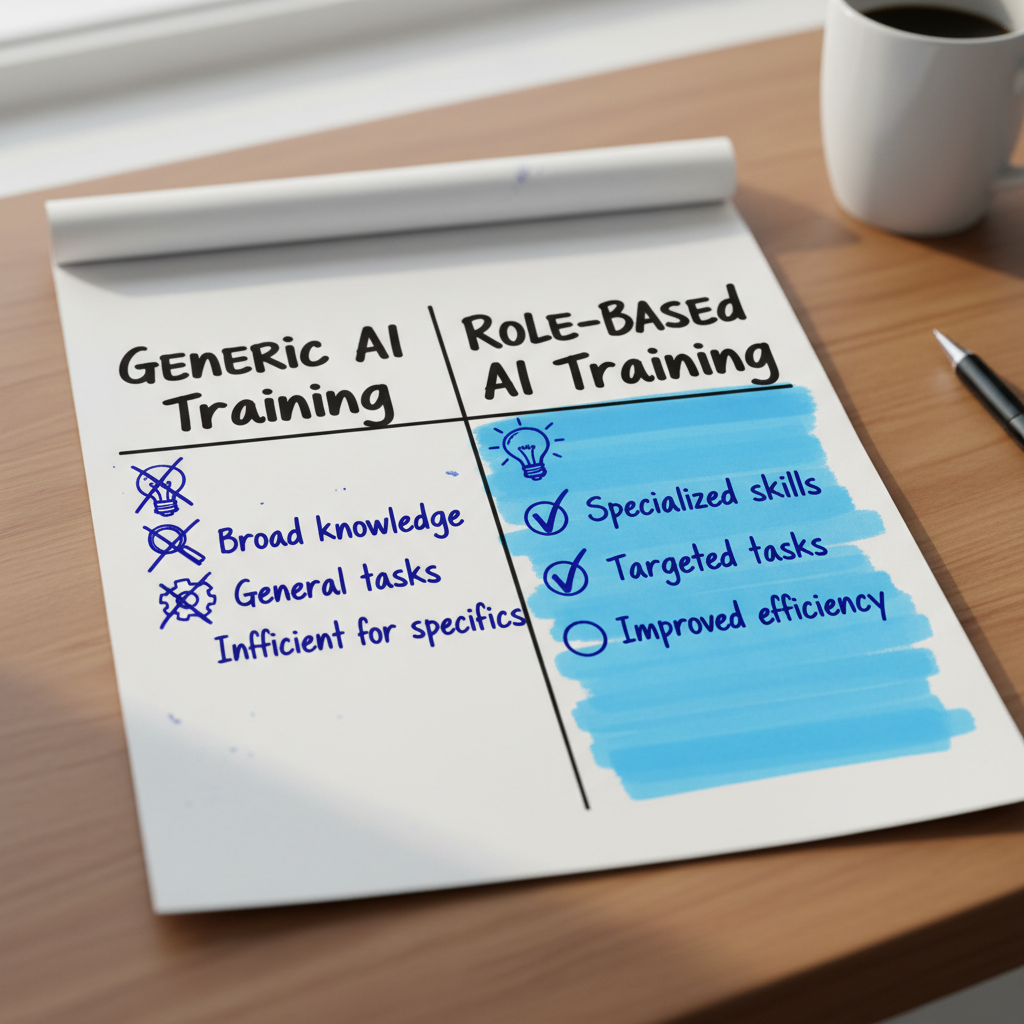
Role-based training creates stronger adoption than generic one-size-fits-all workshops.
Phase 3: Custom Solutions Where Needed
Some workflows cannot be addressed by ChatGPT, Gemini or Copilot alone. When an organisation needs a custom AI chatbot, an internal copilot for SOP access, or workflow automation for repetitive processes, AIHQ can help design and implement solutions that fit the existing environment.
What Makes an Effective AI Consultancy Partner in Malaysia?
When evaluating AI training and consultancy providers, Malaysian enterprises should look for:
| Factor | Why It Matters |
|---|---|
| Cross-sector experience | Different industries have different compliance, workflow and adoption needs |
| Both training and advisory capability | Strategy without skills is incomplete; skills without strategy is unfocused |
| Role-based approach | One-size-fits-all training produces low adoption |
| Responsible AI grounding | Governance should be built in, not added after problems appear |
| Implementation support | Some workflows need custom solutions beyond off-the-shelf tools |
AIHQ has experience across sectors including media, retail, property, professional services, insurance and the public sector. This breadth means we understand how AI adoption differs between regulated and non-regulated environments, between knowledge-work teams and operational teams.
Responsible AI: Built Into the Process, Not Tacked On
A responsible approach to AI is not an optional module — it is a core part of structured adoption. AIHQ integrates responsible use and governance into every stage:
- Leadership sessions cover data privacy, vendor assessment and decision rights
- Role-based training includes safe usage guidelines relevant to each team's work
- Custom solutions are built with appropriate guardrails, human-in-the-loop workflows and escalation paths
Organisations scaling AI usage can also engage AIHQ for dedicated responsible AI and governance workshops tailored to their risk profile and regulatory context.
From Awareness to Measurable Outcomes
AIHQ's structured adoption journey moves organisations through five stages:
- Interest — Building awareness and curiosity across the workforce
- Capability — Developing practical skills through role-based training
- Usage — Embedding AI into daily workflows with observable adoption
- Outcomes — Tracking efficiency, quality and workflow improvement
- Implementation — Building custom solutions where gaps remain
This staged approach prevents the common failure pattern of skipping from awareness directly to implementation without building the middle capability layer.
Real-World Application: Structured Capability Journeys
AIHQ has supported organisations through structured, multi-phase AI adoption programmes. For example, one major Malaysian media group engaged AIHQ over a 12-month period progressing through awareness, fundamentals, intermediate skill-building and advanced application workshops. Programme outcomes included 98% satisfied participants and 92% finding training relevant and applicable to their work.
This kind of progressive capability building — where each phase builds on the previous one — is what distinguishes structured AI adoption from one-off training sessions.
Is Your Organisation Ready for Structured AI Adoption?
If your organisation currently relies on scattered AI experimentation or generic workshops, you are not alone — but you may be leaving value on the table. The gap between AI awareness and real workflow impact is bridged through structured capability building, not through more tool access.
AI training and consultancy in Malaysia should help you close that gap. AIHQ can support your organisation through leadership alignment, role-based training and — where needed — custom solutions that fit your actual workflows.
To explore a structured AI adoption approach for your organisation, reach out to AIHQ for a discussion aligned with your current stage, team readiness and business priorities.
FAQ
What is the difference between AI training and AI consultancy?
AI training focuses on building workforce capability — teaching teams how to use AI tools responsibly and effectively. AI consultancy focuses on strategy, use-case identification, governance and adoption roadmaps. AIHQ combines both, ensuring that strategic direction is supported by practical skills across the organisation.
Does AIHQ offer HRDC claimable AI training?
AIHQ is a registered HRD Corp training provider. Programmes can be structured to be HRDC claimable, subject to client eligibility, grant approval and HRD Corp submission requirements. Contact AIHQ to discuss eligibility for your organisation.
How is role-based AI training different from generic AI workshops?
Generic workshops teach the same content to all participants regardless of role. Role-based AI training is designed for specific departments — HR, finance, operations, customer service — so teams learn to apply AI to their actual daily workflows, not theoretical examples.
When should an organisation consider a custom AI solution instead of off-the-shelf tools?
Off-the-shelf tools like ChatGPT and Copilot work well for general tasks. However, when you need an AI chatbot integrated with your internal knowledge base, an internal copilot for company SOPs, or workflow automation tied to specific processes, a custom solution is often more appropriate.
What sectors has AIHQ worked with in Malaysia?
AIHQ has worked across corporate organisations, government agencies, public sector bodies, professional institutions and regulated sectors. Selected engagements include Media Prima Group, Silverlake Group, Prudential BSN Takaful, ACCA, Selangor State Government, MDEC and others.
How long does a structured AI adoption journey typically take?
The timeline depends on your organisation's size, readiness and goals. Some organisations start with a leadership briefing followed by phased training over several months. Others begin with a focused innovation bootcamp to prioritise use cases. AIHQ can help design a timeline that fits your context.