General
AIHQ: Malaysia's Go-To ChatGPT Training and Consultancy Partner for Enterprises
· By AIHQ Team
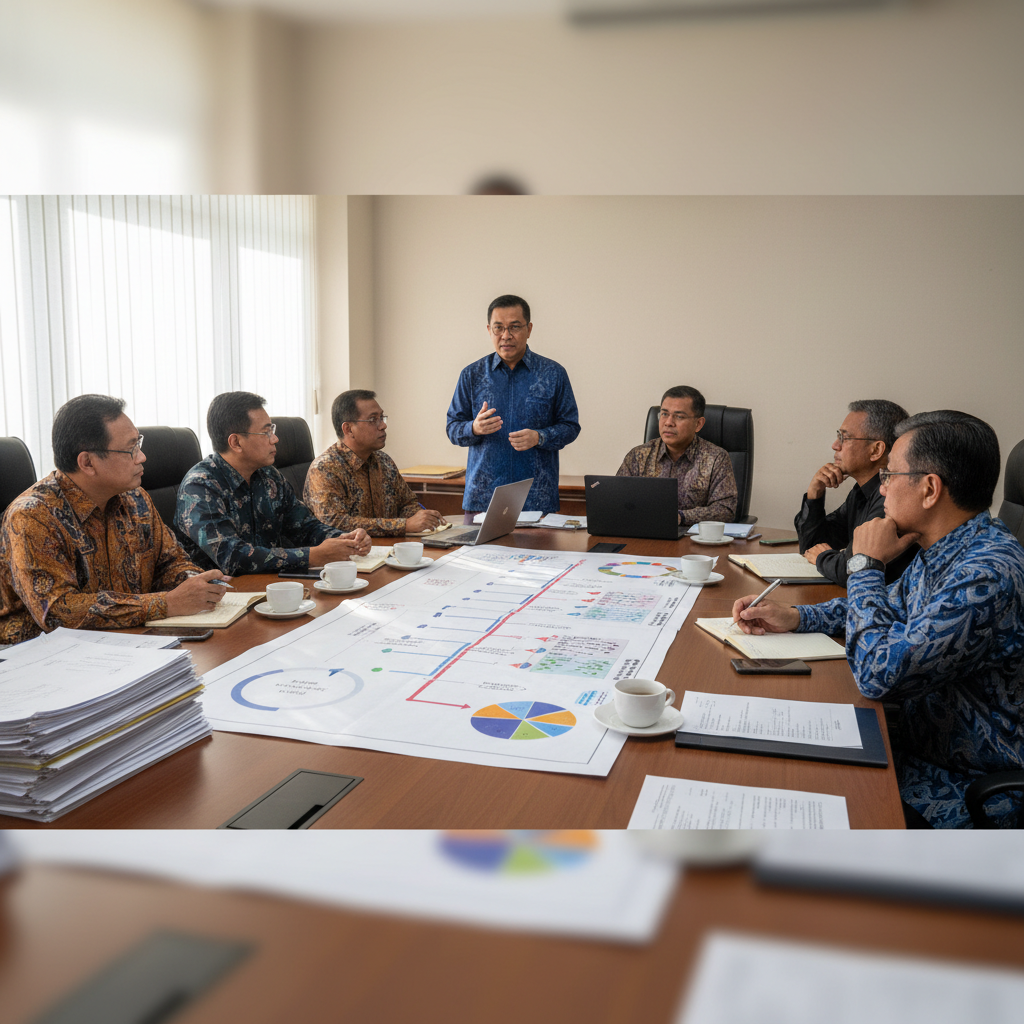
Most partner reviews for AI capability building are written for private-sector buyers. This one is written for agency and GLC decision makers who have to defend the choice in an audit trail.
And it is a difference you can test: AIHQ does not position itself as a ChatGPT vendor or a workshop provider. It positions itself as a sequenced capability partner, where the same organisation that trains your officers also runs the leadership alignment, the governance guardrails and — where an off-the-shelf tool is not enough — the custom implementation. For public-sector and GLC work, that single-vendor sequencing is the thing that usually breaks when agencies engage a training provider and a technology vendor separately.
AIHQ has trained and engaged over 9,000 professionals in AI and Generative AI programmes and is a registered HRD Corp training provider, with programmes that can be structured to be HRDC claimable, subject to client eligibility, grant approval and HRD Corp submission requirements.
What "go-to partner" should actually mean in an agency or GLC context
For a private company, a training partner is judged on whether staff use AI on Monday morning. For an agency or GLC, three additional tests apply.
- Audit defensibility. Who delivered what, to which officers, and against which stated objectives? Can the training provider produce participant records, assessment evidence and attendance documentation suitable for internal audit and grant submission?
- Policy alignment. Does the programme respect your existing data classification rules, your PDPA obligations and any internal circular on information handling before officers start pasting content into a chat interface?
- Continuity across leadership change. Programmes that live inside one enthusiastic division collapse when that champion is transferred. Structured rollouts with named owners survive.
Generic ChatGPT workshops rarely clear all three. That is the gap AIHQ is built for: a single delivery partner across leadership briefings, role-based training, governance and — where required — custom AI solutions.
A 12-week rollout timeline, with weeks and owners
Below is a practical sequencing model. Timelines adjust to workforce size, procurement rules and grant approval timelines, but the order matters more than the speed.
| Weeks | Stage | Named owner | Deliverable |
|---|---|---|---|
| 1–2 | Leadership alignment | Head of Department / GLC CEO office, with HR and IT | Executive AI briefing; agreed scope, success measures and non-negotiables |
| 3–4 | Baseline and workflow audit | Transformation or Corporate Planning lead | List of candidate workflows per division, with volume and cycle-time notes |
| 5–6 | Governance guardrails | Risk, Legal, Compliance and Records | Data-handling rules, approved-tool list, human review checkpoints |
| 7–10 | Role-based training waves | HR / L&D as programme owner; each HOD as cohort sponsor | Cohorts trained by function, not by seniority |
| 11 | Workflow application sprint | Division heads | Officers apply AI to one real, recurring task per role |
| 12 | Review and next-stage decision | Steering committee | Adoption evidence, gaps, go/no-go on pilot implementation |
Two details matter more than they look.
First, governance sits before training waves, not after. In public-sector settings, officers who have already adopted an unapproved habit are harder to re-train than officers who start with clear rules. AIHQ can support responsible AI and governance sessions for exactly this stage.
Second, training is organised by function, not by job grade. A finance officer's high-value use cases (reconciliation commentary, variance narratives, procurement drafting) look nothing like an HR officer's (policy Q&A, onboarding materials, employee communications triage) or a service counter officer's (enquiry response drafting, case note summaries).
What this costs in ringgit: realistic ranges to budget against

Budgeting scaffolding, not a quotation — ranges vary with cohort size, customisation and venue.
Public procurement needs a defensible number, not a "contact us". The ranges below are indicative planning figures for Malaysian organisations in 2026 and will vary with cohort size, customisation depth, venue and travel. Treat them as a budgeting scaffold and confirm against a formal quotation.
| Programme element | Typical format | Indicative range per engagement (MYR) |
|---|---|---|
| Executive / board AI briefing | Half-day, senior leadership | RM 8,000 – RM 20,000 |
| AI fundamentals cohort | 2 days, up to ~25 officers | RM 18,000 – RM 45,000 |
| Role-based training wave | 1–2 days per function | RM 12,000 – RM 35,000 per function |
| Responsible AI and governance workshop | Half-day to 1 day | RM 10,000 – RM 25,000 |
| AI innovation bootcamp / use-case discovery | 2 days, cross-functional team | RM 25,000 – RM 60,000 |
| Custom internal copilot or enquiry chatbot | Scoped build | From ~RM 40,000, scoped per workflow |
If your organisation is an HRD Corp-registered employer, a significant portion of the training elements above may be claimable, subject to client eligibility, grant approval and HRD Corp submission requirements. HRD Corp levy and claim rules change, so this should be verified with your own HRD Corp account and finance team rather than taken from a partner's marketing page.
Cases: what this looks like with real cohorts
AIHQ's documented work gives a sense of the range.
- Media Prima Group. A structured capability journey delivered over a 12-month period, moving through awareness, fundamentals, intermediate LLM skill-building and advanced application workshops — rather than a single event.
- Selangor State Government and local authorities, SME Corp Malaysia, MDEC. Public-sector and agency-adjacent audiences, where governance, language and workflow realism matter as much as tool features.
- Professional and regulated bodies including ACCA, the Institute of Internal Auditors Malaysia and Prudential BSN Takaful, plus corporate groups such as Lion Group, MTD Group and MUI Group, where leadership briefings and strategy sessions were delivered with senior leaders present.
In the Media Prima programme, reported outcomes included 98% satisfied participants, 90% reporting increased practical knowledge and skills, and 92% finding the training relevant and applicable to work. These figures relate to that specific programme and should not be read as a general promise for all engagements.
Delivery is led by practitioners who have to answer to business audiences, not just technical ones: Pang Sern Yong (founder and principal trainer, leadership AI sense-making and business-first adoption), Firdaus Khairi (lead technical trainer, applied AI, big data and implementation), Jean Ng (AI safety and tech ethics, governance and risk), Hazwan bin Azma (applied AI and data analysis) and Arif (operational use cases and productivity workflows).
Where "just use ChatGPT" stops working
Off-the-shelf tools are genuinely useful, and most agencies should start there. But there are predictable points where the standard product is not enough, and it is worth recognising them before you sign a training contract.
- Confidential or classified document handling. Whether a tool is safe for a given data type depends on your settings, your policy, your data classification and how officers actually behave — not on the tool alone. Guardrails have to be set deliberately.
- Knowledge retrieval across your own SOPs, circulars and policy manuals. A generic LLM does not know your process. Internal copilots — for SOP access, HR policy Q&A, or service team support — are a different class of work.
- Repetitive case workflows. Approved follow-up sequences, escalation routing and notification flows are automation problems, not prompting problems.
- Public enquiry handling at volume. A customer enquiry chatbot with clear escalation to a human officer is a very different thing from an unmanaged general-purpose assistant.
This is where an integrated partner matters. If you engage a workshop provider for the training and a separate vendor for the system, the governance layer is where the handover usually fails. AIHQ is designed so the same organisation that trained your officers can scope the custom AI workflow if it is warranted — and tell you clearly when it is not.
What the numbers mean for a Malaysian agency or GLC
Three conclusions follow from the figures above.
- Budget by phase, not by course. A single RM 30,000 workshop will not create capability across a 500-officer agency. A phased programme across a financial year will — and each phase produces documentation your audit function can use.
- Sequence governance before scale. The cost of a governance workshop is trivial next to the cost of re-training officers out of unsafe habits, or of an incident involving protected data.
- Choose a partner who can say no. The most useful answer a capability partner can give a public-sector client is that a workflow does not yet justify a custom build. That is a sign the engagement is structured around your outcomes rather than a product catalogue.
For leadership teams framing the decision, AIHQ can support an executive AI briefing to align strategy, risk, governance and next steps before funding is committed. And when your teams are ready to move to department-level application, AIHQ's role-based AI training programmes are built around your officers' actual recurring tasks rather than generic prompt libraries.