General
AIHQ Enterprise AI Training: How We Help Malaysian Organisations Align AI with Business Goals
· By AIHQ Team

Most organisations do not lack AI awareness anymore. They lack a structured path from awareness to real workplace use. That is the gap AIHQ's enterprise AI training is designed to close.
Generic workshops can leave employees inspired but unsure how to apply AI to their actual work. Enterprise AI training, done well, is different. It starts with the organisation's strategic objectives, maps skills to roles, and builds a curriculum around real workflows — not around tool features.
This article walks through how AIHQ designs and delivers enterprise AI training programmes for Malaysian organisations, from the first assessment to measured outcomes.
Why enterprise AI training fails when it is generic
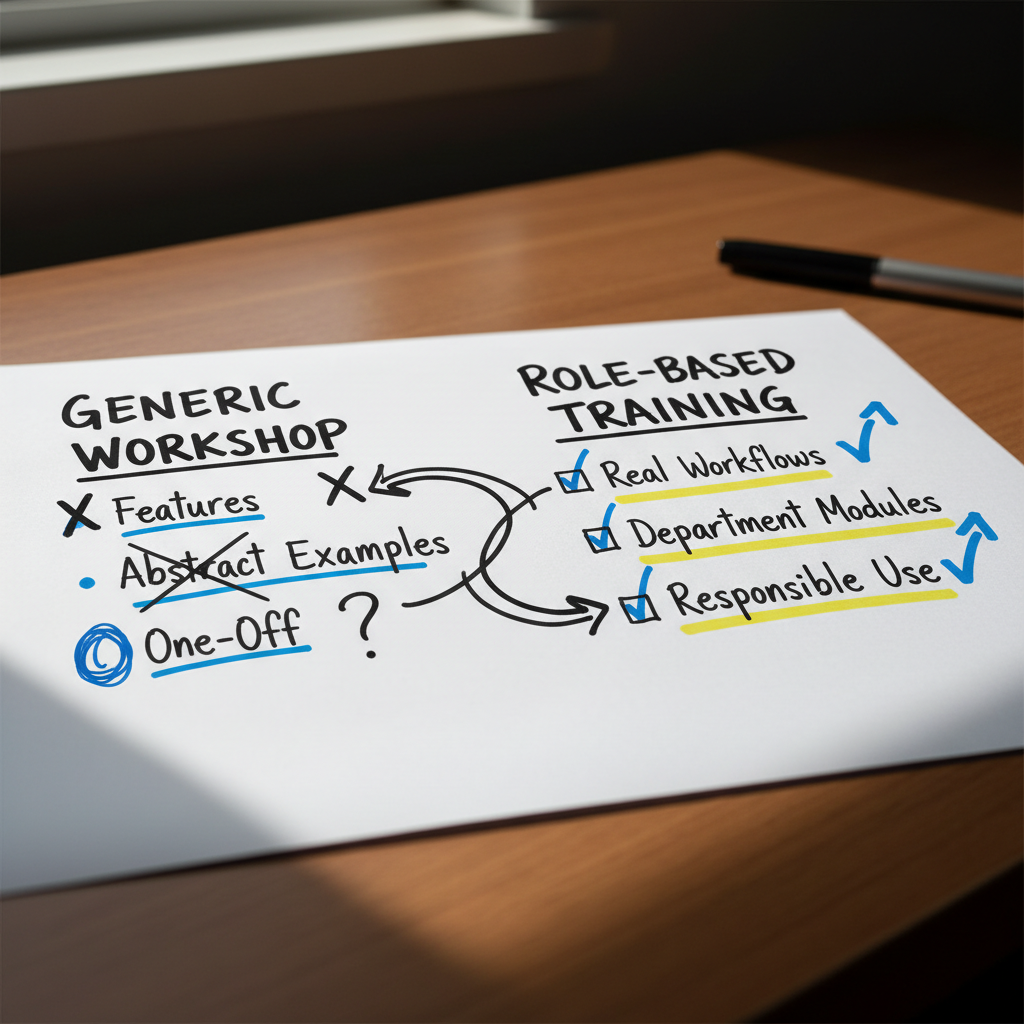
Role-based training builds sustainable adoption where generic workshops fall short.
Talk to any HR or L&D leader in Malaysia and they will describe the same pattern. A vendor runs a one-day ChatGPT workshop, employees feel energised, and then nothing changes. A few people use the tool for email drafts. Most quietly stop.
The problem is not the tools. It is the approach. Generic training teaches features. It does not teach workflow thinking, role-based application or responsible use. When an employee returns to their desk, they do not know how a prompt applies to their monthly report, their vendor follow-ups or their compliance checks.
AIHQ takes a different view. Practical adoption happens when training is connected to the work people actually do. That is why our enterprise programmes begin with the organisation's goals, not with a tool demonstration.
Step 1: Needs assessment and business-goal alignment
Every enterprise training programme at AIHQ starts with a structured needs assessment. We want to understand three things before designing anything:
- What the organisation is trying to achieve strategically — cost discipline, faster service, stronger decision-making, or something else
- Which roles and departments are most ready to apply AI to their workflows
- What constraints exist — data sensitivity, governance maturity, technical readiness, regulatory context
This step is about alignment, not assessment for its own sake. A finance team and a customer service team need different training. A listed company and a government agency face different governance expectations. The programme must reflect that.
Through this assessment, AIHQ maps where AI capability is already present, where it is missing, and where building it would move the organisation toward its stated goals.
Step 2: Skills-gap mapping across roles
Once we understand the business context, we map the skills gap. This goes beyond saying "everyone needs AI literacy."
Different roles use AI differently. A finance analyst needs support interpreting data and drafting variance narratives. An HR business partner needs help with policy drafting, interview note summarisation and workforce reporting. A customer service lead needs guidance on drafting consistent responses and escalating complex cases.
AIHQ's role-based approach identifies these differences and builds capability around them. We have delivered AI training across corporate organisations, government agencies, professional institutions, regulated sectors and leadership audiences — and the pattern is consistent: adoption improves when people learn to apply AI to their own workflows rather than to abstract examples.
A strong example comes from our work with Media Prima, where we supported a structured 12-month AI capability journey. It moved from awareness and fundamentals through intermediate LLM skill-building into advanced application workshops. The design was deliberately progressive — each stage built on the last, giving teams time to practise and apply learning to real work.
That programme returned strong participant feedback, including high satisfaction and relevance scores. More importantly, it demonstrated that structured, staged training sustains engagement far better than a single workshop.
Step 3: Custom curriculum and workshop design
With the skills map in hand, AIHQ designs a custom curriculum. This is where enterprise AI training diverges sharply from off-the-shelf workshops.
The curriculum is built around the organisation's roles, workflows and governance context. It includes:
- Structured fundamentals for broad workforce readiness — how GenAI works, what it is good at, where it has limits
- Role-based modules for specific departments — finance, HR, marketing, operations, customer service and others
- Practical exercises using the organisation's actual types of documents, reports and processes
- Responsible-use guidance embedded throughout, not tacked on as an afterthought
- Leadership alignment sessions where needed, so decision-makers understand risks, value and adoption priorities
Someone might ask: why not just train staff on ChatGPT prompts? Prompting is useful, but it is only one piece. Sustainable adoption requires role-based capability, workflow thinking, governance and leadership alignment. A curriculum that ignores these treats a symptom of a deeper issue — the absence of a structured adoption pathway.
Step 4: Hands-on delivery with real workflows
AIHQ's trainers bring practical, implementation-aware delivery. Our workshops are run by professionals who understand both the technology and the business context — teams including lead technical trainers, applied AI and data analysis specialists, and responsible-AI and governance experts.
This matters because a training session is only as good as its practical applicability. Participants should leave able to:
- Use AI to speed up documentation and reporting while keeping human judgment in control
- Summarise research, long documents and meeting notes confidently
- Draft structured business communications with clear review checkpoints
- Apply safe-use boundaries to confidential and sensitive information
We deliberately design sessions as hands-on, with laptops, real exercises and group discussion. The emphasis is on building repeatable habits, not memorising prompts.
Step 5: Measuring outcomes and tracking adoption
Enterprise AI training is not finished when the workshop ends. AIHQ helps organisations think about how they will measure adoption and outcomes.
It is important to be honest about this part. Training outcomes vary by organisation, role, adoption and measurement. We do not promise guaranteed productivity gains. But we help organisations design the conditions in which measurable outcomes become possible.
That means agreeing on practical success signals before training begins — for example, the share of staff using AI tools consistently after 60 days, the reduction in time on routine reporting, or the number of AI-supported workflows built by department champions. These signals are tracked over time, and where follow-through drops, the programme design can be adjusted.
AIHQ's approach is designed to support measurable outcomes, but real impact depends on implementation, adoption, data and follow-through across the organisation.
Where training ends and implementation begins
Some workflows need more than training. When an organisation has a process that off-the-shelf tools simply cannot handle well — a high-volume customer enquiry flow, an internal SOP retrieval problem, or a reporting process that needs automation — that is where AIHQ's custom solutions come in.
We are clear about the boundary. Off-the-shelf tools are useful, and most organisations will get strong value from them. But some workflows require a custom AI chatbot, an internal copilot or workflow automation. That is a separate conversation, and it should follow capability building, not replace it.
The workforce and the solutions should be built together, so the organisation's people understand how to work alongside the AI it implements.
Why structured enterprise AI training matters for Malaysian organisations
Malaysia's organisations are at very different points in their AI journeys. Some are piloting internally. Others are still trying to understand where AI creates value. Few have a structured path that moves from awareness to capability to practical use.
That structure is exactly what AIHQ brings. We have trained and engaged over 9,000 professionals across AI and Generative AI programmes, working across corporate, public sector, professional and regulated environments. We are also a registered HRD Corp training provider, so programmes can be structured to be HRDC claimable — subject to client eligibility, grant approval and HRD Corp submission requirements.
Enterprise AI training is not about a single workshop. It is about building structured capability that connects people to their work, their roles and the organisation's goals. When that connection is made, adoption is far more likely to stick.
If your organisation is ready to move beyond generic AI workshops, the next step is a conversation about what a structured, role-based programme could look like for your teams.
FAQ
What makes AIHQ's enterprise AI training different from generic AI workshops?
Generic workshops teach tool features in isolation. AIHQ designs training around your organisation's strategic goals, specific roles and real workflows — pairing practical exercises with responsible-use guidance and structured adoption thinking.
How long does an enterprise AI training programme take?
It depends on scope. Some programmes run as a single structured engagement, while others, like our work supporting Media Prima, unfold across a 12-month staged journey from awareness to advanced application. We design the cadence to match your adoption goals.
Can AIHQ's training be structured to be HRDC claimable?
As a registered HRD Corp training provider, AIHQ can structure programmes to be HRDC claimable. Eligibility, grant approval and HRD Corp submission requirements always apply, so we advise organisations to confirm their status early.
Do we need technical staff to benefit from enterprise AI training?
No. AIHQ designs role-based training for professionals across finance, HR, marketing, customer service, operations and other non-technical teams. Technical and developer training is available separately for IT and engineering audiences.
Does AIHQ measure training outcomes?
We help organisations define practical success signals and track adoption over time. Outcomes vary by role, adoption and measurement, so we focus on building the right conditions for measurable impact rather than promising guaranteed results.
FAQ
What makes AIHQ's enterprise AI training different from generic AI workshops?
Generic workshops teach tool features in isolation. AIHQ designs training around your organisation's strategic goals, specific roles and real workflows — pairing practical exercises with responsible-use guidance and structured adoption thinking.
How long does an enterprise AI training programme take?
It depends on scope. Some programmes run as a single structured engagement, while others, like our work supporting Media Prima, unfold across a 12-month staged journey from awareness to advanced application. We design the cadence to match your adoption goals.
Can AIHQ's training be structured to be HRDC claimable?
As a registered HRD Corp training provider, AIHQ can structure programmes to be HRDC claimable. Eligibility, grant approval and HRD Corp submission requirements always apply, so we advise organisations to confirm their status early.
Do we need technical staff to benefit from enterprise AI training?
No. AIHQ designs role-based training for professionals across finance, HR, marketing, customer service, operations and other non-technical teams. Technical and developer training is available separately for IT and engineering audiences.
Does AIHQ measure training outcomes?
We help organisations define practical success signals and track adoption over time. Outcomes vary by role, adoption and measurement, so we focus on building the right conditions for measurable impact rather than promising guaranteed results.