General
Meet Pang Sern Yong: The AIHQ Founder on a Mission to Democratize AI in Malaysia
· By AIHQ Team
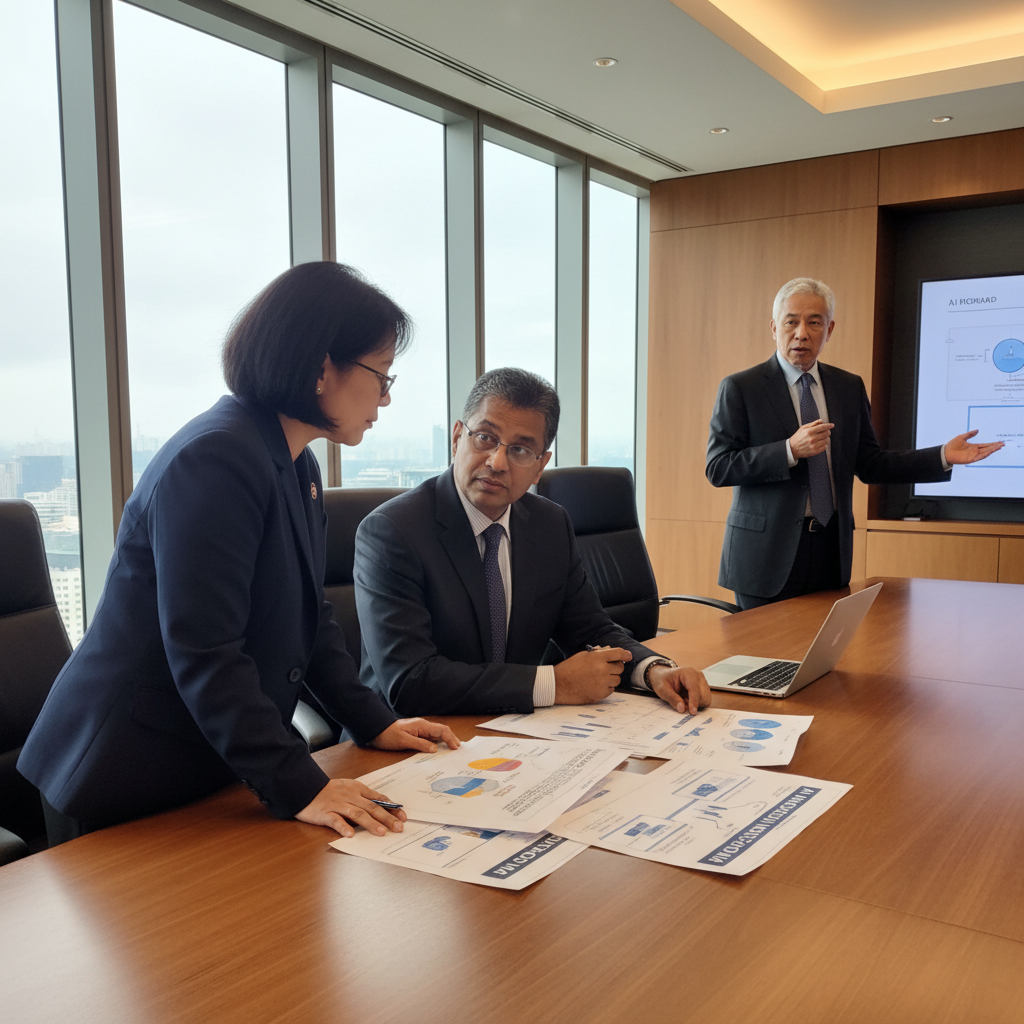
AIHQ's founder-led model treats AI as a capability line item, not a software line item — and that changes what a CFO signs off on. The specific, defensible claim here is: the cheapest path to AI value is usually sequencing leadership alignment, then role-based training, then selective implementation — and a partner who can do all three beats going direct to a tool vendor for most Malaysian organisations above 200 staff. Everything below is written to help you test whether that claim holds for your organisation.
Who Pang Sern Yong is, and why finance leaders should care
Pang Sern Yong is the founder, programme lead and principal trainer at AIHQ. His focus areas, per AIHQ's own materials, are leadership AI sense-making, business-first GenAI adoption, workforce readiness, practical AI strategy, executive briefings and role-based training.
That list matters to you because it is not a product list. If you are a CFO in a Malaysian corporate, a GLC or a regulated business, you have probably already received proposals that are essentially tool licences with a two-day workshop attached. Pang's positioning is different: AIHQ describes itself as an AI capability and solutions company, not a training provider only and not a software house.
The core belief AIHQ states is: capability improves how people work; solutions improve how organisations run. For a finance function, that translates to two separate budget questions — one for workforce capability, one for systems and workflow change — instead of one blended 'AI' number nobody can audit.
AIHQ reports having trained and engaged over 9,000 professionals, and having worked across corporate organisations, government agencies, public sector bodies, professional institutions, regulated sectors, education and training environments, and leadership/C-suite audiences. It is also a registered HRD Corp training provider.
The problem the founder is actually solving
Most Malaysian AI spending in the last two years went into one of three buckets:
- Tool subscriptions — licences bought centrally, used by a small percentage of seats.
- Generic awareness training — one-off sessions with no role context and no follow-through.
- Departmental experiments — a champion builds something useful, then leaves, and the workflow disappears with them.
None of those is wasteful on its own. The failure mode is sequence: organisations buy tools before leadership has agreed what AI is for, then train everyone the same way, then wonder why adoption data is flat.
Pang's stated approach inverts that. AIHQ describes its pathway as: Interest → Capability → Practical Usage → Measurable Outcomes → Optional Implementation. The word 'optional' is the commercially interesting one. It signals that AIHQ does not assume every engagement ends in a custom build.
AIHQ at a glance: what the founder has built
| Dimension | Detail |
|---|---|
| Positioning | AI capability and solutions company — training, advisory and custom AI |
| Founder | Pang Sern Yong — Founder / Programme Lead / Principal Trainer |
| Key trainers | Firdaus Khairi (technical, big data, implementation); Jean Ng (AI safety and tech ethics); Hazwan bin Azma (applied AI and data analysis); Arif (AI and data applications) |
| Scale | 9,000+ professionals trained and engaged |
| Cross-sector reach | Corporate, government agencies, public sector, professional institutions, regulated sectors, education |
| Training credentials | Registered HRD Corp training provider; programmes can be structured to be HRDC claimable, subject to client eligibility, grant approval and HRD Corp submission requirements |
| Recognitions | AI Project of the Year — Winner, and ESG & Social Impact of the Year — Winner (2025); Top Course Provider, National Training Week (2024) |
Note the trainer bench. A founder-led firm with a named technical trainer, a named safety and ethics specialist, and named applied-AI practitioners is a different risk profile from a single-person consultancy. For a CFO, that matters at renewal time.
Head-to-head: how the founder-led model compares

Where off-the-shelf tools end, workflow mapping and implementation begin.
Finance leaders need to choose between genuinely different delivery routes. Here is the comparison that usually gets skipped.
| Criterion | AIHQ (founder-led partner) | Going direct to a tool vendor | In-house build | Freelance trainer |
|---|---|---|---|---|
| Leadership alignment | Executive briefings for boards, EXCOs and HODs | Usually not offered | Depends on internal sponsorship | Rarely in scope |
| Role-based training | Department-specific, mapped to real workflows | Generic enablement only | Possible but competes for internal time | Usually generic |
| Custom implementation | Yes — chatbots, internal copilots, automation | Product-configuration only | High build risk and lead time | No |
| Responsible AI / governance | Named specialist (Jean Ng) | Policy templates | Often deferred | Rarely covered |
| HRDC claimability | Programmes can be structured to be claimable, subject to eligibility, grant approval and submission requirements | Typically not applicable to training claims | Internal L&D may structure it | Depends on provider registration |
| Time to first usable workflow | Typically weeks, not quarters | Immediate tool access, slow behaviour change | Long | Fast to book, low follow-through |
| Accountability for outcomes | Shared, structured, with measurement discussion | Vendor disclaims business outcomes | Full, if resourced | Limited |
Read the table this way: the vendor column wins on speed to access; the in-house column wins on control; the partner column wins on sequencing. Most organisations above 200 staff need sequencing more than they need another licence.
Who should pick what
Pick a founder-led partner (AIHQ-type engagement) if:
- You have budget approved but no agreed list of priority use cases.
- Your workforce is mixed — some AI-confident, most not — and role context matters.
- You need HRDC-claimable structuring so training sits against a levy-funded budget line rather than headcount cost.
- You want the option of a custom solution later but are not ready to commit to one now.
Go direct to a tool vendor if:
- You already have an internal AI capability function with a roadmap.
- Your need is narrow and well-defined — for example, standardising on one enterprise assistant for a single department.
- You have no intention of building custom workflows in the next 18 months.
Build in-house if:
- You have a genuine engineering bench with capacity, and AI is core to your product.
- You can absorb a 6–12 month learning curve without a delivery deadline.
Use a freelance trainer if:
- You need a one-off awareness session for a small group and have no follow-on plan.
A rollout timeline you can actually budget
This is a representative AIHQ-style sequence, not a fixed promise. Durations shift with scope and approval timing. Owners are named by role, not by person, so you can map it to your own org chart.
| Phase | Timing | Owner | What happens |
|---|---|---|---|
| 1. Leadership alignment | Weeks 1–3 | CFO / CEO sponsor, with HR Director | Executive briefing on implications, governance, decision rights and priority use cases. Output: agreed scope and a named programme owner. |
| 2. Use-case discovery | Weeks 4–6 | Head of Transformation, with department heads | Workflow audit and prioritisation across finance, HR, operations and service functions. Output: a ranked shortlist with effort/impact scoring. |
| 3. Role-based training | Weeks 7–14 | HR / L&D Lead, with department heads | Department-specific training built on the shortlisted workflows. Output: trained cohorts with role-specific practice tasks. |
| 4. Governance guardrails | Weeks 10–16 (overlapping) | Risk / Compliance Lead, with Legal | Responsible-use session covering confidential data, human review and escalation. Output: a practical usage policy your teams can follow, not a document nobody reads. |
| 5. Practical usage & measurement | Weeks 15–24 | Department heads, with the programme owner | Teams apply AI to agreed workflows; baseline and track time-to-output and rework rates on the shortlisted tasks. Output: evidence for phase 6. |
| 6. Optional implementation | Week 25+ | IT Lead, with the CFO sponsor | Where off-the-shelf tools are not enough, scope a custom workflow — internal copilot, enquiry chatbot or automation. Output: a costed proposal, not an assumption. |
For a finance audience, phases 2 and 5 are the ones that justify the spend. Phase 2 stops you funding the wrong use case. Phase 5 gives you something to report.
The HRD Corp angle, stated carefully
AIHQ is a registered HRD Corp training provider, and its programmes can be structured to be HRDC claimable — subject to client eligibility, grant approval and HRD Corp submission requirements. No provider can confirm approval in advance, and any proposal that implies otherwise should be treated sceptically.
What you can do as a CFO or finance lead:
- Confirm your organisation's current levy position and claimable headroom before scoping.
- Ask the provider for the submission pathway, required documentation and typical turnaround in writing.
- Ring-fence the training budget separately from the implementation budget so approval delays on one do not stall the other.
- Treat claimable status as a budget relief, not as a reason to buy more than you need.
Where the founder's approach shows up in practice
AIHQ's work with Media Prima Group is the most documented example: a structured capability journey over a 12-month period covering awareness, fundamentals, intermediate LLM skill-building and advanced application workshops. Reported programme outcomes were 98% satisfied participants, 90% reporting increased practical knowledge and skills, and 92% finding the training relevant and applicable to work.
Those figures refer specifically to that programme and should not be generalised — different organisations, roles and measurement approaches produce different results. But the shape of the engagement is the useful part: a year, staged by capability level, rather than a single event.
AIHQ's leadership engagements have included organisations such as Lion Group, MTD Group, Parkland Group and MUI Group, with senior leaders present. Selected engagements also include ACCA, Silverlake Group, Prudential BSN Takaful, the Institute of Internal Auditors Malaysia, New Straits Times Press, the Selangor State Government and local authorities, SME Corp Malaysia, MDEC, CIAST Shah Alam, Lion Property Group and PEKEMA.
Three things to verify before you sign anything
- Ask for the measurement plan in phase 2, not phase 5. If a provider cannot describe how they will baseline a workflow, the outcomes conversation will be anecdotal.
- Ask who delivers. Founder-led is an advantage only if the founder is actually in the room. AIHQ names its full trainer bench — use that to check coverage for your sector and function.
- Ask what happens if training does not stick. A partner should be able to describe a follow-on or reinforcement pathway, not just a satisfaction score.
The bottom line
Pang Sern Yong's contribution is not a new AI tool. It is a sequencing argument: leadership first, capability second, usage third, implementation only where the workflow genuinely demands it. For a finance leader, that is a spend pattern you can defend to a board — because each phase produces an artefact, and each phase can be stopped.
If your organisation is at the stage where you need to decide between a licence renewal and a capability programme, that decision is worth an hour of structured conversation before it becomes a three-year commitment.
FAQ
Who is Pang Sern Yong?
Pang Sern Yong is the Founder, Programme Lead and Principal Trainer at AIHQ, an AI capability and solutions company working with organisations in Malaysia and Singapore. His stated focus areas are leadership AI sense-making, business-first GenAI adoption, workforce readiness, practical AI strategy, executive briefings and role-based training.
What is AIHQ's approach to AI adoption?
AIHQ describes a five-stage pathway: Interest, Capability, Practical Usage, Measurable Outcomes and Optional Implementation. In practice, that means leadership alignment and use-case discovery come before any large-scale employee rollout, and custom builds are only considered where off-the-shelf tools are not sufficient.
Is AIHQ training HRDC claimable?
AIHQ is a registered HRD Corp training provider, and its programmes can be structured to be HRDC claimable — subject to client eligibility, grant approval and HRD Corp submission requirements. Claimability cannot be confirmed in advance, so finance and L&D teams should verify their organisation's levy position and the submission pathway before budgeting.
How long does a structured AI capability programme take?
A representative sequence runs across roughly six phases: leadership alignment (weeks 1–3), use-case discovery (weeks 4–6), role-based training (weeks 7–14), governance guardrails (overlapping weeks 10–16), practical usage and measurement (weeks 15–24), and optional implementation from week 25 onward. Durations vary with scope, approval timing and organisational readiness.
Should we go direct to a tool vendor or work with a partner?
Organisations with an internal AI capability function and a clear roadmap can often go direct. Organisations that have budget approved but no agreed priority use cases — or that need role-based training, governance guardrails and an implementation option later — typically get better sequencing from a partner that can cover all three.
Does AIHQ guarantee productivity gains or ROI?
No. Outcomes depend on implementation, adoption, data, workflows and how results are measured. AIHQ's stated role is to help organisations identify practical use cases and build adoption pathways that can support measurable outcomes, with measurement baselines agreed early.