General
The 10 Best Agentic AI Courses: Free vs. Paid Options for Hands-On Automation Skills
· By AIHQ Team

Agentic AI is quickly becoming one of the most talked-about frontiers in workplace technology. While generative AI tools respond to a single prompt, agentic AI involves systems that can plan, take multiple steps, use tools and complete more complex workflows with some degree of autonomy.
That capability is why so many professionals — and the organisations they work for — are looking for an agentic AI course to build hands-on skills before the gap widens. But the market is crowded, and the difference between a course that builds real automation ability and one that just walks you through tool features is significant.
This guide compares the strongest free and paid agentic AI courses, breaking each one down by curriculum depth, hands-on project opportunities, instructor credibility and return on investment. No hype, no vague promises — just a practical framework for choosing the right path for your level, budget and goals.
What to Look For in an Agentic AI Course
Before comparing specific options, it helps to know what separates a genuinely useful agentic AI course from a superficial one. Four factors matter most.
1. Curriculum Depth, Not Tool Names
Agentic AI is more than learning a specific platform. A strong course covers core concepts — how agents plan, how they call tools, how they handle memory, and how they reason through multi-step tasks. Courses that focus only on "here's how to click this button" will age quickly. Courses that teach underlying patterns stay useful even as tools change.
2. Hands-On Project Work
Agentic AI is a build-and-test skill. The best courses include real projects where you design an agent, connect it to a workflow, run it and debug it. Look for courses that get you building within the first few lessons rather than sitting through hours of theory.
3. Instructor Credibility
Check whether instructors have actual experience shipping AI systems or delivering AI capability programmes, not just certificates in theory. Practitioner-taught courses tend to be far more practical.
4. Clear ROI for Your Time
A free course can be excellent value if it builds genuine skill. A paid course is justified when it saves you months of trial and error, gives you structured projects, or comes with feedback and certification that your organisation values.
The Best Free Agentic AI Courses
Free courses are ideal for foundations, orientation and deciding whether agentic AI is worth deeper investment. You trade some structure and support for zero cost.
1. DeepLearning.AI's Short Courses on AI Agents
DeepLearning.AI offers several free, focused short courses on building AI agents, often co-created with tool providers. They are concise, practical and taught by credible practitioners.
- Best for: Professionals who want a fast, structured introduction.
- Strengths: High production quality, hands-on notebooks, current tooling.
- Weaknesses: Each course is short; you'll likely take several to build depth.
- Cost: Free.
- ROI: Excellent for orientation and fundamentals.
2. Google's Generative AI Learning Path
Google's free learning path includes introduction to AI, large language models and responsible AI, with newer content touching on agent-based reasoning. It's a solid foundation, especially for those new to AI concepts.
- Best for: Beginners and technical-adjacent professionals.
- Strengths: Structured, credential-friendly, Google-backed.
- Weaknesses: More conceptual than deeply hands-on with agents.
- Cost: Free.
- ROI: Good for fundamentals and foundational credentials.
3. Microsoft Learn's AI Learning Modules
Microsoft Learn offers free modules on building intelligent agents and AI solutions within its ecosystem. Practical examples use real tooling, which helps if your organisation already runs Microsoft.
- Best for: Teams and individuals in Microsoft-centric environments.
- Strengths: Direct ties to the Copilot and Azure ecosystem.
- Weaknesses: Tied to one vendor's stack.
- Cost: Free.
- ROI: High if you work in a Microsoft environment.
4. Official Platform Tutorials and Documentation
OpenAI, Anthropic and similar providers publish free documentation and tutorials covering agentic patterns, function calling and multi-step reasoning. These are dense but genuinely authoritative.
- Best for: Technical audiences who can learn from documentation.
- Strengths: Accurate, current and vendor-authoritative.
- Weaknesses: No structure, feedback or certification.
- Cost: Free.
- ROI: Varies widely depending on your learning style.
The Best Paid Agentic AI Courses
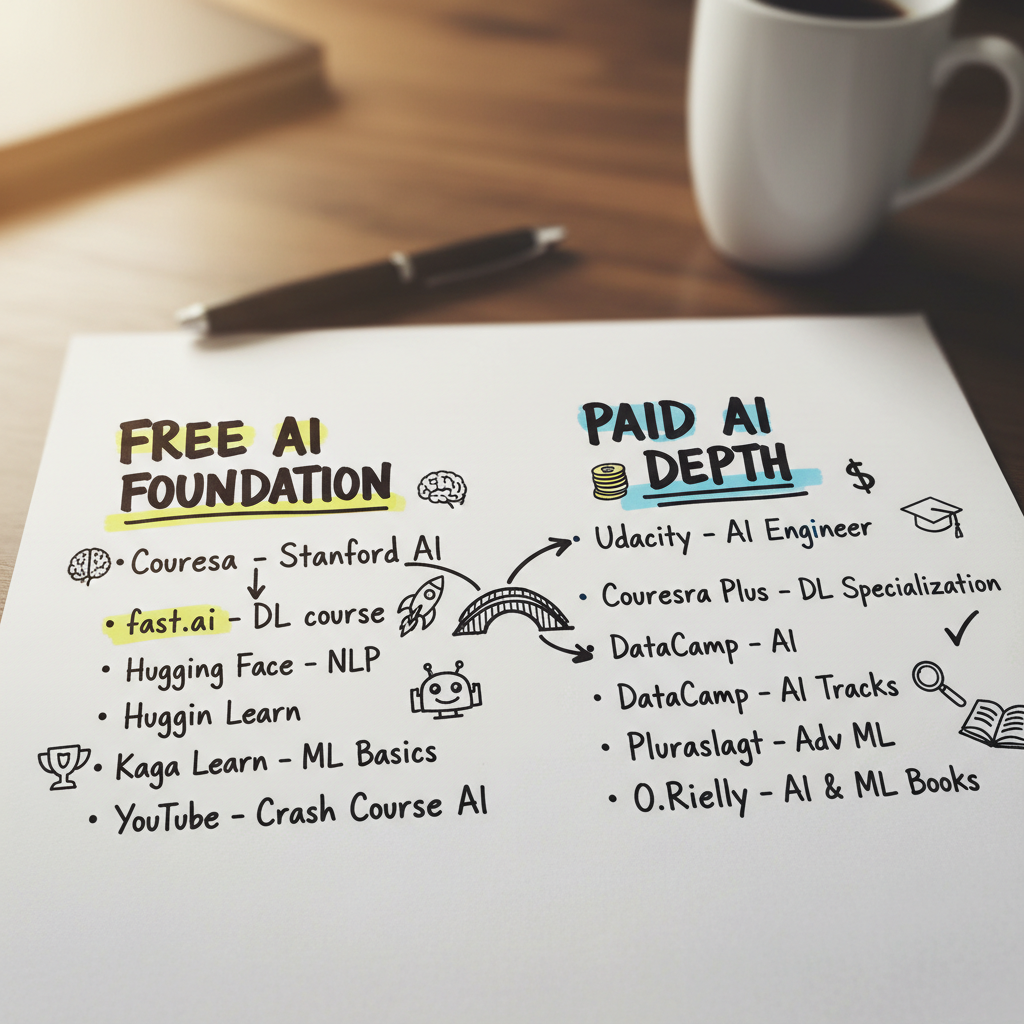
Free courses build foundations; paid courses earn their cost through depth, projects and support.
Paid courses earn their cost when they deliver structure, projects, feedback and practical depth that self-paced free content cannot. Here are the categories worth evaluating — and the questions to ask.
5. Vendor-Native Build Courses (e.g., OpenAI, Anthropic, LangChain)
Several paid offerings teach you to build agents using a specific provider's stack, with guided projects, community support and often certification.
- Best for: Developers and technical teams aiming to build production-ready agents.
- Strengths: Deep technical depth, real projects, active communities.
- Weaknesses: Often vendor-locked; quality varies by course.
- Cost: Varies, typically mid-to-high.
- Questions to ask: Is it current with the latest agentic patterns? Does it include deployment and evaluation, not just a demo?
6. Bootcamp-Style AI Automation Programmes
Some providers offer structured multi-week programmes covering the full journey: concepts, tools, workflow design, hands-on building and evaluation. These suit professionals who want guided, end-to-end depth.
- Best for: Professionals moving from using AI tools to designing automations.
- Strengths: Structured progression, projects, community and support.
- Weaknesses: More expensive; some programmes overpromise outcomes.
- Cost: Mid-to-high.
- Questions to ask: What projects will you actually build? What does success look like, and how is it measured?
7. Role-Based and Organisation-Led Agentic AI Training
Increasingly, organisations prefer agentic AI training that is mapped to actual workflows rather than generic courses. This is where role-based and in-house training stands apart — it connects agentic capabilities to the specific documents, processes and decisions your teams handle every day.
- Best for: Organisations that want skills to translate into real workflow improvement.
- Strengths: Role-specific, workflow-grounded, large-group efficiency.
- Weaknesses: Not a solo option; requires organisational buy-in.
- Cost: Varies by scope.
AIHQ designs role-based AI training and technical AI training that help teams apply agentic concepts to real workflows, rather than sitting through generic lectures. For developers and IT teams, AIHQ's technical and developer AI training covers coding agents, workflow automation and agentic AI workflows in a hands-on way — structured to build capability, not just awareness.
Free vs. Paid: How to Decide
Here's a practical decision framework rather than a one-size-fits-all answer.
Choose Free Courses When
- You're new to AI and want to test whether agentic AI is relevant to your role.
- You prefer learning yourself and can stay motivated without deadlines.
- You need foundational concepts before investing real money.
Choose Paid Courses When
- You want structured progression and hands-on projects with feedback.
- You're building production-ready skills for your current role or a promotion.
- Your organisation values completion certificates or structured training.
- Your employer is funding it — which changes the investment calculus entirely.
The Org-Scale Shortcut
If your entire team needs agentic AI capability — not just one passionate individual — organisation-led training usually delivers stronger adoption than asking employees to take individual courses. This is especially true when the training is mapped to your specific workflows and supported by role-based AI training that connects skills to daily work.
The Hidden Cost That Most Courses Don't Cover
Most agentic AI courses teach you to build agents. Far fewer prepare you for what happens when agents start running inside a real organisation: data privacy, accuracy, human oversight and governance.
Buying a course that ignores these realities will cost you later. Every agentic system sits on your data and makes decisions inside your workflows. That's why responsible use and guardrails matter as much as technical skill. Responsible AI training helps teams use AI safely and appropriately as automation scales — something an individual build course rarely addresses.
Equally important is understanding that off-the-shelf tools and courses cannot solve every workflow problem. Some processes require structured implementation and, where appropriate, custom AI solutions to fit a specific context. Recognising when a course is enough, and when you need implementation support, is itself a valuable skill.
A Practical Checklist Before You Enrol
Before you commit to any agentic AI course, run it through this checklist:
- Does the curriculum cover agent concepts, not just one tool?
- Will you build and debug real agents within the first third of the course?
- Are the instructors practitioners with shipping or delivery experience?
- Is the content current, or is it teaching outdated patterns?
- Does it address evaluation, error handling and governance — or stop at the demo?
- What measurable outcome will you have at the end?
If a course cannot answer these clearly, its value is probably overestimated.
Beyond the Course: Turning Skills Into Workflow Impact
The uncomfortable truth is that finishing any single course — free or paid — is only the beginning. Real agentic AI capability shows up when skills connect to actual workflows, when teams have leadership alignment, and when responsible use is built in from the start.
That's the philosophy AIHQ brings to both training and consulting. AIHQ has trained and engaged over 9,000 professionals across corporate organisations, government agencies, public sector bodies, professional institutions and regulated sectors — building practical AI capability that translates into real workflow impact, not just course completion.
If your team is ready to move beyond individual courses into structured, role-based agentic AI capability, an AI innovation bootcamp can help you identify and prioritise the workflows where automation will deliver the most value first.
Frequently Asked Questions
Is an agentic AI course worth it if I'm not a developer?
Yes, but choose your course carefully. Non-developers benefit most from courses that teach agentic concepts, workflow design and practical tool use rather than deep programming. Role-based and organisation-led training often fits better than developer-focused bootcamps.
How long does it take to learn agentic AI?
It depends on your starting point. A free short course can orient you in days. Building genuine production-ready skill typically takes several weeks to months of structured learning and hands-on projects — longer if you're learning foundational AI concepts at the same time.
What's the difference between generative AI and agentic AI?
Generative AI responds to a single prompt to produce output. Agentic AI involves systems that plan, take multiple sequential steps, use external tools and complete more complex workflows with some autonomy. Many agentic systems still use generative AI models underneath.
Are free agentic AI courses enough to get hired?
Free courses are excellent for foundations and portfolio projects, but employers and organisations increasingly value demonstrable workflow results over certificates alone. Combining free fundamentals with structured projects — or role-based training mapped to real work — strengthens your position considerably.
Does an agentic AI course replace organisational training?
No. Individual courses build personal skill; organisation-led training builds workforce capability tied to specific processes and workflows. Most successful adoptions use both. AIHQ pairs AI training programmes with consulting so capability and implementation reinforce each other.