General
Best AI Agent Training Courses in 2025: Top Certifications for Professionals
· By AIHQ Team

Agentic AI is no longer a futuristic concept—it is reshaping how professionals automate workflows, reason through complex tasks, and build systems that act on their own judgment. But finding an AI agent training course that teaches real, practical skills rather than surface-level theory is a challenge.
This guide compares the top AI agent training courses and certifications for professionals in 2025. We evaluated each program on curriculum depth, hands-on project work, industry recognition, practical relevance, and cost value.
Whether you are a developer, a product manager, a data professional, or an L&D leader planning team upskilling, this comparison will help you choose the right program.
What to Look for in an AI Agent Training Course
Not all AI agent courses deliver the same depth. Before choosing a program, consider these evaluation criteria:
- Hands-on agent building — Does the course include real projects where you build, test, and deploy agents?
- Tool-use and API integrations — Can you learn how agents interact with external tools, databases, and APIs?
- Reasoning and planning logic — Does the curriculum cover chain-of-thought, multi-step reasoning, and agent orchestration?
- Industry recognition or certification — Is the credential valued by employers and organisations?
- Practical workflow relevance — Can you apply what you learn to real business workflows immediately?
Using these criteria, here are the best AI agent training courses available in 2025.
1. DeepLearning.AI — AI Agentic Design Patterns with Autogen
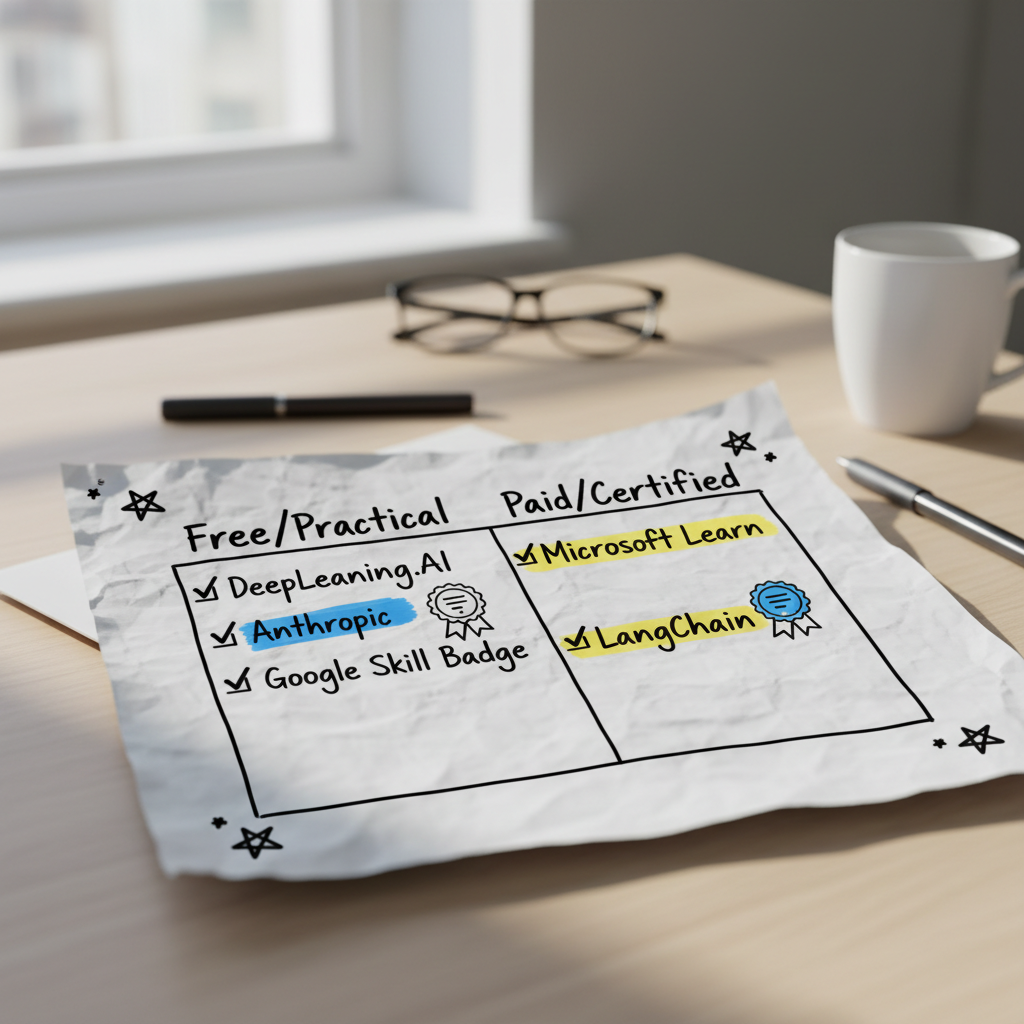
Quick comparison of free practical courses versus paid certified AI agent training.
Best for: Developers and technical professionals who want to build multi-agent systems using Microsoft's AutoGen framework.
This short, focused course from DeepLearning.AI (co-founded by Andrew Ng) covers core agentic design patterns including reflection, tool use, planning, and multi-agent collaboration.
What you will learn:
- How to design agents that reflect on their own outputs
- Building agents that use external tools and APIs
- Multi-agent conversations and orchestration with AutoGen
- Practical code-first implementation in Python
Hands-on projects: Yes — you build functional multi-agent systems using Jupyter notebooks.
Certification: Completion certificate from DeepLearning.AI.
Cost: Free to audit on Coursera (or paid certificate).
Best for: Developers with Python experience who want to move from single LLM calls to structured agentic workflows.
2. Anthropic — Building Effective Agents
Best for: Technical teams and developers who want to understand when agentic architectures are appropriate and how to build them responsibly.
Anthropic published a highly practical guide and companion course on agentic design. This is less a traditional certification and more a practical blueprint used by engineering teams.
What you will learn:
- When to use agents versus simpler workflows
- Agent architecture patterns (tool-use, retrieval, multi-step reasoning)
- Building agents with the Anthropic API and Claude
- Safety and oversight in agentic systems
Hands-on projects: Yes — includes code examples and workflow blueprints.
Certification: No formal certificate, but widely referenced in industry as a practical benchmark.
Best for: Technical teams building production agent systems who value practical patterns over certificates.
3. Google Cloud — Build AI Agents on Vertex AI (Skill Badge)
Best for: Cloud practitioners and enterprise architects working within Google Cloud ecosystems.
Google's skill badge on agent building walks learners through creating conversational AI agents using Vertex AI Agent Builder, including grounding, tool integration, and deployment.
What you will learn:
- Building conversational agents with Vertex AI
- Grounding agents with enterprise data
- Integrating search, tool-use, and human handoff
- Deploying agents for real-world use
Hands-on projects: Yes — lab-based projects using Google Cloud Console.
Certification: Google Cloud Skill Badge (shareable on LinkedIn).
Cost: Free for the first lab module; subsequent labs may incur usage costs.
Best for: Cloud engineers and enterprise architects with access to Google Cloud infrastructure.
4. Microsoft Learn — Create AI Agents with Azure AI Agent Service
Best for: Enterprise developers and IT teams already using the Microsoft ecosystem.
Microsoft's learning path on Azure AI Agent Service covers how to build, deploy, and manage intelligent agents that integrate with enterprise tools, data sources, and workflows.
What you will learn:
- Creating agents using Azure AI Agent Service
- Connecting agents to enterprise data with grounding
- Building retrieval-augmented generation (RAG) pipelines
- Agent lifecycle management and monitoring
Hands-on projects: Yes — sandbox-based labs within Microsoft Learn.
Certification: Microsoft Applied Skills credential (when assessed).
Cost: Free (Azure usage costs may apply).
Best for: Organisations already on Microsoft Azure looking to build enterprise-grade agent solutions.
5. LangChain — LangChain & LangGraph: AI Agent Development
Best for: Developers who want to master the LangChain and LangGraph ecosystem for building stateful, multi-agent systems.
LangChain's official course teaches developers how to build agents using LangGraph, a framework for creating controllable, stateful AI agent workflows.
What you will learn:
- Building agents with LangChain and LangGraph
- State management and agent memory
- Multi-agent orchestration and supervision
- Tool-use, human-in-the-loop, and error handling
Hands-on projects: Yes — extensive coding exercises building production-like agent systems.
Certification: Completion certificate from LangChain.
Cost: Paid — typically $199–$399 depending on cohort.
Best for: Python developers who want deep, architecture-level understanding of agentic workflows.
6. AIHQ — Role-Based AI Training Including Practical Agent Adoption
Best for: Organisations and teams that want to move beyond individual certifications toward team-wide capability and structured adoption.
AIHQ's role-based AI training programmes help teams understand when agentic workflows are useful, how to evaluate agent tools safely, and how to implement agent use cases within real business processes.
What you will learn:
- Understanding agentic AI versus simple automation
- Identifying workflow use cases that benefit from agent reasoning
- Responsible use and governance for agent-driven tasks
- Practical adoption pathways for teams and departments
Hands-on projects: Yes — workflow audits, use-case prioritisation, and team exercises.
Certification: Completion credential from AIHQ.
Cost: Contact AIHQ for pricing tailored to your organisation.
Best for: HR and L&D leaders, department heads, and teams planning structured AI agent capability building across the organisation.
Comparison Table: AI Agent Training Courses at a Glance
| Course | Best For | Hands-On | Certification | Cost |
|---|---|---|---|---|
| DeepLearning.AI — AI Agentic Design Patterns | Developers (Python) | Yes | Completion cert | Free / Paid cert |
| Anthropic — Building Effective Agents | Technical teams | Yes | None (industry reference) | Free |
| Google Cloud — Vertex AI Agent Builder | Cloud practitioners | Yes | Google Skill Badge | Free / Usage costs |
| Microsoft Learn — Azure AI Agent Service | Enterprise developers | Yes | Applied Skills | Free / Usage costs |
| LangChain — LangGraph Agent Development | Advanced developers | Yes | Completion cert | Paid |
| AIHQ — Role-Based AI Agent Training | Organisations and teams | Yes | AIHQ credential | Contact AIHQ |
How to Choose the Right AI Agent Training Course
Your choice depends on your role, technical background, and organisational context.
If you are a developer building agents: Start with DeepLearning.AI or LangChain for deep technical practice. Use Anthropic's guide as a reference.
If you work in an enterprise with a cloud provider: Choose Google Cloud or Microsoft Learn for ecosystem-specific agent building skills.
If you are an L&D leader or department head: Consider AIHQ's role-based AI training to build team-wide agent capability aligned with your actual workflows.
If you are new to agentic AI: Begin with foundational concepts before jumping into code-heavy courses. A structured AI literacy session can help your team understand what agents can and cannot do.
FAQ
1. What is an AI agent training course? An AI agent training course teaches professionals how to build, deploy, and manage AI agents—systems that can reason, plan, use tools, and act autonomously on defined tasks. These courses go beyond basic chatbot usage into multi-step reasoning and workflow automation.
2. Do I need coding experience to take an AI agent course? Most advanced AI agent courses require Python experience and familiarity with APIs. However, some organisational training programmes and introductory workshops focus on conceptual understanding, use-case identification, and responsible adoption without deep coding.
3. Which AI agent certification is most recognized? Google Cloud Skill Badges and Microsoft Applied Skills credentials are widely recognized in enterprise environments. DeepLearning.AI certificates carry strong weight in the developer community. Industry references such as Anthropic's agent guide are valued by technical teams.
4. Can I learn AI agent skills without a technical background? Yes. Many organisations offer AI literacy and adoption workshops that help non-technical teams understand agentic workflows, identify use cases, and evaluate agent tools safely—even without writing code.
5. How long does it take to complete an AI agent training course? It varies. Short courses like DeepLearning.AI's agentic patterns course can be completed in a few hours. Comprehensive programmes like LangChain's LangGraph course may span several weeks. Organisational training can be customised to your schedule.
6. Are AI agent certifications worth it for career growth? Yes. As organisations move from basic chatbot experiments to structured agent workflows, professionals with practical agent-building skills are increasingly in demand. Certifications signal hands-on capability, especially when backed by real projects.
Build Practical AI Agent Capability for Your Organisation
Choosing the right AI agent training course is a solid first step. But sustainable capability comes when learning connects to real workflows, team roles, and governance practices.
AIHQ helps organisations move beyond individual courses toward structured, role-based AI adoption. Whether you are evaluating agent tools, planning team upskilling, or designing responsible use guidelines, AIHQ can support your journey.
Contact AIHQ to discuss a role-based AI training roadmap for your team.
Explore AIHQ's AI training programmes to see how structured capability building works in practice.
FAQ
What is an AI agent training course?
An AI agent training course teaches professionals how to build, deploy, and manage AI agents—systems that can reason, plan, use tools, and act autonomously on defined tasks. These courses go beyond basic chatbot usage into multi-step reasoning and workflow automation.
Do I need coding experience to take an AI agent course?
Most advanced AI agent courses require Python experience and familiarity with APIs. However, some organisational training programmes and introductory workshops focus on conceptual understanding, use-case identification, and responsible adoption without deep coding.
Which AI agent certification is most recognized?
Google Cloud Skill Badges and Microsoft Applied Skills credentials are widely recognized in enterprise environments. DeepLearning.AI certificates carry strong weight in the developer community. Industry references such as Anthropic's agent guide are valued by technical teams.
Can I learn AI agent skills without a technical background?
Yes. Many organisations offer AI literacy and adoption workshops that help non-technical teams understand agentic workflows, identify use cases, and evaluate agent tools safely—even without writing code.
How long does it take to complete an AI agent training course?
It varies. Short courses like DeepLearning.AI's agentic patterns course can be completed in a few hours. Comprehensive programmes like LangChain's LangGraph course may span several weeks. Organisational training can be customised to your schedule.
Are AI agent certifications worth it for career growth?
As organisations move from basic chatbot experiments to structured agent workflows, professionals with practical agent-building skills are increasingly in demand. Certifications signal hands-on capability, especially when backed by real projects.