General
The Best AI Automation Course Certificates to Boost Your Enterprise Career
· By AIHQ Team

The Best AI Automation Course Certificates to Boost Your Enterprise Career
Automation is no longer a nice-to-have skill inside modern enterprises — across banking, media, manufacturing, professional services and the public sector, teams are increasingly expected to use AI not just to draft content but to improve workflows, reduce repetitive work and support decisions. The question professionals and their L&D leaders keep asking is the same: which AI automation course certificate is actually worth the time and money?
The honest answer depends on your goal. A certificate matters when it signals verifiable, practical skill to a hiring manager or a business leader. So before you invest in any badge, you need to compare courses on curriculum depth, cost, industry recognition and career impact.
Here is a practical look at the AI automation course certificates worth considering — and the criteria you should use to judge any course, including your own training provider.
What to look for in an AI automation course certificate
Before comparing specific options, it helps to define what makes a certificate genuinely useful. Most of the difference between a strong badge and a weak one comes down to four things:
- Hands-on projects, not passive watching. Automation is a doing-skill. A course that makes you build a real workflow, bot or agent is worth far more than one where you simply watch videos.
- Verifiable credentials. Look for certificates that can be checked by an employer — linkable, dated and ideally tied to an official account or issuer.
- Curriculum depth on automation, not just AI basics. A good certificate walks you through real automation concepts: workflow design, prompts, tool triggers and where human oversight still matters.
- Recognition and relevance to your industry. A certificate is most valuable when employers in your sector understand and trust it.
A solid rule: if a course hands you a certificate without asking you to demonstrate a skill, it will rarely help your career.
Top AI automation course certificates to consider
1. AI automation courses with verified certificates from major platforms
The big learning platforms — Coursera, edX, Google, Microsoft and IBM — offer structured AI and automation certificates that carry genuine name recognition. These are useful when you want a credential that a board or hiring manager will recognise immediately.
Look for certificates that combine AI fundamentals with practical automation or workflow components. Courses that touch on tools like Microsoft Power Automate, Make or Zapier, or that cover AI-assisted workflow design, tend to convert into real workplace skill fastest.
Best for: professionals who want a broadly recognised credential they can list on a CV or LinkedIn profile.
2. Free AI automation courses with certificates
You do not have to spend money to start. Several established platforms offer free automation courses with certificates you can earn at your own pace. Free doesn't mean low value — some of the strongest introductory automation courses are free — but you should read the fine print: some issue certificates only in the paid tier, or expire after a set period.
Free courses are a smart starting point to test whether automation is a direction you want to invest in, and to build a foundation before moving to deeper or paid options. They are especially useful for teams exploring AI adoption before committing a training budget.
Best for: early-career professionals and teams doing a low-cost capability scan.
3. Agentic AI and advanced automation courses
As automation moves beyond simple triggered workflows toward agentic AI — where an AI system plans and executes multi-step tasks with human oversight — demand for these skills is rising. Courses covering agentic concepts, coding agents and structured automation workflows are among the most career-relevant additions you can make right now.
These tend to be more technical and are best suited to IT, developer and data teams, or to 'AI champions' who will drive adoption inside their department. They also pair well with advanced prompt techniques and workflow design.
Best for: technical teams, developers and employees tasked with building and stewarding automation.
4. Role-based and enterprise AI training with practical certificates
Increasingly, the most career-relevant certificates come not from standalone online courses but from structured, role-based training delivered within or for an organisation. These programmes teach automation in the context of your actual role — how a finance team automates reporting, how HR automates onboarding drafts, how operations automates approvals and follow-ups.
A certificate from this kind of programme is often more credible inside your own organisation because it is tied to the workflows you actually run. For L&D leaders, this is also the difference between generic AI training and training that creates real workplace adoption.
Best for: professionals and HR/L&D leaders who want skills that map directly to the job rather than to a generic platform syllabus.
What a certificate does — and does not — prove
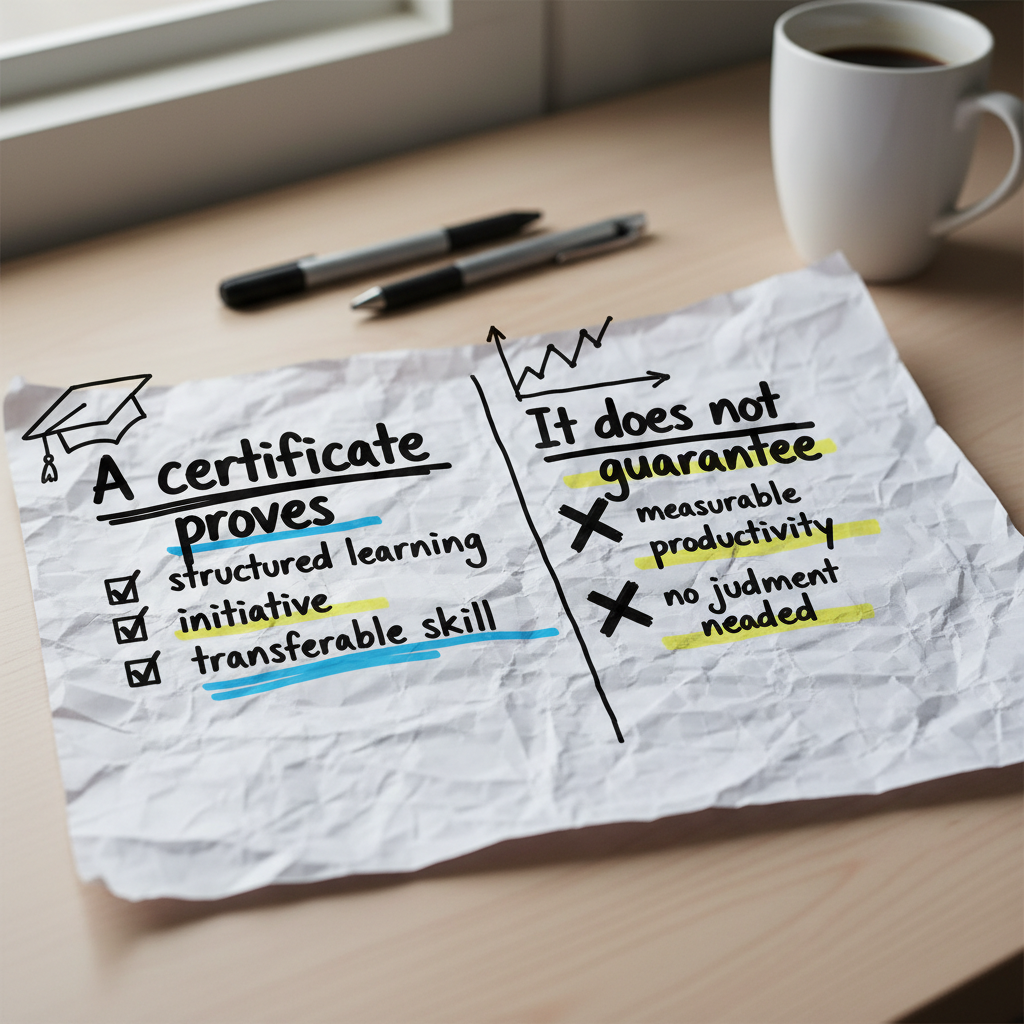
A certificate shows skill; applying it in your role shows impact.
It is worth being realistic about a certificate's role in your career. A good certificate demonstrates that you have invested in structured learning and can apply automation concepts in a supervised exercise. It signals initiative, foundational knowledge and a willingness to build a genuinely transferable skill.
What a certificate does not prove is that you will deliver measurable productivity gains in your specific role. That depends on your workflows, your tools, the data you handle and how well the training was designed for your context. The most valuable thing you can pair with any certificate is actual application — building one real automation workflow and showing what it changed.
A certificate is a strong signal you have skills; an example of a workflow you improved is what turns that signal into a story a hiring manager remembers.
How to compare courses before you commit
When evaluating any AI automation course certificate — free or paid, online or delivered in-house — ask these questions.
Is the curriculum practical? Does it require building, configuring or testing an automation, or is it mostly theory and video? Practical beats passive every time.
Is the certificate verifiable and dated? Can an employer check it? Is it tied to your name and an official account? Avoid badges with no issuer.
Does it match your role and industry? A certificate that teaches automation in the context of your function — finance, HR, operations, customer service — converts to workplace value faster than a generic course.
Does it cover responsible and safe use? Any worthwhile automation course should address data privacy, guardrails and where human review still matters. Automation without governance is a risk, not just a skill.
What happens after the certificate? Does the provider help you apply the skill, or is the certificate the end of the road? Structured providers will point you toward workflow thinking and real application.
Making automation skills count inside your organisation
If you are an individual professional, the practical move is to complete a certificate and build one real automation in your daily work — then measure what it saves. If you are an HR or L&D leader, the higher-value move is to design a programme where certificates are a milestone, not the goal, and employees are supported to apply automation to genuine workflow pain points.
That is where AIHQ's perspective matters. We help organisations move beyond generic AI awareness into structured capability, practical adoption and real workflow impact. Our AI training programmes are designed around roles and real workflows, so that skills genuinely transfer to the job — supported where needed by custom AI solutions when off-the-shelf tools are not enough. And we have trained and engaged over 9,000 professionals across corporate, public sector, professional and regulated environments.
For teams wanting to identify and prioritise which automations are worth piloting, a structured AI innovation bootcamp can turn ideas into practical use cases. And because responsible use matters, AI governance and responsible-use training helps teams use automation safely and appropriately.
The takeaway
The best AI automation course certificate is the one that genuinely builds a skill your role needs, comes from a recognisable issuer, is verifiable, and sets you up to apply it. Whether you choose a free starting point, a major platform credential or structured role-based training, the career payoff comes from application — the certificate opens the door, but the workflow you improve is what moves your career forward.
Our full AI capability and solutions work at AIHQ exists to help people and organisations make exactly that leap from learning to real workflow impact.
FAQ
Is the AI automation course certificate free option worth it?
Yes, as a starting point. Several established platforms offer free automation courses with verifiable certificates. They are a low-cost way to test whether automation suits your role and to build a foundation. Just check the fine print — some issue certificates only in paid tiers or expire after a period, and free courses rarely go deep enough to count as proof of advanced skill on their own.
What is the difference between an AI automation course and an agentic AI course?
A standard automation course usually covers triggered workflows — for example, a notification, approval or follow-up flow. An agentic AI course covers multi-step systems where an AI plans and executes several actions with human oversight. Agentic courses are more advanced and typically suit IT, developer and data teams, or AI champions building automation inside a department.
Do employers actually value AI automation certificates?
Yes, when the certificate is verifiable, dated and tied to a recognised issuer, because it signals initiative and foundational skill. But a certificate alone rarely determines hiring. Employers value it most when combined with evidence you have applied automation to a real workflow. The strongest move is pairing a certificate with an example of work you automated and improved.
How long does an AI automation certificate take to earn?
It varies widely. Short introductory courses may take a few hours, while structured programmes or role-based training can span days or weeks depending on depth and the amount of hands-on practice. Paid or advanced agentic courses generally take longer because they require building and testing actual automation workflows.
What should an organisation look for in AI automation training for its teams?
Prioritise training that is role-based — taught in the context of your teams' actual workflows — practical, and that covers responsible and safe use including data privacy and human review. A certificate should be a milestone, not the goal. The measure that matters is whether employees can apply automation to real workflow pain points after the training ends.