General
Best AI Chatbots for Malaysian Businesses in 2026
· By AIHQ Team

Choosing the right AI chatbot for your Malaysian business in 2026 is no longer just about picking a popular tool. Customer service teams need Bahasa Malaysia support. HR departments want internal assistants that understand company policies. Operations teams expect escalation workflows that don't drop enquiries.
This guide compares leading AI chatbot platforms across the factors that matter most to Malaysian organisations: language support, pricing in MYR, data residency considerations, integration capability, and fit for customer-facing versus internal use cases.
What Makes an AI Chatbot Right for Malaysian Businesses?
Before comparing platforms, it helps to understand the specific requirements that apply in the Malaysian market.
Bahasa Malaysia and Multilingual Support
Customer-facing chatbots in Malaysia must handle Bahasa Malaysia naturally, along with English and sometimes Mandarin or Tamil. Platforms that only support English well will create friction for users who prefer to interact in BM.
Local Pricing and Payment
Pricing quoted in USD and billed per seat can be expensive for Malaysian teams. Platforms with MYR pricing, regional resellers, or consumption-based models often suit local budgets better.
Data Residency and Compliance
With growing attention on data protection under the Personal Data Protection Act (PDPA), some organisations prefer chatbot solutions that can be deployed within Malaysian or Southeast Asian data centres.
Customer-Facing vs Internal Use
A chatbot for customer enquiries has different requirements than one used internally for HR policy lookups or SOP guidance. The comparison below distinguishes between these use cases.
AI Chatbot Platform Comparison for Malaysian Businesses
1. Zendesk AI (with Answer Bot and Triage)
Best for: Customer service teams already using Zendesk
Zendesk's AI chatbot features integrate directly into its existing ticketing and support platform. The AI triages incoming customer enquiries, suggests responses, and escalates complex cases to human agents.
Malaysia-specific considerations:
- Supports Bahasa Malaysia in the knowledge base and response suggestions
- Enterprise plans require quoting in USD through regional partners
- Data hosted in Singapore data centres (within reach for PDPA compliance)
- Best suited for structured customer service workflows
Limitations: Less ideal for internal HR or SOP use. The platform is designed for customer-facing ticketing, not internal knowledge retrieval.
2. Tidio (Lyro AI)
Best for: SMEs and e-commerce businesses
Tidio's Lyro AI agent handles common customer enquiries automatically using your existing FAQ, product pages and knowledge base. It learns from your content rather than requiring custom training.
Malaysia-specific considerations:
- Bahasa Malaysia support is functional but less fluent than English
- Pricing starts affordably (free tier available, paid plans in USD)
- Easy setup for small teams without technical support
- Integrates with Shopify, WooCommerce and WordPress
Limitations: Less suitable for large enterprises with complex workflows. Limited Bahasa Malaysia fluency may frustrate BM-first customers.
3. Intercom (Fin AI)
Best for: Mid-market and enterprise customer support teams
Intercom's Fin AI agent resolves support enquiries, qualifies leads, and routes conversations to the right human agent when needed. It integrates deeply with Intercom's broader customer communication platform.
Malaysia-specific considerations:
- Supports Bahasa Malaysia in chatbot responses
- Pricing in USD, billed by resolution volume
- Strong analytics and reporting for customer service leaders
- Can handle multilingual conversations within one chat thread
Limitations: Premium pricing can add up for high-volume teams. Best suited when you already use or plan to adopt the Intercom ecosystem.
4. Custom AI Chatbot (Build or Partner Solution)
Best for: Organisations with unique workflows, Bahasa Malaysia-heavy use cases, or data residency requirements
Off-the-shelf platforms work well for many teams, but some organisations need a custom AI chatbot. This is common when:
- Your workflows are specific to your industry or organisation
- You need full Bahasa Malaysia fluency beyond template responses
- You require deployment within Malaysia's data boundaries
- You want a chatbot that integrates with internal systems like HRIS, ERP or custom databases
A custom chatbot can serve both customer-facing and internal use cases — from FAQ handling to SOP lookups to employee self-service.
Malaysia-specific considerations:
- Can be built with Bahasa Malaysia, English and other languages at native fluency
- Pricing is project-based (one-time build + ongoing hosting/maintenance) rather than per-seat
- Data can remain within your organisation's infrastructure or a Malaysian cloud instance
- Full control over escalation logic, knowledge sources and user permissions
AIHQ helps organisations explore whether a custom AI chatbot is appropriate, from customer enquiry handling to internal knowledge assistants. If your off-the-shelf chatbot is hitting its limits, a custom approach may be worth evaluating.
5. WhatsApp Business with AI Integration
Best for: Malaysian businesses where customer communication already happens on WhatsApp
WhatsApp Business API, combined with an AI layer, allows organisations to deploy chatbots directly within the messaging app most Malaysians already use. This removes the friction of asking customers to download a new app or visit a website.
Malaysia-specific considerations:
- WhatsApp penetration in Malaysia exceeds 85% among smartphone users
- AI providers (e.g., Twilio, WATI, Gupshup) offer integration layers for AI-powered WhatsApp chatbots
- Bahasa Malaysia support depends on the AI layer, not WhatsApp itself
- Pricing includes WhatsApp Business API fees plus the AI integration cost
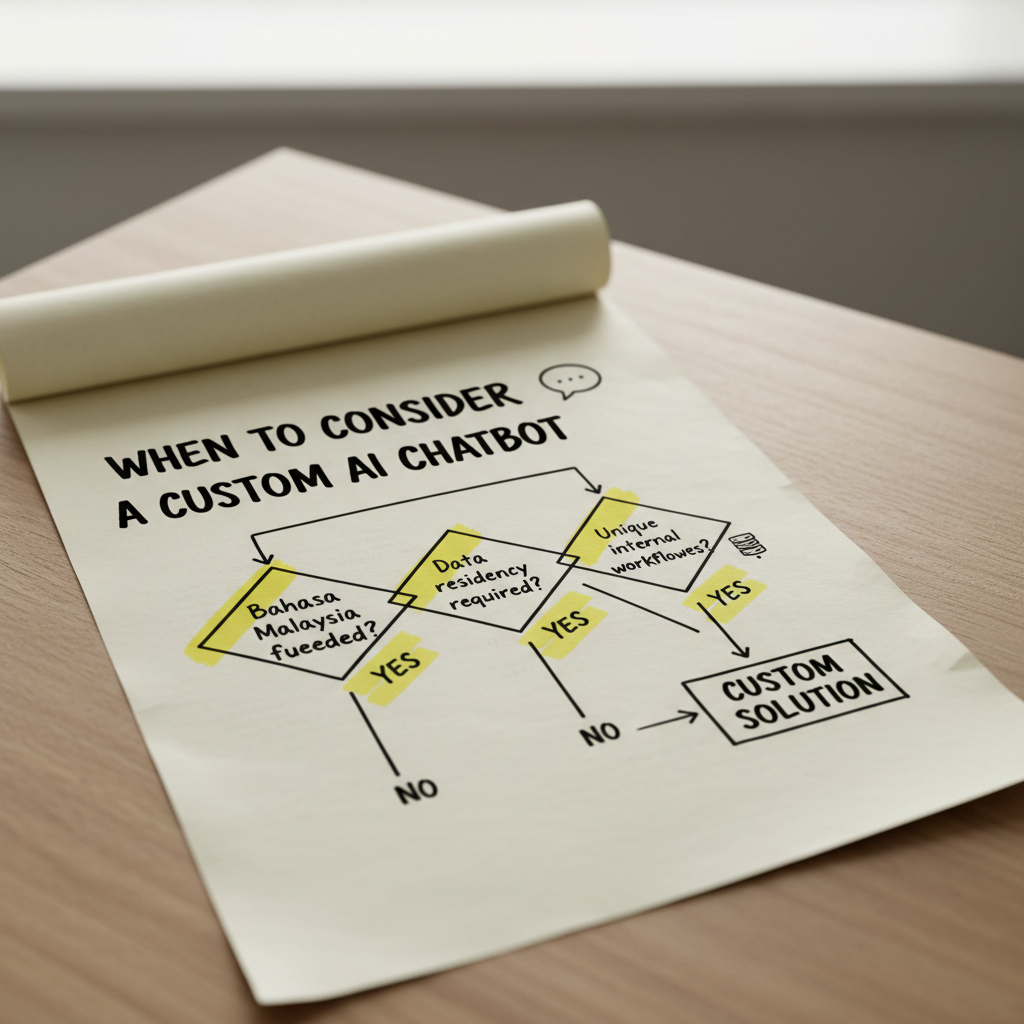
Custom AI chatbots may suit organisations needing full Bahasa Malaysia fluency, data residency or unique workflow integration.
Limitations: WhatsApp API has strict messaging policies. Unsolicited marketing messages are restricted. Best used for initiated or opt-in customer conversations.
6. ChatGPT (Custom GPTs) for Internal Use
Best for: Internal team productivity, not customer-facing deployment
Custom GPTs allow organisations to create tailored AI assistants for tasks like drafting documents, analysing data, summarising reports or answering SOP questions — without building a full application.
Malaysia-specific considerations:
- Bahasa Malaysia support is strong in ChatGPT-4 and above
- Enterprise plans (ChatGPT Team or Enterprise) offer data privacy controls
- Not designed for customer-facing chatbot deployment without a custom interface
- Good as a starting point for internal AI experimentation
Limitations: Not a customer-facing chatbot platform. Data privacy depends on your plan and settings. Custom GPTs work best for internal productivity, not live customer interactions.
Comparison Table: AI Chatbot Platforms at a Glance
| Platform | Best For | Bahasa Malaysia | Pricing Model | Customer-Facing | Internal Use |
|---|---|---|---|---|---|
| Zendesk AI | Customer service teams | Good | USD/subscription | Yes | Limited |
| Tidio Lyro | SMEs, e-commerce | Functional | USD/freemium | Yes | No |
| Intercom Fin | Mid-market support | Good | USD/usage | Yes | Limited |
| Custom AI Chatbot | Unique workflows, full BM | Full | MYR/project-based | Yes | Yes |
| WhatsApp + AI | High-reach customer comms | Depends on AI layer | USD+API fees | Yes | No |
| ChatGPT Custom GPTs | Internal productivity | Strong | USD/subscription | No | Yes |
How to Choose the Right AI Chatbot for Your Malaysian Business
Identify Your Primary Use Case First
Start by asking: Is this chatbot for customers, employees, or both?
- Customer-facing: Prioritise Bahasa Malaysia fluency, WhatsApp integration, and escalation to human agents. Platforms like Zendesk AI, Intercom, or a custom chatbot are strong options.
- Internal use: Focus on knowledge retrieval, document search, and role-based access. Custom internal copilots or ChatGPT Enterprise may be more appropriate.
- Both: Consider a platform that can handle both use cases with separate configurations. A custom AI chatbot often fits best here.
Consider Total Cost, Not Just Per-Seat Pricing
Per-seat pricing can become expensive as you scale. A handful of AI chatbot seats for a customer service team may be affordable, but licensing an entire organisation can add up quickly. Project-based or consumption-based models may offer better value.
Evaluate Bahasa Malaysia Fluency
Not all chatbots handle Bahasa Malaysia equally well. Test your shortlisted platforms with real customer or employee queries in BM before committing. A chatbot that stumbles on simple BM phrases will erode user trust.
Check Data Residency Options
If your organisation handles sensitive data or operates in a regulated sector, confirm where your chatbot's data will be stored. Some platforms offer deployment within Southeast Asian data centres; others may route data through the US or Europe.
When an Off-the-Shelf Chatbot Isn't Enough
Many organisations start with a platform chatbot and discover limitations over time:
- The chatbot can't handle complex internal workflows (e.g., HR policy enquiries that require context from multiple documents)
- Bahasa Malaysia support is inconsistent and frustrates users
- The platform cannot integrate with existing internal systems like an HRIS or ERP
- Data residency requirements aren't met by the provider's available regions
When these challenges arise, a custom AI chatbot or internal copilot may be a more appropriate solution. AIHQ helps organisations evaluate this, from discovery through to implementation.
Frequently Asked Questions
1. Which AI chatbot supports Bahasa Malaysia best for customer service?
For native-level Bahasa Malaysia fluency in a customer-facing chatbot, a custom-built solution offers the most control. Among off-the-shelf platforms, Zendesk AI and ChatGPT (via its API) provide strong BM support, while Tidio's BM capability is more functional than fluent.
2. Are AI chatbots compliant with Malaysia's PDPA?
Compliance depends on how the chatbot is deployed and where data is stored. Platforms offering data residency in Singapore or Malaysia, combined with proper data processing agreements, support PDPA compliance. Always verify with your provider and legal team.
3. Can an AI chatbot replace my customer service team?
Well-designed AI chatbots handle repetitive enquiries and triage, allowing human agents to focus on complex cases that require judgment and empathy. Most Malaysian businesses use chatbots to support — not replace — their service teams.
4. How much does an AI chatbot cost for a Malaysian business?
Costs vary by platform. Tier 1 platforms like Tidio start from free to ~USD 50/month. Mid-market options like Intercom or Zendesk AI range from USD 100–500/month depending on volume. Custom AI chatbots are project-based and typically range from RM 20,000–RM 80,000+ depending on complexity.
5. What is the best AI chatbot for internal HR and SOP support?
For internal use cases like HR policy lookups and SOP guidance, an internal copilot (custom-built or ChatGPT Enterprise) usually outperforms customer service chatbots. AIHQ designs internal copilots that connect to your knowledge base and support role-based access.
6. Can an AI chatbot handle both English and Bahasa Malaysia in the same conversation?
Yes, platforms using large language models (LLMs) like GPT-4 or Claude can handle mixed-language conversations naturally. Custom chatbots built on these models offer the best multilingual experience. Some off-the-shelf platforms may handle mixed languages inconsistently.
Moving Beyond Chatbot Evaluation
Selecting the right AI chatbot platform is only the first step. Sustainable adoption requires role-based capability building, clear escalation workflows, governance guardrails, and ongoing measurement of whether the chatbot is actually helping your teams and customers.
Organisations that invest in both the right platform and the right capability-building approach tend to see stronger, longer-lasting results.
FAQ
Which AI chatbot supports Bahasa Malaysia best for customer service?
For native-level Bahasa Malaysia fluency in a customer-facing chatbot, a custom-built solution offers the most control. Among off-the-shelf platforms, Zendesk AI and ChatGPT (via its API) provide strong BM support, while Tidio's BM capability is more functional than fluent.
Are AI chatbots compliant with Malaysia's PDPA?
Compliance depends on how the chatbot is deployed and where data is stored. Platforms offering data residency in Singapore or Malaysia, combined with proper data processing agreements, support PDPA compliance. Always verify with your provider and legal team.
Can an AI chatbot replace my customer service team?
Well-designed AI chatbots handle repetitive enquiries and triage, allowing human agents to focus on complex cases that require judgment and empathy. Most Malaysian businesses use chatbots to support — not replace — their service teams.
How much does an AI chatbot cost for a Malaysian business?
Costs vary by platform. Tier 1 platforms like Tidio start from free to ~USD 50/month. Mid-market options like Intercom or Zendesk AI range from USD 100–500/month depending on volume. Custom AI chatbots are project-based and typically range from RM 20,000–RM 80,000+ depending on complexity.
What is the best AI chatbot for internal HR and SOP support?
For internal use cases like HR policy lookups and SOP guidance, an internal copilot (custom-built or ChatGPT Enterprise) usually outperforms customer service chatbots. AIHQ designs internal copilots that connect to your knowledge base and support role-based access.
Can an AI chatbot handle both English and Bahasa Malaysia in the same conversation?
Yes, platforms using large language models (LLMs) like GPT-4 or Claude can handle mixed-language conversations naturally. Custom chatbots built on these models offer the best multilingual experience. Some off-the-shelf platforms may handle mixed languages inconsistently.