General
Best AI Classes in Malaysia 2026 – Top-Rated Courses, Workshops & Certifications
· By AIHQ Team

If you are searching for the best AI classes in Malaysia in 2026, you are not alone. More professionals, managers and executives are looking for structured training that goes beyond basic ChatGPT tutorials.
The challenge is separating credible, practical programmes from the noise. Generic one-day workshops might give you a quick overview, but real capability comes from training that connects AI tools to your actual work, role and responsibilities.
This guide covers the top-rated AI classes, workshops and certifications available in Malaysia for 2026. Whether you are a complete beginner, a working professional looking to upskill, or a senior leader planning organisational AI adoption, there is a programme that fits.
Why AI Classes in Malaysia Are Growing Rapidly
Malaysia's AI training landscape has matured significantly. Organisations are no longer asking whether AI matters — they are asking how to build practical capability across their teams.
Several trends are driving this demand:
- Workforce upskilling mandates — Companies are investing in AI literacy as a core competency.
- HRDC-claimable programmes — Eligible organisations can structure training to be HRDC claimable, subject to grant approval requirements.
- Role-specific needs — Generic AI awareness is no longer enough. Teams want training tailored to HR, finance, marketing, operations and customer service workflows.
- Leadership readiness — CEOs and boards are seeking executive-level briefings to guide strategy, governance and responsible adoption.
AIHQ has trained and engaged over 9,000 professionals across corporate, public sector and regulated environments, reflecting the growing appetite for structured AI capability in Malaysia.
What to Look for in an AI Class
Before choosing a programme, consider these criteria:
- Practical relevance — Does the training connect to your daily work or your team's workflows?
- Trainer expertise — Are the facilitators experienced in both AI and your industry context?
- Format and duration — Is it a half-day overview, a multi-session workshop, or a certification track?
- Responsible AI coverage — Does the programme address data privacy, accuracy and governance?
- Post-training support — Is there follow-up material, community access or advisory support?
1. AI Fundamentals Training — Best for Beginners
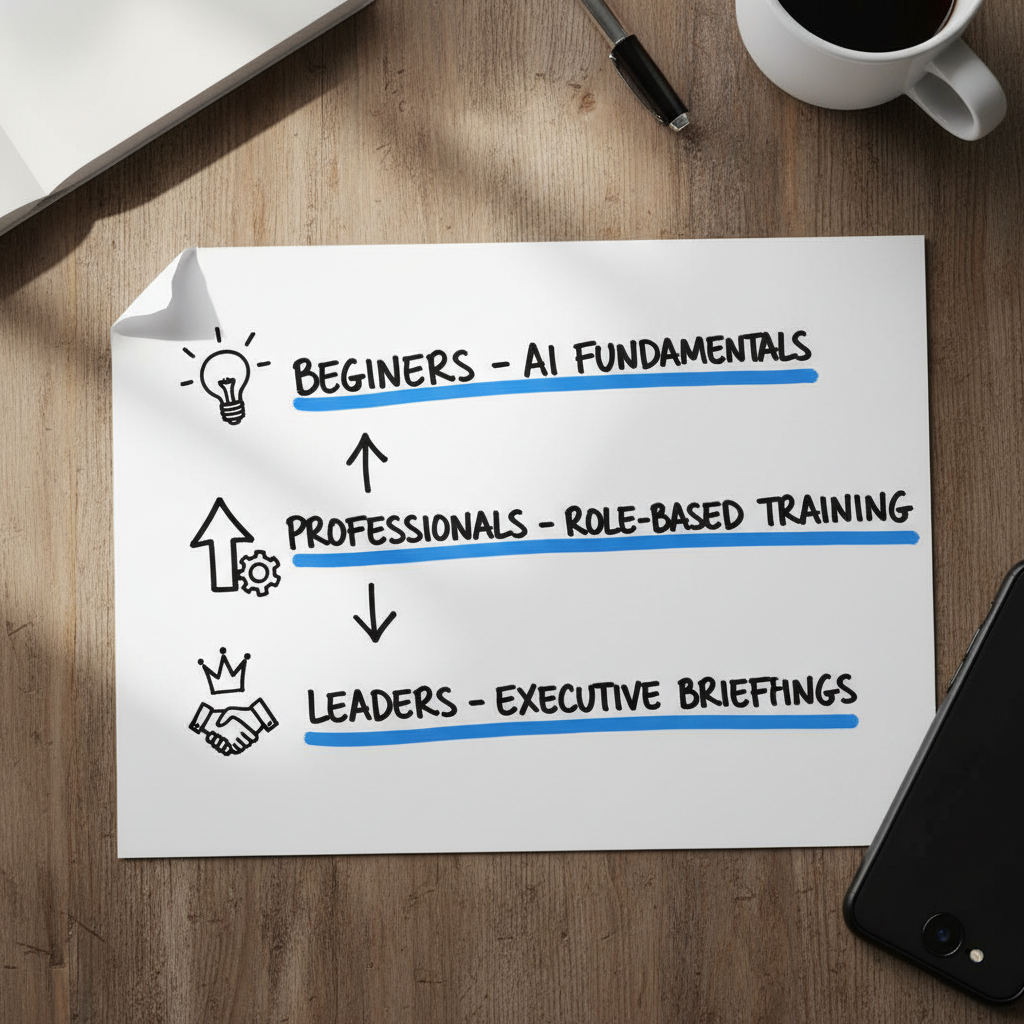
Three AI training pathways matched to different experience levels and roles.
Best for: Professionals with little to no AI experience who need a structured introduction.
AI fundamentals training covers the core concepts of artificial intelligence and generative AI, practical tool usage, limitations and safe adoption. These classes are designed to move participants from curiosity to confident, responsible usage.
What you will learn:
- How AI and Generative AI actually work (in plain language)
- Practical use of tools like ChatGPT, Microsoft Copilot and Gemini
- Prompting techniques for better outputs
- Responsible use, data privacy and avoiding common mistakes
Why it works: Rather than a theoretical lecture, good fundamentals training uses real exercises based on workplace scenarios — writing emails, summarising documents, analysing data and generating ideas.
AIHQ's AI training programmes offer structured fundamentals sessions that can be tailored to organisational needs.
2. Role-Based AI Training — Best for Working Professionals
Best for: HR, finance, marketing, operations, customer service and other department teams.
Generic AI classes teach tools. Role-based training teaches workflows. This type of programme is designed around the actual tasks a professional performs daily.
Example by department:
HR teams learn how AI can support job description drafting, interview question preparation, employee handbook summarisation, policy Q&A and onboarding documentation — while recognising that human judgment remains essential for sensitive decisions.
Finance teams explore AI for data analysis, variance reporting, meeting summaries, policy interpretation and draft board paper preparation — always within guardrails that protect confidential financial data.
Marketing and communications teams practise using AI for content outlines, social media drafts, campaign briefs, audience segmentation summaries and performance reporting.
Operations teams work through AI applications for process documentation, SOP drafting, status report generation and workflow improvement ideas.
Why it works: Participants leave with skills they can apply immediately because the training mirrors their actual work.
To discuss a role-based AI training roadmap for your team, AIHQ can design a programme aligned with your specific roles, workflows and business priorities.
3. Executive AI Briefings — Best for Leaders and Decision-Makers
Best for: CEOs, boards, EXCOs, HODs and senior management.
Leadership-focused AI classes are not about prompting. They focus on strategy, governance, risk, value creation and adoption roadmaps.
What executives gain:
- A clear framework for thinking about AI beyond the hype
- Governance and decision rights guidance
- Practical understanding of where AI creates value versus where it does not
- Responsible adoption principles that protect the organisation
- A structured approach to moving from experimentation to organisational capability
These sessions are typically half-day or full-day closed-door briefings with senior trainers who understand both business and technology.
AIHQ has delivered leadership briefings for organisations including Lion Group, MTD Group, Parkland Group and MUI Group. If your leadership team needs an AI leadership briefing, this format is designed for your context.
4. AI Innovation Bootcamps — Best for Teams Exploring Use Cases
Best for: Cross-functional teams, innovation units and transformation departments.
An AI innovation bootcamp is a structured workshop where teams identify, prioritise and begin planning AI use cases relevant to their workflows. It bridges the gap between AI awareness and practical adoption.
What happens in a bootcamp:
- Workflow audit to identify pain points and opportunities
- Use-case ideation and prioritisation exercises
- Pilot planning and business-to-technical translation
- Outputs that can feed directly into implementation
This format is especially useful for organisations that have done basic training but are unsure which AI projects to pursue next.
AIHQ's AI innovation bootcamp helps teams move from ideas to actionable pilot plans.
5. Responsible AI and Governance Workshops — Best for Risk and Compliance Teams
Best for: Legal, compliance, risk, data protection and regulated organisations.
As AI usage scales, organisations need clear guardrails. Responsible AI workshops cover policy development, safe usage principles, data privacy, human oversight and organisational governance.
What is covered:
- Building an organisational AI policy that translates into practical employee behaviour
- Understanding data sovereignty and confidentiality risks
- Setting appropriate human review workflows
- Balancing productivity gains with responsible use
These sessions are relevant for any organisation deploying AI beyond isolated experiments, especially in regulated sectors.
Explore AIHQ's responsible AI training and governance workshops for structured guidance.
6. Custom AI Solution Training — Best for Implementation-Ready Teams
Best for: Organisations that have trained their teams and are ready to build AI-powered workflows.
For organisations moving beyond off-the-shelf tools, custom AI solution training helps teams understand how internal copilots, AI chatbots, workflow automation and knowledge systems work — and how to design them.
What this covers:
- When off-the-shelf AI tools are sufficient versus when custom solutions are needed
- Designing an internal copilot for SOPs, policies or knowledge bases
- Understanding AI chatbot architecture for customer service or employee support
- Workflow automation design principles
This is advanced territory. Most organisations benefit from starting with fundamentals and role-based training before exploring custom solutions.
AIHQ's custom AI solutions team can support organisations ready for this next stage.
How to Choose the Right AI Class for You
| Your Situation | Recommended Programme |
|---|---|
| Complete beginner | AI Fundamentals Training |
| Working professional wanting practical skills | Role-Based AI Training |
| Senior leader planning strategy | Executive AI Briefing |
| Team exploring AI opportunities | AI Innovation Bootcamp |
| Compliance or risk role | Responsible AI & Governance Workshop |
| Ready for implementation | Custom AI Solution Training |
What About Certifications?
Many professionals ask about AI certifications. While vendor-specific certifications (such as Microsoft AI, Google AI or OpenAI-related credentials) can demonstrate technical familiarity, they are often tool-specific rather than workflow-focused.
For most Malaysian professionals, a structured capability-building programme that includes practical application, responsible use and role-specific exercises provides stronger long-term value than a standalone certification. Many organisations find that combining internal structured training with vendor certifications creates the best outcomes.
Final Thoughts
The best AI class in Malaysia is the one that matches your current stage — whether you are just beginning, upskilling your team, aligning your leadership or preparing for implementation. A structured, practical programme connected to real workflows will always outperform a generic workshop that teaches features without context.
AIHQ has worked across corporate organisations, government agencies, professional institutions and regulated sectors. If you are ready to move beyond AI awareness into structured capability, the right training pathway exists.
Frequently Asked Questions
What is the best AI class for beginners in Malaysia?
AI Fundamentals Training is the most suitable starting point for beginners. It covers core AI and Generative AI concepts, practical tool usage and responsible adoption principles — all explained in plain, business-friendly language.
Are AI classes in Malaysia HRDC claimable?
AIHQ programmes can be structured to be HRDC claimable, subject to client eligibility, grant approval and HRD Corp submission requirements. It is advisable to confirm eligibility before enrolling.
How long do AI training programmes typically last?
Programme length varies. Fundamentals sessions can run from half a day to two days. Role-based training typically spans one to three days. Executive briefings are usually half-day or full-day. Innovation bootcamps may last one to two days depending on scope.
Is there a difference between AI classes and AI certification courses?
Yes. AI classes focus on building practical capability and workflow application. Certification courses are often tool-specific and assess technical proficiency. Many professionals benefit from both, but practical capability training tends to create stronger daily workplace impact.
Can AI training be customised for my organisation's industry?
Yes. Leading providers like AIHQ offer sector-specific and role-specific training. Programmes can be designed for banking, media, retail, manufacturing, public sector, professional services and other industries, with relevant use cases and examples.
What should executives look for in an AI class?
Executives should prioritise programmes that address strategy, governance, risk and adoption roadmaps rather than tool-specific training. An executive AI briefing should help leaders ask better questions and make informed decisions about organisational AI direction.
FAQ
What is the best AI class for beginners in Malaysia?
AI Fundamentals Training is the most suitable starting point for beginners. It covers core AI and Generative AI concepts, practical tool usage and responsible adoption principles — all explained in plain, business-friendly language.
Are AI classes in Malaysia HRDC claimable?
AIHQ programmes can be structured to be HRDC claimable, subject to client eligibility, grant approval and HRD Corp submission requirements. It is advisable to confirm eligibility before enrolling.
How long do AI training programmes typically last?
Programme length varies. Fundamentals sessions can run from half a day to two days. Role-based training typically spans one to three days. Executive briefings are usually half-day or full-day. Innovation bootcamps may last one to two days depending on scope.
Is there a difference between AI classes and AI certification courses?
Yes. AI classes focus on building practical capability and workflow application. Certification courses are often tool-specific and assess technical proficiency. Many professionals benefit from both, but practical capability training tends to create stronger daily workplace impact.
Can AI training be customised for my organisation's industry?
Yes. Leading providers like AIHQ offer sector-specific and role-specific training. Programmes can be designed for banking, media, retail, manufacturing, public sector, professional services and other industries, with relevant use cases and examples.
What should executives look for in an AI class?
Executives should prioritise programmes that address strategy, governance, risk and adoption roadmaps rather than tool-specific training. An executive AI briefing should help leaders ask better questions and make informed decisions about organisational AI direction.