General
Best AI Classes for Professionals in Malaysia: Upskill Without Leaving Your Job
· By AIHQ Team

Why Professionals Need AI Skills — Without a Career Break
Malaysian professionals are increasingly expected to understand and use AI tools in their daily work. Whether you are in HR, finance, marketing, operations or corporate communications, AI literacy is becoming a baseline skill — not a niche technical speciality.
But finding the best AI classes for professionals in Malaysia that fit around a full-time job is not straightforward. Many courses are designed for full-time students, require technical prerequisites or offer generic content that does not translate to real workplace use.
This guide covers the types of AI classes that working professionals should look for, what to expect from quality programmes, and how to choose training that fits your role and schedule without leaving your job.
What Makes an AI Class Suitable for Working Professionals?
Not all AI training is built for people who are already employed. The best AI classes for professionals in Malaysia share a few common features:
- Flexible scheduling — Evening, weekend or self-paced online options that work around office hours
- Role-relevant content — Exercises and examples connected to real workplace tasks, not abstract theory
- Practical, not academic — Hands-on use of AI tools for writing, analysis, reporting, research and decision support
- No heavy prerequisites — Programmes designed for business professionals, not developers
- Responsible use built in — Coverage of data privacy, accuracy checking and human oversight
If a programme checks these boxes, it is likely designed with professionals like you in mind.
Types of AI Classes Available for Malaysian Professionals
1. AI Literacy and Fundamentals Programmes
These are entry-level classes covering what AI and Generative AI are, how large language models work, and how to use tools like ChatGPT, Microsoft Copilot or Gemini responsibly.
Best for: Professionals who are new to AI and want to build confident, safe foundational skills.
Typical format: 1–2 day workshops, evening sessions or short online courses.
What you will learn:
- Core AI concepts without unnecessary jargon
- Practical prompting for daily tasks
- Safe usage habits and data privacy awareness
- Limitations of current AI tools
2. Role-Based AI Training
These classes focus on how specific departments — HR, finance, marketing, customer service, legal — can apply AI to their actual workflows.
Best for: Professionals who want training directly connected to their job function.
Typical format: Half-day or full-day sessions, often department-specific.
What you will learn:
- Use cases relevant to your role
- Workflow integration rather than tool features
- How to review and verify AI output
- Responsible use within your professional context
Related resource: Explore role-based AI training designed for HR, finance, marketing and other departments.
3. Leadership AI Briefings
For senior professionals, managers and decision-makers, these sessions focus on strategic understanding, governance, risk and adoption planning — not tool tutorials.
Best for: Managers, HODs, directors and C-suite leaders who need to lead AI adoption, not just use AI tools.
Typical format: Half-day executive sessions or bespoke team briefings.
What you will learn:
- Strategic implications of AI for your industry
- Governance and decision rights
- Responsible adoption frameworks
- Separating AI value from vendor hype
Related resource: Book an executive AI briefing to align your leadership team on AI strategy.
4. AI Innovation Bootcamps
Structured workshops where teams identify workflow pain points, explore AI use cases, and prioritise opportunities for pilot projects.
Best for: Cross-functional teams looking to move from AI awareness to practical action.
Typical format: Multi-day or multi-session workshops combining facilitation and hands-on work.
What you will learn:
- How to audit workflows for AI potential
- How to prioritise use cases worth piloting
- How to plan a small-scale AI implementation
5. Responsible AI and Governance Workshops
Focused on safe and compliant AI use, these classes address data privacy, policy design, human oversight and organisational governance.
Best for: Risk, compliance, legal and leadership professionals, especially in regulated sectors.
Typical format: Half-day workshops or custom sessions for leadership teams.
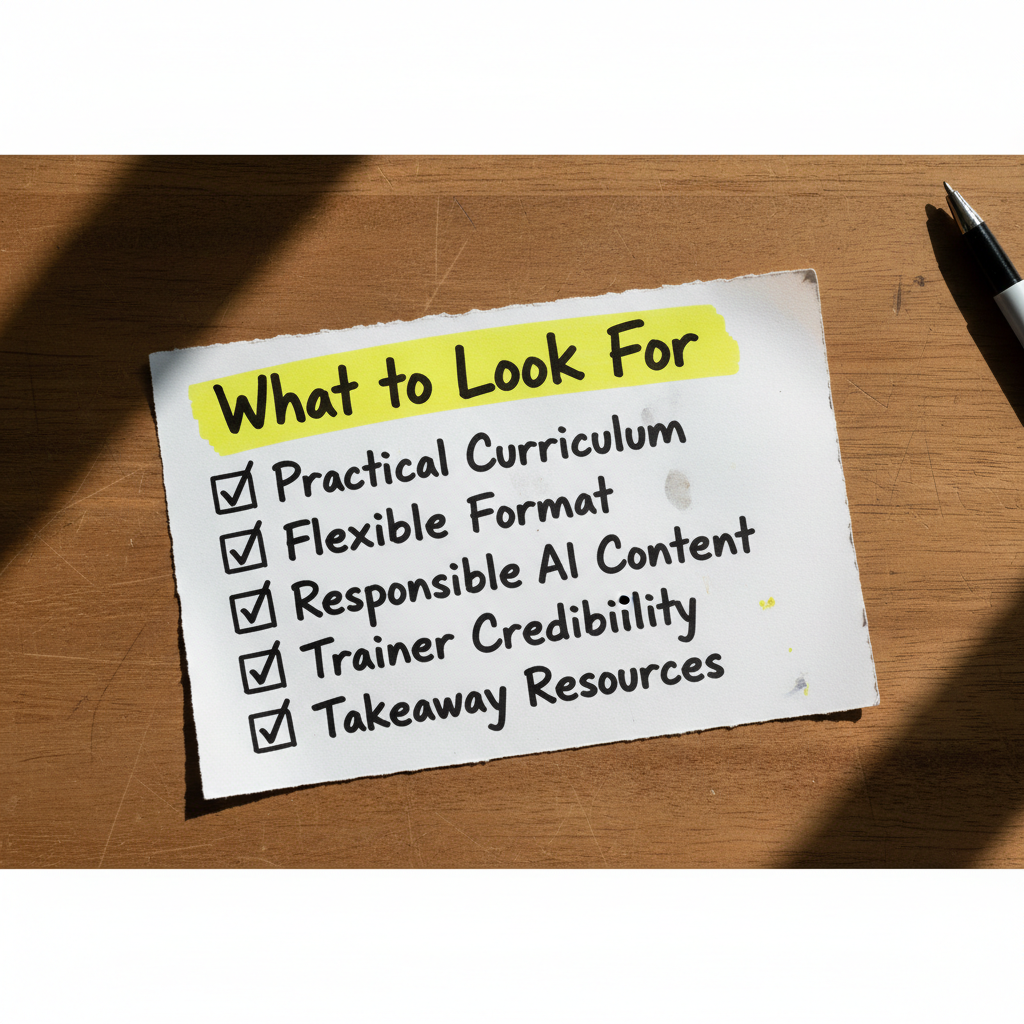
A practical checklist for choosing the right AI training programme
What you will learn:
- AI governance frameworks for organisations
- How to design responsible AI policies
- Balancing productivity with data protection
Related resource: Learn about responsible AI training for governance and safe adoption.
What to Look for When Choosing AI Classes
Check the Curriculum for Practical Application
A good AI class for professionals should spend most of its time on using AI tools in realistic work scenarios, not on slide-heavy theory. Look for programmes that include exercises, live demonstrations, templates and takeaway resources.
Consider the Format and Schedule
- Live online sessions are convenient for professionals with unpredictable schedules
- In-person workshops offer better interaction and hands-on practice
- Self-paced courses work well for independent learners but may lack guidance
- Blended programmes combine online learning with live application sessions
Look for Responsible AI Content
Any quality AI class should cover data privacy, accuracy checking, bias awareness and human oversight. Professionals need to know not just what AI can do, but when and how to use it safely.
Examine Trainer Credibility
Look for trainers with real-world experience in AI adoption across organisations, not just academic knowledge. Programmes delivered by practitioners who have worked with corporate, public sector and regulated environments tend to be more practical.
AIHQ, for example, has trained over 9,000 professionals and worked across corporate organisations, government agencies, professional institutions and regulated sectors. The team includes specialists in AI strategy, responsible AI, technical implementation and applied workflows.
Sample AI Class Formats for Professionals
| Format | Duration | Best For | Typical Schedule |
|---|---|---|---|
| Fundamentals workshop | 1 day | New to AI | Weekend or weekday |
| Role-based training | Half to full day | Department-specific upskilling | Weekday or custom |
| Leadership briefing | Half day | Senior management | Weekday |
| Innovation bootcamp | 2–3 sessions | Cross-functional teams | Weekly sessions |
| Governance workshop | Half day | Risk and compliance | Weekday |
Questions to Ask Before Enrolling
- Is the content relevant to my role and industry? — Generic AI classes often lack role-specific depth.
- What format is the training delivered in? — Ensure it fits your schedule and learning style.
- Do I get practical exercises or just slides? — Hands-on practice matters more than theory.
- Is responsible AI covered? — Safe usage should be part of every professional AI class.
- Who are the trainers, and what is their real-world experience? — Practitioner-led training tends to be more useful.
How to Start Building AI Skills Without Leaving Your Job
Step 1: Identify Your Starting Point
Are you completely new to AI, or have you experimented with ChatGPT? Be honest about your current comfort level so you can choose a class that challenges without overwhelming.
Step 2: Match Training to Your Role
A finance professional needs different AI skills than a marketing manager. Look for classes that address your specific workflows, reporting tasks or decision-making needs.
Step 3: Check Your Organisation's Support
Many Malaysian employers support professional development through HRDC-claimable programmes. AIHQ programmes can be structured to be HRDC claimable, subject to client eligibility, grant approval and HRD Corp submission requirements.
Step 4: Start with a Short Programme
Begin with a one-day workshop or online course rather than a multi-month programme. This lets you test whether the format and content suit you before committing more time.
Step 5: Apply What You Learn Immediately
The value of any AI class depends on how quickly you apply the skills. Choose programmes that give you templates, prompts and workflows you can use the next day.
Beyond Classes: Building Real AI Capability
Individual AI classes are a great starting point, but sustainable AI capability in an organisation requires more than one-off training. It requires:
- Leadership alignment on AI priorities and governance
- Role-based training tailored to different departments
- Practical adoption support including workflows, templates and review processes
- Ongoing capability development as tools and practices evolve
If you are responsible for building AI capability across a team or organisation, consider a structured programme rather than standalone classes.
Explore AIHQ's AI training programmes designed for organisations, or contact AIHQ to discuss a custom capability roadmap for your team.
Final Thoughts
The best AI classes for professionals in Malaysia are the ones that fit your schedule, match your role and give you practical skills you can use immediately. Look for programmes led by experienced practitioners, built around real workflows, and designed with flexibility in mind.
AI capability is not about attending a single course. It is about building confidence, using tools responsibly and improving how you work — one practical skill at a time.
FAQ
Are there part-time AI classes in Malaysia for working professionals?
Yes. Many AI classes for professionals in Malaysia are offered in part-time formats including evening sessions, weekend workshops and self-paced online programmes. AIHQ's training can be scheduled flexibly to accommodate working professionals.
What is the best AI class for someone with no technical background?
An AI literacy or fundamentals workshop is ideal for professionals without a technical background. These classes cover core concepts, practical tool usage and responsible use in plain business language without requiring coding or data science skills.
Can AI training be claimed under HRDC?
AIHQ programmes can be structured to be HRDC claimable, subject to client eligibility, grant approval and HRD Corp submission requirements. Speak to AIHQ to discuss your organisation's eligibility.
How long does an AI class for professionals typically take?
Most professional AI classes range from half-day introductory workshops to one or two full-day sessions. Leadership briefings are typically half-day. Some programmes offer multi-session formats spread across several weeks for deeper learning.
What is the difference between a general AI course and role-based AI training?
General AI courses cover broad concepts and tool usage for a general audience. Role-based AI training is tailored to specific job functions — such as HR, finance or marketing — using department-specific workflows, examples and exercises.
Do I need to know programming to join an AI class for professionals?
Not at all. Most AI classes designed for professionals assume no programming background. They focus on using existing AI tools productively and responsibly within your daily work. Technical prerequisites are only needed for developer-focused programmes.