General
The Best AI Training Courses in Malaysia (2026): Free & Paid Certifications to Boost Your Career
· By AIHQ Team

The AI skills gap is real, and in Malaysia it is showing up in job descriptions, promotion criteria and boardroom conversations alike. Working professionals are asking one practical question: which AI training course in Malaysia is actually worth my time and money?
The honest answer is that there is no single “best” course. The right choice depends on your current level, your role, your preferred learning format and whether a recognised certificate matters for your next career move. This guide cuts through the marketing to curate the most practical AI, agentic AI and automation options available in Malaysia for 2026.
One caveat before we begin: prompting alone does not build lasting AI capability. Sustainable adoption comes from role-based skills, workflow thinking, governance and hands-on practice. Keep that in mind as you compare options below.
How to Choose the Right AI Course for You
Before scrolling through course lists, take sixty seconds to map yourself. All good course selection starts with three questions:
- What is your current level? Are you a beginner who has barely used ChatGPT, an intermediate user handling daily tasks, or someone ready to build custom workflows and AI agents?
- What job outcome are you chasing? A certificate for your CV, a skills boost for your current role, or the technical depth to lead AI projects in your department?
- How do you learn best? Self-paced online sessions, structured in-person workshops, or a blend of both?
Answering these makes the long lists below easy to navigate. And remember: a certificate proves you finished a course, but employers ultimately care about whether you can apply AI to real work.
Beginner-Level AI Courses in Malaysia
If you are starting from close to zero, focus on fundamentals that build genuine literacy rather than hype. Beginners need to understand what AI and generative AI can and cannot do, how the major tools work, and how to use them safely.
Free foundational options worth starting with:
- Global university micro-courses on AI literacy — Platforms like Coursera, edX and Google's free skill programs offer short, respected foundational courses. Many are free to audit, with an optional paid certificate. These are ideal first steps to test your appetite for learning.
- Vendor fundamentals from OpenAI, Google and Microsoft — Each major platform provides free basic materials covering how generative AI works, what prompts are and where the limits sit. These give a solid, tool-neutral grounding before you commit to anything paid.
Paid options with stronger structure:
- Workforce AI and GenAI fundamentals training delivered by specialist providers such as AIHQ, designed around AI literacy, LLM basics, practical tool usage and responsible use. These suit organisations and individuals who want structured, assessable learning rather than scattered tutorials.
A well-known catch: generic tools courses make you fluent in one interface but rarely teach you how to apply AI across your actual daily workflow. Prioritise courses that connect AI to real tasks.
Intermediate AI Courses: Applying AI to Real Work
Once you can use a tool competently, the value shifts to application. Intermediate learners need courses that move beyond “what is ChatGPT” into how to use it reliably for writing, research, reporting, analysis and presentations.
Look for courses that teach:
- Role-specific use cases — how a finance analyst, HR executive or marketing lead uses AI differently, rather than a one-size-fits-all prompt list.
- Workflow design — turning one-off AI experiments into repeatable, reliable daily processes.
- Review and verification habits — essential because off-the-shelf tools can still produce confident-sounding errors, especially on confidential or detailed material.
In Malaysia, role-based AI training is the strongest option here because it is built around the actual tasks people do in their jobs. Department-focused workshops let teams practise on real documents and workflows rather than generic exercises.
For individual upskilling, look for intermediate certificate courses that include guided practice and feedback — a live instructor matters more at this level than short video modules.
Advanced & Agentic AI Courses: Beyond Basic Chatbots
This is where the market is moving fastest in 2025–2026. Advanced learners want to move from asking an AI questions to building AI that works for them: custom assistants, internal copilots, workflow automation and the newer “agentic AI” approaches where AI can plan and execute multi-step tasks.
What separates real advanced courses from rebranded beginner content:
- Genuine coverage of custom copilot and assistant concepts rather than just longer prompts.
- Hands-on work with automation, APIs and AI-assisted development for technical and IT audiences.
- Exposure to agentic workflows — but taught with the honest caveat that these need governance, human oversight and careful rollout.
Technical and developer AI training is its own category here. Programmers and IT teams exploring coding copilots, AI-assisted debugging and agentic development need courses delivered by practitioners who understand engineering judgment, not just tool features.
For non-technical advanced users, the best mid-step toward implementation is an AI innovation bootcamp — a structured session where teams audit workflows, identify high-value use cases and plan pilots. This is where awareness turns into a buildable roadmap.
Free vs Paid AI Courses: What Malaysia Professionals Should Know
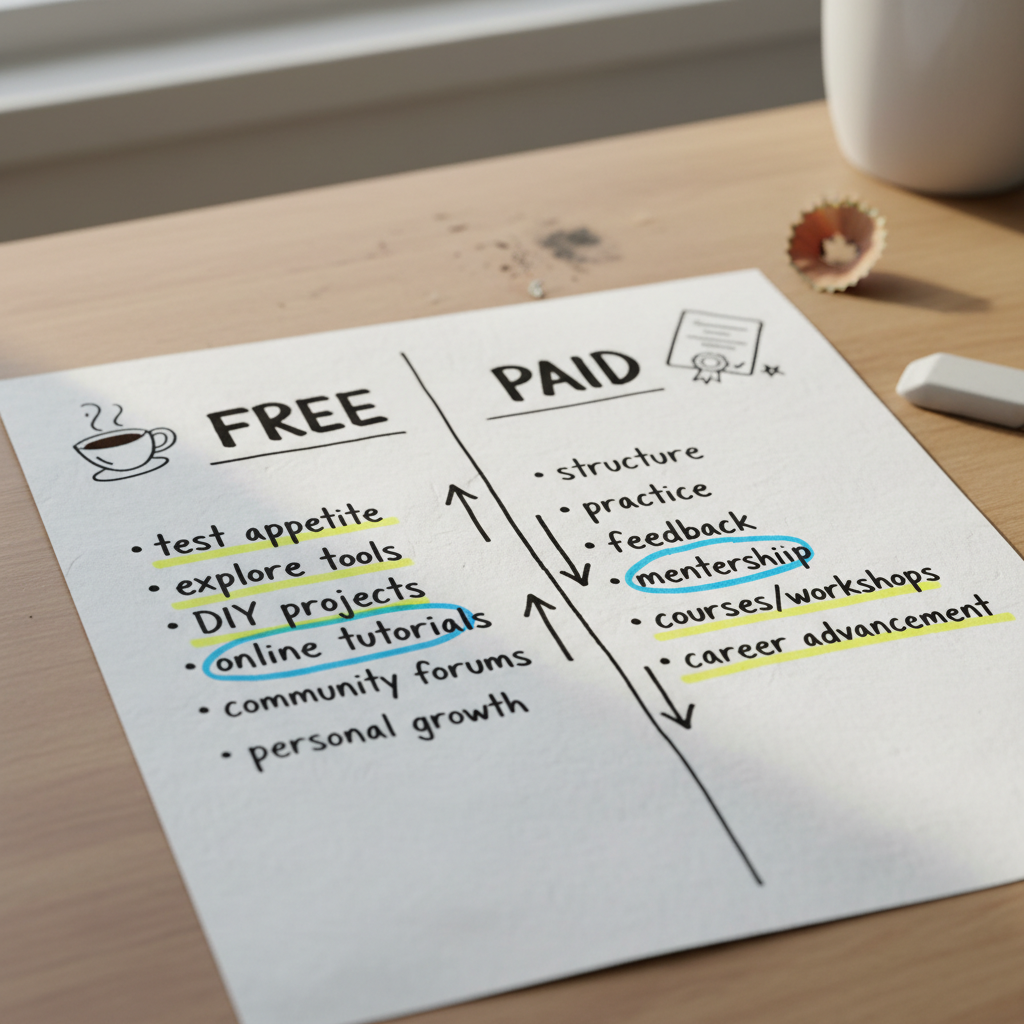
Start free to test interest; move to paid for structure, practice and feedback.
A recurring question is whether you can upskill purely on free resources. The honest answer: you can start free, but free content rarely creates job-ready capability on its own.
Free courses are excellent for:
- Testing whether you enjoy AI learning
- Building base familiarity with tools
- Understanding AI concepts at your own pace
- Deciding whether a deeper investment is worthwhile
Paid courses justify their cost when they offer:
- Structured progression from beginner to applied skill
- Live, practical exercises with feedback from an instructor
- Recognised certificates that carry weight with employers
- Role relevance — content built around your actual work
- Responsible-use grounding so you adopt AI safely
Many Malaysian professionals also fund training through their employers, sometimes via HRDC-claimable programmes. AIHQ is a registered HRD Corp training provider, and its programmes can be structured to be HRDC claimable subject to client eligibility, grant approval and HRD Corp submission requirements — approval is never guaranteed.
Online vs In-Person AI Training in Malaysia
Delivery format shapes how much you actually retain.
Online, self-paced learning is flexible, affordable and ideal for busy schedules. It suits foundational content and independent professionals who learn well from video and reading. Its weakness is limited feedback and accountability — it is easy to watch a course and feel confident while never applying the skill.
Instructor-led and in-person workshops are stronger for applied learning. Live sessions allow you to ask questions, practise on real examples and get immediate correction. In a corporate setting, in-person role-based AI training builds consistent habits across a whole team rather than leaving each person to improvise alone.
For most professionals serious about career impact, a blended approach works best: free or low-cost online courses for foundations, then a structured, applied programme for the skills that actually move your career forward.
Certification Value: Which Certificates Actually Matter?
Not all certificates are equal, and Malaysian employers are getting better at spotting the difference.
Certificates that carry genuine weight generally come from:
- Respected universities and established learning platforms with verifiable credentials
- Vendor-recognised programmes (Microsoft, Google, major AI platforms)
- Specialist providers whose certificates are tied to demonstrated, applied skills rather than attendance alone
Be wary of courses offering ornate certificates in exchange for short quizzes and little real practice. What employers value most is a certificate that sits on top of demonstrable skill — usually proven through a portfolio, a work example or an interview conversation about how you applied AI.
When shortlisting courses, ask each provider: What will I be able to do differently at the end of this course, and how will that be assessed?
A Practical Route to AI Upskilling in 2026
If you want a simple path forward, here is one that works for most Malaysian professionals:
- Start free. Complete a foundational literacy course to confirm your interest and baseline.
- Connect AI to your role. Find a course or workshop built around your department's real tasks — not a generic prompt tutorial.
- Practise with governance in mind. Learn how to use AI responsibly, especially with confidential data, and how to review AI output critically.
- Move toward implementation. If your team needs more than off-the-shelf tools, explore structured support and custom solutions.
- Measure, then build again. Track how AI changes your workflow so your next learning step is based on evidence, not hype.
Choosing Organisational vs Individual Training
If you are an HR, L&D or department leader deciding on behalf of a team, the calculus shifts. Individual courses treat each employee separately; organisational training builds a shared capability baseline.
For teams, the strongest return usually comes from programmes that:
- Align with the business's actual processes and priorities
- Distinguish between fundamentals, role-based usage and advanced implementation needs
- Include governance so teams adopt AI safely and consistently
- Connect where training ends and where custom implementation support begins
If your team has trained individuals but seen little day-to-day change, the gap is usually not training quality — it is that generic content was never tied to real workflows or supported with structured rollout.
Pick a Course That Moves Your Career — Not Just Your Certificate Collection
The most practical AI training courses in Malaysia for 2026 share one trait: they connect capability to real work. Whether you choose a free foundational course, a role-based workshop or technical agentic AI training, judge every option by whether it changes what you can actually do.
Start where you are, be honest about your gaps, and choose a progression that leads you from awareness into applied skill and real workflow impact. That is what employers — and the Malaysian job market — reward.
FAQ
Are any good AI courses in Malaysia completely free?
Yes. Respected platforms like Coursera, edX and Google's skills programmes offer foundational AI courses that are free to audit, with optional paid certificates. These are excellent for testing your interest and building basic literacy before committing to a deeper, paid programme that delivers practical applied skill.
What is the difference between a generic AI course and role-based AI training?
A generic course teaches one tool's features to everyone the same way. Role-based AI training is built around the actual tasks of specific departments — how an HR executive, finance analyst or customer service lead uses AI differently on real workflows. Role-based training generally creates stronger, more lasting adoption because the learning maps directly to daily work.
Do I need a certificate for my AI course to help my career in Malaysia?
A recognised certificate can strengthen your CV, but employers increasingly value demonstrated skill over certificates alone. The strongest approach pairs a credible certificate with tangible proof — such as a work example or a clear explanation of how you applied AI to improve a workflow.
Is agentic AI training suitable for non-technical professionals?
Some agentic AI training is geared toward developers and IT teams working with APIs and automation, but concepts around AI agents, internal copilots and workflow automation are increasingly relevant to non-technical roles too. Start with applied, concept-level training before moving to technical depth, and keep governance and human oversight in mind.
Can Malaysian employers fund AI training through HRDC?
AIHQ is a registered HRD Corp training provider, and its programmes can be structured to be HRDC claimable. However, eligibility, grant approval and HRD Corp submission requirements all apply — so HRDC approval is never guaranteed and should be confirmed on a case-by-case basis.
How do I choose between online and in-person AI training?
Online self-paced courses are flexible and affordable, ideal for foundations and independent learning. In-person or instructor-led workshops are stronger for applied skill because they offer live feedback and real practice. Many professionals get the best result by blending free online foundations with a structured, applied in-person programme.