General
Best AI Training Courses in Malaysia for Professionals (2025)
· By AIHQ Team

The AI training landscape in Malaysia has matured rapidly. Walking into a two-hour ChatGPT workshop is no longer enough for professionals who want to build real capability — and it is certainly not enough for organisations trying to move from scattered experimentation to structured adoption.
With over 9,000 professionals trained across corporate, public sector and regulated environments, AIHQ has observed that the difference between AI awareness and real workplace impact comes down to the type of training you choose. A free certificate can build confidence. A half-day tool demo can create interest. But sustainable capability requires structured, role-aligned and outcome-aware programmes.
This guide curates the best AI training courses in Malaysia for professionals in 2025 — organised by what each type of programme is best suited for, so you can match the training to your role, your team's maturity and your business priorities.
1. AI Fundamentals and GenAI Literacy Programmes
Best for: General workforce, professionals new to AI, organisations building baseline awareness
Before any department can adopt AI meaningfully, the broader workforce needs a shared understanding of what Generative AI can and cannot do. Fundamentals programmes cover LLM basics, practical tool usage, prompt design, limitations and safe use principles.
What to look for:
- Covers both opportunity and risk (not just the exciting features)
- Includes practical exercises connected to real workplace scenarios
- Addresses data privacy, confidentiality and responsible use from day one
- Designed for non-technical audiences
AIHQ's AI training programmes include fundamentals modules that help entire organisations move from curiosity to confident baseline usage — without oversimplifying adoption or overpromising results.
2. Role-Based AI Training for Departments
Best for: HR, finance, marketing, customer service, operations, legal and other functional teams
Generic AI training produces generic outcomes. The most effective upskilling happens when training is mapped to the actual workflows, documents and decisions a team handles daily.
Department-specific examples:
- HR teams — AI for job description drafting, interview question design, policy Q&A and employee communications
- Finance teams — AI for report summarisation, variance analysis, reconciliation support and narrative commentary
- Marketing teams — AI for content briefs, audience analysis, campaign summaries and multilingual content adaptation
- Customer service teams — AI for response drafting, escalation triage and knowledge base search
What to look for:
- Training content based on real departmental tasks, not generic prompts
- Hands-on exercises using examples from your industry
- Guidance on when to use AI and when human judgment is essential
AIHQ's role-based AI training is designed to help teams apply AI to actual work outputs, supported by trainers who understand both the tool and the business context.
3. Leadership AI Alignment and Strategy Briefings
Best for: CEOs, boards, EXCOs, HODs, senior management
Leadership alignment should precede large-scale AI rollout. Without a shared understanding of AI's strategic implications, governance risks and adoption priorities, organisations risk fragmented experimentation, unclear decision rights and wasted investment.
What an effective leadership briefing covers:
- AI business implications for your sector and operating model
- Governance, risk and decision rights
- Separating value creation from vendor hype
- Building an adoption roadmap that connects awareness to measurable outcomes
- Responsible use and data privacy considerations at the leadership level
What to look for:
- Designed for senior decision-makers, not technical teams
- Strategic, concise and grounded in real organisational experience
- Does not promise guaranteed outcomes but provides a decision framework
AIHQ has delivered executive AI briefings for organisations including Lion Group, MTD Group, Parkland Group and MUI Group, with senior leaders present. These sessions help leadership teams align before investing in training or tools.
4. Responsible AI and Governance Workshops
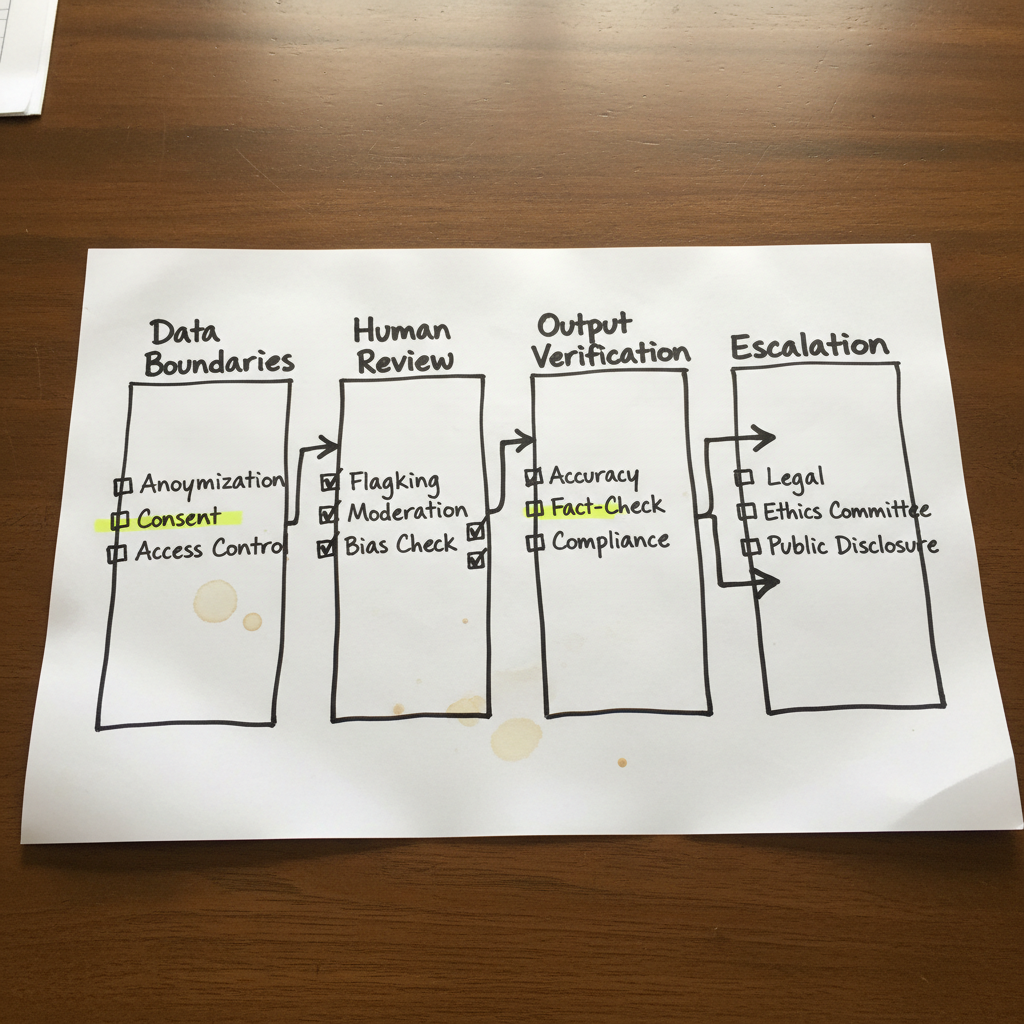
Practical AI governance workshops translate policy into daily team behaviour and workflows.
Best for: Risk, compliance, legal, leadership teams, regulated organisations, public sector
As AI usage scales inside an organisation, responsible use cannot remain a policy document on a shared drive. Teams need practical governance training that translates principles into daily behaviour — data handling boundaries, human review practices, AI output verification and escalation workflows.
What a governance workshop covers:
- Building an organisational AI use policy that people actually follow
- Data confidentiality and safe AI usage guidelines
- Accuracy, accountability and human-in-the-loop principles
- Regulatory awareness without providing legal advice
What to look for:
- Practical, not theoretical — focused on behaviour and workflows
- Tailored to your organisation's risk profile and sector
- Should connect to your existing compliance frameworks
AIHQ's responsible AI and governance training helps organisations scale AI usage safely, particularly for teams in regulated environments.
5. Technical AI Training for Developers and IT Teams
Best for: Software engineers, IT teams, data teams, technical leads
For technical audiences, AI training goes beyond prompt engineering. Effective programmes cover AI-assisted coding, API integration, coding copilots, debugging workflows, agentic concepts and evaluating AI tools for production readiness.
What to look for:
- Practical coding exercises using real tools (GitHub Copilot, Claude, OpenAI APIs)
- Guidance on when AI-generated code needs human review and testing
- Coverage of agentic AI workflows and automation architecture
- Business-to-tech translation skills — helping technical teams understand what stakeholders actually need
AIHQ's technical training modules help developer teams adopt AI without weakening engineering judgment or bypassing quality controls.
6. AI Innovation Bootcamps and Use-Case Discovery
Best for: Innovation teams, transformation leads, cross-functional project groups
Many organisations struggle not with using AI tools, but with identifying which workflows are actually worth transforming. An innovation bootcamp helps teams audit processes, brainstorm opportunities, prioritise use cases and plan pilot projects.
What an effective bootcamp produces:
- A prioritised list of AI use cases connected to real business pain points
- A pilot-ready workflow or prototype concept
- Shared vocabulary between business and technical teams
- An adoption roadmap for the next 30–90 days
What to look for:
- Structured facilitation, not a free-form brainstorming session
- Outputs that connect directly to business priorities
- Support for post-bootcamp implementation, not just ideation
AIHQ's AI innovation bootcamp helps teams move from "what could we do with AI?" to "what should we actually build or try first?"
7. Custom AI Solutions Training and Implementation Support
Best for: Teams that need more than off-the-shelf tools
Some workflows cannot be solved by ChatGPT, Gemini or Copilot alone. When an organisation needs an internal copilot, a customer enquiry chatbot, a knowledge system or workflow automation, the training shifts from "how to use a tool" to "how to design, test and adopt a solution."
What this involves:
- Workflow audit to identify where automation creates real value
- Solution design sessions with business and technical stakeholders
- Training on how to use, maintain and improve the custom solution
- Change management support for adoption
What to look for:
- A provider that offers both training and implementation capability
- Solutions designed for your specific workflows, not generic templates
- Clear handover so your team can manage the solution post-deployment
AIHQ's custom AI solutions team helps organisations design chatbots, internal copilots and automation workflows that off-the-shelf tools cannot address.
How to Choose the Right AI Training Path for Your Team
| If your team needs... | Start with... |
|---|---|
| Baseline AI confidence for everyone | Fundamentals programme |
| Department-specific workflows improved | Role-based training |
| Leadership clarity before investment | Executive AI briefing |
| Safe AI usage and policy | Governance workshop |
| Technical team capability | Developer AI training |
| Use-case prioritisation | Innovation bootcamp |
| A custom workflow solution | Custom AI consultation |
There is no single "best" AI training course in Malaysia that fits every professional or organisation. The right choice depends on your current maturity, your role and your business priorities.
Build Structured AI Capability with AIHQ
Whether you are starting with workforce fundamentals, aligning your leadership team, or building a custom AI workflow, AIHQ can help you design a structured AI adoption path that fits your context.
Over 9,000 professionals have engaged with AIHQ programmes across corporate organisations, government agencies, professional institutions and regulated sectors. Our approach is practical, role-based and outcome-aware — without overpromising transformation or guaranteed ROI.
FAQ
What is the best AI training course in Malaysia for working professionals?
The best course depends on your role and experience level. For general workforce upskilling, start with a fundamentals programme covering GenAI literacy, prompt design and safe use. For department-specific impact, choose role-based training tailored to your team's workflows (HR, finance, marketing, etc.). Leadership teams benefit most from an executive AI briefing before investing in organisation-wide rollout.
Are there AI training courses in Malaysia that are HRDC claimable?
Yes. AIHQ is a registered HRD Corp training provider, and its programmes can be structured to be HRDC claimable, subject to client eligibility, grant approval and HRD Corp submission requirements. Always verify eligibility with your HR team and the grant body before planning.
How is role-based AI training different from a general ChatGPT workshop?
A general ChatGPT workshop teaches tool features and generic prompting. Role-based AI training connects AI usage to actual departmental workflows — for example, how a finance team uses AI for variance analysis and report summarisation, or how HR uses it for policy Q&A and job descriptions. This leads to higher adoption and more practical workplace impact.
Do I need technical skills to attend an AI training course?
Not for fundamentals, role-based or leadership programmes. These are designed for non-technical professionals. Technical AI training for developers and IT teams does require some programming familiarity.
What should organisations do before enrolling staff in AI training?
Leadership alignment is recommended first. Without a shared understanding of AI's strategic implications, governance risks and adoption priorities, training investments may not translate into sustained capability. An executive briefing or leadership alignment session can help organisations plan before they train.
Can AIHQ help if my team needs a custom AI tool, not just training?
Yes. AIHQ provides both training and custom AI solutions — including internal copilots, customer enquiry chatbots, workflow automation and knowledge systems. If off-the-shelf tools cannot address your workflow, a custom solution may be more appropriate.