General
ChatGPT Adoption in Malaysian Enterprises: A Practical Guide
· By AIHQ Team

Enterprise interest in ChatGPT has moved quickly from curiosity to active deployment across Malaysian organisations. Teams are using it for drafting reports, summarising meeting notes, generating marketing copy and supporting customer service responses.
But the gap between individual experimentation and organisation-wide adoption is wide. Without structured governance, role-based capability building and a clear understanding of how tools like ChatGPT behave in local languages and regulated environments, enterprises risk inconsistent usage, data exposure and low return on effort.
This guide covers what Malaysian enterprises need to know before scaling ChatGPT adoption—from Bahasa Melayu support and data sovereignty to workforce training and governance guardrails.
Why Malaysian Enterprises Are Adopting ChatGPT
The appeal is practical. ChatGPT offers a low-entry way for teams to accelerate writing, research, summarisation and brainstorming tasks. Malaysian professionals across sectors are using it to draft internal communications, refine client-facing materials and reduce time spent on repetitive documentation.
For enterprise decision-makers, the question is no longer whether teams will use ChatGPT. It is whether the organisation can adopt it in a way that is effective, responsible and sustainable.
Bahasa Melayu Support: What Enterprises Should Know
For Malaysian organisations with Bahasa Melayu as a core working language—especially in government-linked companies, public sector agencies and local enterprises—language support matters.
ChatGPT handles Bahasa Melayu with reasonable fluency for general writing, summarisation and translation tasks. However, enterprise teams using it for formal correspondence, regulatory documentation or culturally nuanced client communication should apply human review.
Key limitations to be aware of:
- Formal versus informal register: ChatGPT may default to casual or mixed register unless specifically instructed to use formal Bahasa Melayu baku.
- Industry-specific terminology: Terms used in Malaysian legal, financial or regulatory contexts may not be recognised accurately without custom instructions or fine-tuned prompts.
- Consistency at scale: For enterprises standardising Bahasa Melayu output across departments, off-the-shelf ChatGPT may produce inconsistent tone and vocabulary.
Organisations working with Bahasa Melayu-heavy workflows can benefit from prompt guidelines tailored to their industry language and from training teams to evaluate and refine AI-generated Malay content.
Data Privacy and Sovereignty Considerations
When employees use ChatGPT at work—especially the free version—data entered into prompts is processed through OpenAI's servers, which may be hosted outside Malaysia. For enterprises handling confidential client data, financial records or sensitive internal information, this raises important questions.
What enterprises should evaluate:
- ChatGPT Free and Plus: Data may be used for model training unless opted out. Not suitable for confidential or regulated data.
- ChatGPT Team and Enterprise tiers: Offer data privacy controls where prompts and conversations are not used for training. Enterprise tier includes SOC 2 compliance and data encryption at rest.
- API usage: Organisations integrating ChatGPT via API can configure data retention policies and choose regional hosting where available.
Practical steps for Malaysian enterprises:
- Classify what types of information are safe to use with ChatGPT. Customer names, financial figures and internal strategy documents should be treated as restricted.
- Establish clear guidelines on which version or tier employees should use based on task sensitivity.
- Consider that data residency requirements may apply depending on your sector. Organisations in regulated industries should consult their data protection or legal team before approving enterprise-wide use.
- Train employees to anonymise or remove sensitive details before pasting information into any public AI tool.
AIHQ offers responsible AI training and governance sessions that help organisations set practical guardrails for safe AI adoption.
Moving from Individual Use to Enterprise-Wide Capability
One of the most common challenges we see is adoption remaining at the individual level. A few team members become confident ChatGPT users, but the rest of the organisation either avoids it, uses it inconsistently or uses it without understanding limitations.
Sustainable enterprise adoption requires a structured approach:
1. Awareness and Foundations
Before teams can use ChatGPT effectively, they need a baseline understanding of how large language models work—including their limitations. This includes recognising that ChatGPT can produce confident-sounding but incorrect answers, that it does not reason like a human, and that every output requires human judgment.
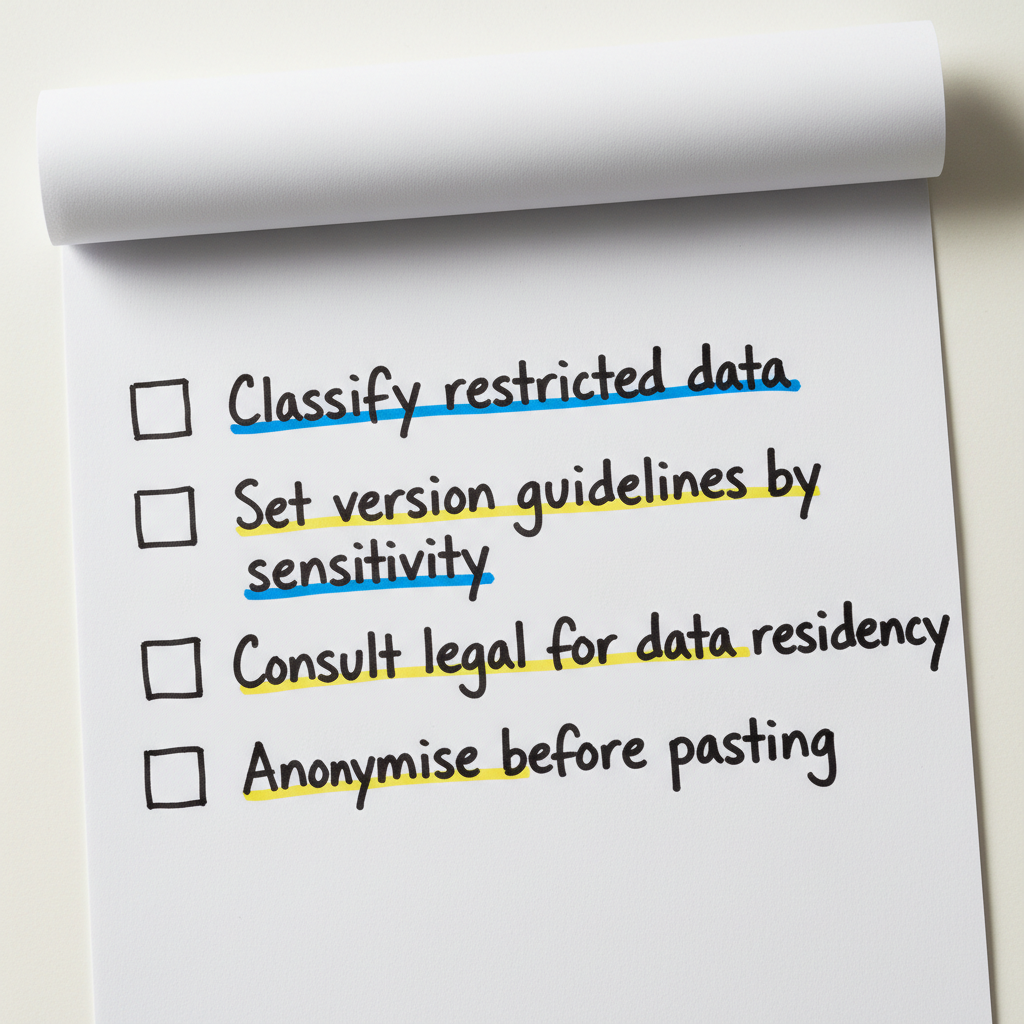
Establishing clear data privacy guidelines protects your organisation before scaling AI usage.
2. Role-Based Capability Building
Generic one-hour ChatGPT workshops rarely create lasting adoption. Teams need training connected to their actual work:
- HR teams drafting policies, job descriptions and internal communications
- Finance teams summarising reports, drafting commentary and checking documentation
- Marketing teams generating campaign drafts, ad copy and content variations
- Customer service teams drafting responses and summarising enquiry patterns
AIHQ's role-based AI training programmes are designed to help teams apply ChatGPT and similar tools to real departmental workflows.
3. Workflow Integration
Adoption becomes sustainable when ChatGPT usage is built into how work actually happens—not treated as a separate activity. This might mean using ChatGPT as part of a drafting workflow, embedding it into research processes or connecting it to internal knowledge bases through custom solutions.
4. Governance and Responsible Use
As ChatGPT usage scales, governance becomes essential. Organisations should define:
- What types of data are safe to share with AI tools
- How AI-generated content is reviewed before use
- Who is responsible for outputs in regulated workflows
- When human oversight is mandatory
For organisations scaling AI usage, AIHQ supports responsible AI and governance workshops designed to help teams use AI safely and appropriately.
Common Pitfalls in Enterprise ChatGPT Adoption
Pitfall 1: Treating ChatGPT as a finished product ChatGPT is a general-purpose language model, not a custom-built enterprise system. It works well for many tasks but is not optimised for your organisation's specific processes, terminology or data. Off-the-shelf tools are useful, but some workflows require custom AI solutions or structured implementation.
Pitfall 2: Assuming prompting skills are enough Prompting is useful, but sustainable adoption requires role-based capability, workflow thinking, governance and leadership alignment. It is not sufficient to simply teach employees how to write better prompts.
Pitfall 3: Skipping governance until something goes wrong Organisations that wait until after a data incident or compliance issue to set AI policies often find it harder to implement guardrails retrospectively. Starting governance conversations early makes scaling safer.
Pitfall 4: Over-relying on ChatGPT for Bahasa Melayu formal documents While ChatGPT handles conversational Malay reasonably well, formal documentation—especially in legal, regulatory or government contexts—requires careful human review and editing.
When to Consider Custom AI Solutions
Not every workflow is suited to ChatGPT. If your organisation needs:
- A chatbot trained on your specific SOPs, policies or product catalogue
- An internal copilot that answers employee questions from your knowledge base
- Automated workflows that connect ChatGPT capabilities to your existing systems
Then off-the-shelf ChatGPT may not be enough. AIHQ's custom AI solutions help organisations build AI workflows tailored to their data, processes and compliance requirements.
A Practical Roadmap for Malaysian Enterprises
| Stage | Focus | Typical Activities |
|---|---|---|
| 1. Assess | Understanding readiness | Audit current tool usage, identify risks, classify data sensitivity |
| 2. Align | Leadership and governance alignment | Define policies, set usage boundaries, identify responsible owners |
| 3. Build capability | Role-based workforce training | Train teams on practical ChatGPT use in their specific workflows |
| 4. Scale | Structured adoption across departments | Integrate tools into processes, monitor usage, refine guidelines |
| 5. Optimise | Custom solutions and automation | Identify workflows that need tailored AI tools beyond ChatGPT |
Leadership Alignment Matters Before Scale
One of the most important factors in successful enterprise adoption is leadership alignment. When senior leaders understand what ChatGPT can and cannot do—and when they communicate clear expectations about responsible use—adoption becomes more consistent and less risky.
For leadership teams planning AI adoption, AIHQ can support an executive briefing to align strategy, risks, governance and practical next steps.
Conclusion
ChatGPT adoption in Malaysian enterprises is not simply about giving everyone access to a new tool. It requires structured thinking about language support, data privacy, workforce capability, governance and the workflows where AI adds real value.
Organisations that approach adoption thoughtfully—starting with awareness, moving through role-based training, embedding governance early and evaluating custom solutions where needed—will be better positioned to use AI in ways that are both productive and responsible.
FAQ
Is ChatGPT safe for Malaysian enterprise data?
It depends on the version used and the type of data shared. ChatGPT Free and Plus do not offer data privacy guarantees for enterprise use. ChatGPT Team and Enterprise tiers include stronger data protection controls. Organisations should classify their data, use appropriate tiers and train employees on safe usage practices.
Does ChatGPT support Bahasa Melayu well for business use?
ChatGPT handles conversational Bahasa Melayu reasonably well, but formal business or regulatory language requires human review. Organisations working with formal Malay documentation should set clear prompt guidelines and verify outputs before use.
What is the difference between ChatGPT and a custom AI solution?
ChatGPT is a general-purpose language model. A custom AI solution is built around your organisation's specific data, workflows and compliance needs. Off-the-shelf tools are useful for many tasks, but some workflows require tailored implementation.
How can Malaysian enterprises ensure responsible ChatGPT usage?
By establishing clear usage policies, classifying data sensitivity, training employees on safe adoption, reviewing AI-generated content before publishing and starting governance conversations early. AIHQ offers responsible AI and governance workshops to support this.
What is the first step for a Malaysian enterprise adopting ChatGPT?
Start with an assessment of current tool usage, identify data risks, align leadership on adoption goals and build role-based workforce training before scaling across departments.
Can AIHQ help with ChatGPT training for our teams?
Yes. AIHQ provides role-based AI training programmes designed to help teams apply ChatGPT and similar tools to their actual departmental workflows. Contact AIHQ to discuss a training roadmap aligned with your organisation's needs.