General
ChatGPT in Bahasa Melayu: What Enterprise Deployments Mean for Malaysian Businesses
· By AIHQ Team

When OpenAI rolled out ChatGPT in Bahasa Melayu, it was more than a language toggle. For Malaysian enterprises, it raised a practical question: can this tool meaningfully serve our Bahasa Melayu-speaking customers, employees and stakeholders?
For years, Bahasa Melayu was an afterthought in the global AI landscape. English dominated training data, benchmarks and product roadmaps. Local users who tested ChatGPT in Bahasa Melayu often noticed clunky phrasing, unnatural sentence structures and a lack of cultural nuance. But the gap is narrowing — and the implications for Malaysian businesses are worth examining.
This article explores what Bahasa Melayu ChatGPT means for enterprise deployments, where it works well, where it still falls short, and what organisations should consider before building customer-facing or internal AI chatbots around it.
The State of Bahasa Melayu in AI Today
Bahasa Melayu is spoken by over 250 million people across Malaysia, Indonesia, Brunei and Singapore. Yet it remains an under-resourced language in natural language processing (NLP). Most large language models (LLMs) are trained predominantly on English internet content — Common Crawl, Wikipedia, Reddit, books and academic papers.
Because Bahasa Melayu makes up a tiny fraction of training data, models can struggle with:
- Colloquial variations — pasar malam Malay, Manglish, regional dialects and code-switching with English
- Cultural references — local terms like lepak, makan angin, or gotong-royong that don't translate directly
- Context-appropriate formality — knowing when to use awak versus anda versus kamu in customer-facing interactions
- Industry-specific terminology — legal, financial or technical Malay terms that models rarely encounter in training
OpenAI's Bahasa Melayu support has improved significantly. But production-grade enterprise deployment requires more than a passable translation layer.
Where Bahasa Melayu ChatGPT Works Well for Enterprises
Customer Service Tiers
For first-line customer enquiries — business hours, order status, product information, simple troubleshooting — ChatGPT in Bahasa Melayu can handle a meaningful volume of basic interactions. Many Malaysian consumers prefer being served in their own language, and a well-configured chatbot can improve response times and reduce pressure on human agents.
Internal Knowledge Access
Organisations with Bahasa Melayu SOPs, policy documents or internal guides can deploy ChatGPT-style interfaces to help employees find answers faster. This is particularly useful for public sector agencies, GLCs, educational institutions and organisations with significant Malay-speaking workforces.
Content Drafting and Translation
Marketing teams, corporate communications units and content creators can use ChatGPT in Bahasa Melayu to draft email blasts, social media posts, internal memos and basic reports. Human review is still essential, but the drafting speed improves noticeably.
Where Gaps Remain
Accuracy and Hallucination Risks
Every LLM occasionally generates confident-sounding but incorrect information. In Bahasa Melayu, this risk can be higher because the model has less training data to draw from. A chatbot that tells a customer the wrong refund policy in polite, fluent Malay is still giving the wrong answer.
Enterprises must decide: is this acceptable for your use case? If the answer is no, you need guardrails, escalation paths and human review loops.
Domain-Specific Language
If your business uses specialised Bahasa Melayu vocabulary — think insurance policy language (polisi insurans, tuntutan, pengunderaitan), legal terms, or technical engineering terms — off-the-shelf ChatGPT may not perform consistently. Training a custom model or fine-tuning a retrieval-augmented generation (RAG) pipeline with your organisation's documents is often necessary.
Consistency Across Conversations
A Bahasa Melayu chatbot that works well for one customer query may stumble on another with slightly different phrasing. Malaysian users also frequently mix Malay and English mid-sentence (Saya nak check status pesanan saya), which can confuse models not explicitly trained for code-switching.
What This Means for Malaysian Enterprises Considering AI Chatbots
Language Is a Customer Experience Decision
If your organisation serves a Bahasa Melayu-speaking audience — locally or regionally — language support is not optional. It directly affects how customers perceive your brand's accessibility, responsiveness and local relevance.
A chatbot that can't handle simple Malay queries comfortably will push users toward human agents or worse, toward frustration. Conversely, a well-implemented Bahasa Melayu chatbot can strengthen customer trust and reduce service bottlenecks.
Off-the-Shelf vs Custom AI Chatbots
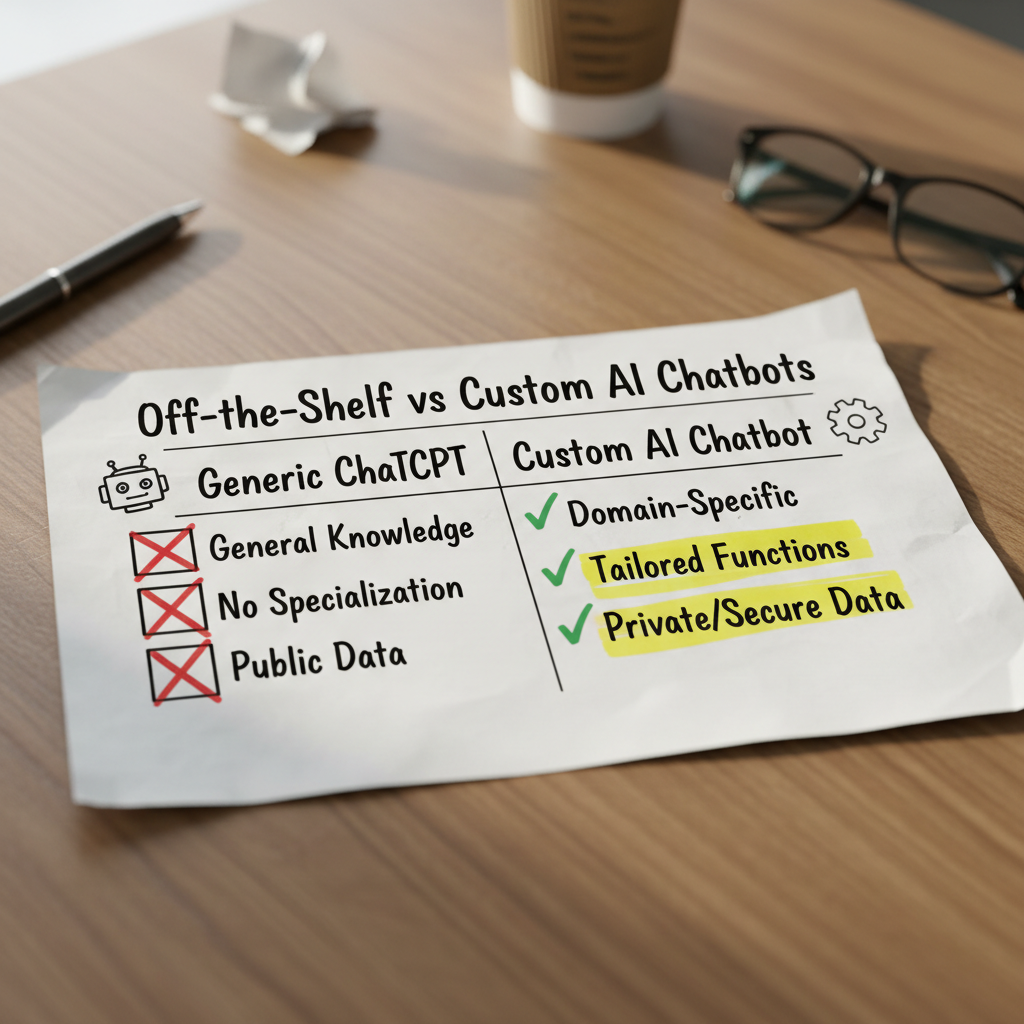
Off-the-shelf versus custom AI chatbots: a practical comparison for Malaysian enterprises.
This is where many enterprises face a fork in the road.
Off-the-shelf ChatGPT is useful for simple FAQ handling, internal knowledge queries and content generation. It deploys quickly and requires minimal technical setup. However, it lacks control over accuracy, brand voice, language consistency and data privacy.
Custom AI chatbots — built on your organisation's data, configured for your language requirements, and deployed with escalation workflows — offer more predictable outcomes. They can be trained or augmented with your Bahasa Melayu documents, SOPs, product catalogues and customer interaction history. The trade-off is time and investment.
AIHQ works with both approaches. The right choice depends on your use case, volume, language complexity and risk tolerance.
Data Privacy and Responsible Use
Malaysian enterprises deploying AI chatbots — whether in English or Bahasa Melayu — should establish clear guardrails around data privacy. Where is customer data processed? Is it used for model training? Can sensitive information be protected?
Organisations should invest in responsible AI training and governance before rolling out customer-facing chatbots, especially in regulated sectors.
What a Bahasa Melayu Enterprise AI Strategy Could Look Like
Rather than treating Bahasa Melayu chatbot support as a standalone project, progressive Malaysian enterprises are embedding it into a broader AI adoption approach:
- Audit your language needs — Which customer segments, internal teams or processes genuinely need Bahasa Melayu support?
- Evaluate off-the-shelf performance — Test ChatGPT in Bahasa Melayu against your real queries before committing to a deployment
- Identify where customisation adds value — If accuracy, domain terminology or brand consistency matters, explore custom AI solutions like a RAG pipeline or fine-tuned model
- Build human review into workflows — No current LLM should operate unsupervised in Bahasa Melayu customer-facing roles
- Train your teams — Equip customer service, operations and content teams with role-based AI training so they understand the tool's strengths and limitations
The Bigger Picture for Malaysian Enterprises
Bahasa Melayu ChatGPT is not a finished product — but it is a meaningful step. For Malaysian enterprises, the question is not whether to use it, but where and how.
The organisations that benefit most will be those that treat language support as part of a structured AI capability journey — not a quick checkbox. They will test before deploying, customise where needed, train their teams, and keep human judgment at the centre.
AIHQ has trained and engaged over 9,000 professionals in AI and Generative AI, across corporate, public sector and regulated environments. We help organisations move beyond ChatGPT experimentation into practical, role-based adoption — whether that means training teams to use off-the-shelf tools more effectively or designing custom solutions where generic tools are not enough.
FAQ
Is ChatGPT in Bahasa Melayu accurate enough for customer-facing use?
For basic enquiries and simple FAQ-style interactions, ChatGPT in Bahasa Melayu can perform adequately. However, accuracy drops with specialised terminology, complex instructions or code-switched language. Enterprises should test against real scenarios and implement human escalation paths before deploying.
Can I build a custom AI chatbot in Bahasa Melayu for my organisation?
Yes. Custom AI chatbots can be built using your organisation's Bahasa Melayu documents, product catalogues, SOPs and interaction history. This improves accuracy and brand consistency compared to off-the-shelf solutions. AIHQ supports custom AI chatbot development for organisations with specific language or workflow needs.
What are the main risks of using ChatGPT in Bahasa Melayu for business?
The main risks include lower accuracy on domain-specific terms, inconsistent handling of colloquial Malay and Manglish, data privacy concerns if customer information is processed externally, and the need for ongoing human oversight. Organisations should establish responsible use policies and governance frameworks.
Should I use an off-the-shelf ChatGPT or a custom AI chatbot for Bahasa Melayu?
It depends on your use case. Off-the-shelf tools work for simple, low-risk interactions. Custom solutions are better when accuracy, brand voice, domain-specific terminology, data privacy and escalation workflows matter. AIHQ offers both role-based training for off-the-shelf tools and custom AI solutions for organisations that need more.
How do I train my team to use ChatGPT in Bahasa Melayu responsibly?
Equip teams with structured, role-based training that covers practical usage, limitations, safe data practices and human review workflows. Generic tool workshops are less effective than programmes aligned to specific roles and workflows. Contact AIHQ to discuss a training roadmap.
Is Your Organisation Ready for Structured AI Adoption?
Language support is one piece of a larger AI adoption picture. Moving beyond isolated ChatGPT experiments into structured, organisation-wide capability requires leadership alignment, role-based training, governance and — where needed — custom solutions.
AIHQ helps enterprises design this journey. Whether you are exploring Bahasa Melayu chatbot deployment, planning workforce upskilling, or evaluating whether off-the-shelf tools are enough, we can help.
FAQ
Is ChatGPT in Bahasa Melayu accurate enough for customer-facing use?
For basic enquiries and simple FAQ-style interactions, ChatGPT in Bahasa Melayu can perform adequately. However, accuracy drops with specialised terminology, complex instructions or code-switched language. Enterprises should test against real scenarios and implement human escalation paths before deploying.
Can I build a custom AI chatbot in Bahasa Melayu for my organisation?
Yes. Custom AI chatbots can be built using your organisation's Bahasa Melayu documents, product catalogues, SOPs and interaction history. This improves accuracy and brand consistency compared to off-the-shelf solutions.
What are the main risks of using ChatGPT in Bahasa Melayu for business?
The main risks include lower accuracy on domain-specific terms, inconsistent handling of colloquial Malay and Manglish, data privacy concerns, and the need for ongoing human oversight. Organisations should establish responsible use policies and governance frameworks.
Should I use an off-the-shelf ChatGPT or a custom AI chatbot for Bahasa Melayu?
It depends on your use case. Off-the-shelf tools work for simple, low-risk interactions. Custom solutions are better when accuracy, brand voice, domain terminology, data privacy and escalation workflows matter.
How do I train my team to use ChatGPT in Bahasa Melayu responsibly?
Equip teams with structured, role-based training covering practical usage, limitations, safe data practices and human review workflows. Generic tool workshops are less effective than programmes aligned to specific roles and workflows.