General
ChatGPT Enterprise in Malaysia: A Practical Adoption Guide for Teams and Workflows
· By AIHQ Team

Many Malaysian organisations today are already using ChatGPT — but most are using it informally, inconsistently and without clear boundaries. Emails get drafted in one corner of the marketing team, meeting summaries get generated in another, and somewhere in Finance a staff member is experimenting with prompts no one has reviewed.
This is not a bad starting point. It proves there is genuine interest. But it is also how AI risk creeps in quietly: ungoverned usage, unclear data boundaries and no path from scattered experiments to repeatable workflows.
This guide is for leaders and teams in Malaysia who want to move from sporadic ChatGPT use to structured, responsible adoption across departments. We'll cover governance and data privacy under Malaysian regulations, how to structure a phased rollout, and how to think about measuring value — so you can move from pilot to production with confidence.
Start With Purpose, Not Tools
The most common mistake in ChatGPT enterprise adoption is deciding to adopt ChatGPT first and looking for problems it can solve afterwards. The tool becomes the starting point, which usually produces shallow usage and little real impact.
A more practical approach starts with a workflow audit. Ask which tasks across your organisation are repetitive, time-consuming or prone to inconsistency. Common examples include:
- Drafting and summarising internal documents and reports
- First-draft responses to routine customer enquiries
- Meeting notes, action items and follow-ups
- Research summaries and content drafting
- Internal knowledge retrieval from SOPs and policies
When you map where the friction actually sits, you begin to identify use cases that are genuinely worth piloting — rather than adopting AI for its own sake.
This is exactly the kind of structured discovery that an AI innovation bootcamp is designed to support: identifying and prioritising AI use cases that are worth moving forward.
Governance and Data Privacy First
Before your teams start pasting company information into any AI tool, you need clear guardrails. This is the part of adoption that most organisations leave until too late — and it is often the most important.
Key questions to settle early:
What is safe to share? Not every AI tool stores or treats your data the same way. Set a clear policy on what types of information can and cannot be entered — especially confidential company data, client information and personal data.
Who decides what is allowed? Assign responsibility for AI usage policy, even if it is a single person early on. Someone should own the boundaries and be able to answer team questions.
How do we handle accuracy? AI can produce confident-sounding but wrong output. Teams need to know which tasks require human review — especially anything customer-facing, regulatory or financial.
What about Malaysian data protection? Organisations handling personal data need to think carefully about what is uploaded, where it is processed and what the data protection obligations are. This is not about avoiding AI — it is about using it responsibly. Organisations should set clear guardrails, especially around confidential or sensitive information.
For teams building this capability deliberately, a responsible AI training and governance workshop can translate an abstract policy into practical employee behaviour.
Treat Data Privacy as a Design Principle
A common misconception is that any AI tool is automatically safe for company data. The reality is that data safety depends on tool settings, policies, the type of data involved and how people actually use it.
Practical steps for Malaysian organisations include:
- Classify your data. Not all information carries the same risk. Triage what is safe to use in general AI tools versus what should stay in controlled systems.
- Review the enterprise settings. Understand what the enterprise offering does and does not do with your data before you commit.
- Educate on boundaries. Most incidents come from well-meaning employees who did not realise they were doing something risky, not from malicious use.
- Keep humans in the loop. For high-stakes outputs, build a review step into the workflow rather than relying on the AI output unverified.
None of this is about restricting AI. It is about allowing teams to use it confidently because the boundaries are clear.
Build Capability Before You Scale
Once you have identified use cases and set guardrails, the next question is capability. A frequent error is assuming that if employees simply learn a few prompts, adoption will follow.
Prompting is useful — but sustainable adoption requires more. It requires role-based capability, workflow thinking, governance and leadership alignment.
This is why role-based AI training tends to create stronger usage than generic workshops. A finance team, a customer service team and a communications team all use ChatGPT differently. Their training should reflect that.
For example:
- Customer service benefits from structured drafts, escalation-aware responses and tone consistency.
- Finance benefits from summarising reports, drafting reconciliations notes and preparing analysis — with human judgment retained throughout.
- Marketing and communications benefit from ideation, content drafting and repurposing across channels.
When capability is built around real roles and real workflows, adoption becomes a natural part of how people work — not a separate activity they squeeze in.
Roll Out in Phases, Not All at Once
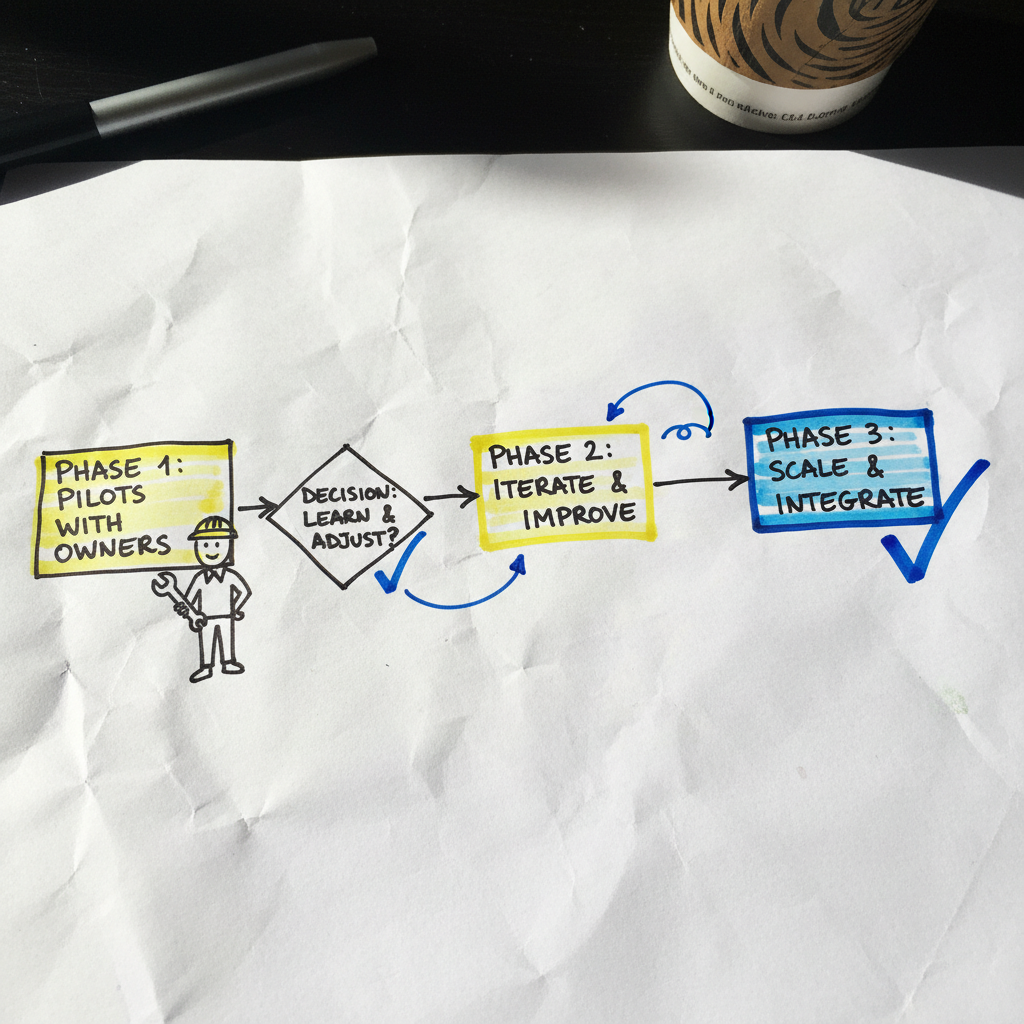
A phased rollout reduces risk and builds momentum before moving from pilot to production.
A structured rollout reduces risk and builds momentum. Consider a phased approach:
Phase 1: Pilots with clear owners. Select a small number of use cases that matter to the business. Give each pilot a named owner and a clear question to answer.
Phase 2: Learn and adjust. Review what worked, what produced weak output and where teams got stuck. Adjust your guardrails and training based on real experience.
Phase 3: Broaden capability. Expand training to more roles and departments using what you learned in the pilots.
Phase 4: Decide on customisation. Where off-the-shelf tools are not enough for a specific workflow, evaluate whether a custom AI solution — such as an internal copilot or chatbot — is appropriate.
This phased sequence keeps expectations realistic and gives you data on what actually creates value in your organisation rather than what looks impressive in a demo.
Measure Value, Not Just Usage
A common trap is measuring AI adoption by how many prompts employees generate. High usage is not the same as high value.
Better measures are tied to the specific use cases you chose to pilot. For example:
- Time taken to produce a routine document
- Consistency of drafting quality
- Time saved on meeting follow-ups
- Reduction in repetitive admin tasks
- Accuracy on tasks that have a clear correct answer
These can move toward measurable outcomes over time — but the exact figures will depend on your organisation, your workflows and how well adoption is followed through. No organisation should promise a specific ROI figure before it has measured its own baseline.
What matters is defining the measure up front, so you can show whether AI is genuinely improving how people work.
Know When Off-the-Shelf Is Not Enough
For many tasks, an off-the-shelf tool like ChatGPT is perfectly useful. But some workflows have requirements that a general tool does not meet cleanly — such as querying an organisation's own documents, enforcing specific policies, or routing complex enquiries to the right team.
In these cases, a custom AI chatbot or internal copilot that is tailored to your SOPs and processes may be a better fit. The guide is simple: use off-the-shelf tools where they genuinely work, and consider custom solutions where they do not.
Moving From Pilot to Production
ChatGPT enterprise adoption in Malaysia does not have to be an overwhelming project. It works best as a structured journey:
- Audit your workflows and pick real use cases.
- Set governance and data privacy guardrails early.
- Build role-based capability before you scale.
- Roll out in phases with named owners.
- Measure outcomes tied to your pilots.
- Escalate to custom solutions where off-the-shelf is not enough.
None of this requires believing that AI will transform everything overnight. It requires treating AI as a practical capability that your teams use responsibly and evaluate honestly.
To explore a structured AI training roadmap for your teams, discuss your AI adoption needs with AIHQ — designed around your roles, workflows and business priorities.
Frequently Asked Questions
Is ChatGPT enterprise adoption safe for company data in Malaysia?
Data safety depends on tool settings, your policies, the type of data involved and how your teams use the tool. The responsible approach is to classify your data, set clear guardrails, review the enterprise settings and keep human oversight for high-stakes outputs — especially around confidential or sensitive information.
How do we start ChatGPT adoption in our Malaysian organisation?
Start with a workflow audit rather than the tool itself. Identify repetitive, time-consuming or inconsistent tasks, then select a small number of high-value use cases to pilot with clear owners and defined measures. Governance and role-based training should come before broad rollout.
Does using ChatGPT require AI governance in Malaysia?
Yes. Governance does not need to be heavy, but someone should own the usage boundaries, and teams should know what is safe to share, what requires human review and who makes decisions. This is especially important where personal data or confidential information is involved.
Will ChatGPT replace our employees?
No. Used responsibly, AI can support employees by reducing repetitive work, improving workflows and strengthening decision support. The goal is human-centred adoption — better, more capable teams — not replacing people.
When should we consider a custom AI solution instead of ChatGPT?
When a workflow requires querying your own documents, enforcing your specific policies, or handling complex routing that a general tool does not do cleanly. In those cases, a tailored chatbot or internal copilot may be more appropriate than relying on an off-the-shelf tool alone.
How do we measure whether ChatGPT adoption is working?
Measure outcomes tied to your chosen use cases — such as time saved on specific documents, quality consistency or reduced admin load — rather than raw prompt counts. Define the measure before you start so you can compare against a baseline.
FAQ
Is ChatGPT enterprise adoption safe for company data in Malaysia?
Data safety depends on tool settings, your policies, the type of data involved and how your teams use the tool. The responsible approach is to classify your data, set clear guardrails, review the enterprise settings and keep human oversight for high-stakes outputs — especially around confidential or sensitive information.
How do we start ChatGPT adoption in our Malaysian organisation?
Start with a workflow audit rather than the tool itself. Identify repetitive, time-consuming or inconsistent tasks, then select a small number of high-value use cases to pilot with clear owners and defined measures. Governance and role-based training should come before broad rollout.
Will ChatGPT replace our employees?
No. Used responsibly, AI can support employees by reducing repetitive work, improving workflows and strengthening decision support. The goal is human-centred adoption — better, more capable teams — not replacing people.
When should we consider a custom AI solution instead of ChatGPT?
When a workflow requires querying your own documents, enforcing your specific policies, or handling complex routing that a general tool does not do cleanly. In those cases, a tailored chatbot or internal copilot may be more appropriate than relying on an off-the-shelf tool alone.
How do we measure whether ChatGPT adoption is working?
Measure outcomes tied to your chosen use cases — such as time saved on specific documents, quality consistency or reduced admin load — rather than raw prompt counts. Define the measure before you start so you can compare against a baseline.