General
ChatGPT Use Cases in Malaysia: How SMEs and Enterprises Are Leveraging AI
· By AIHQ Team

Most Malaysian businesses have heard of ChatGPT. Many teams are already experimenting with it — drafting emails, summarising reports, or asking it to explain a complex concept.
But the question we hear most often from leaders and department heads is not "What can ChatGPT do?" It's "What should we actually use it for?"
The gap between general awareness and practical application is where real value — or costly missteps — happens. When ChatGPT use is scattered and unguided, teams either overtrust the output or underuse the tool entirely.
This guide covers practical ChatGPT use cases in Malaysia across key industries, with realistic examples, local context, and guidance on moving from experimentation to structured adoption.
Why ChatGPT Use Cases Vary by Industry in Malaysia
Not all industries benefit from ChatGPT in the same way. A finance team handling reconciliation reports has different needs than a retail team managing customer enquiries or a logistics coordinator tracking shipments.
The common thread across successful ChatGPT adoption in Malaysian organisations is workflow thinking: identifying where ChatGPT can reduce repetitive work, improve drafting speed, or support decision-making — without replacing human judgment.
For SMEs with lean teams, ChatGPT can serve as an assistant across multiple roles. For enterprises, the focus is often on department-specific applications with guardrails for data privacy and accuracy.
Finance and Accounting: Streamlining Reports, Reconciliation and Documentation
Finance teams in Malaysia handle high volumes of structured and semi-structured information: reconciliation notes, audit reports, board papers, expense summaries, and compliance documentation.
Practical ChatGPT use cases for finance teams:
- Drafting variance explanations — Input monthly financial data and ask ChatGPT to produce a first draft of variance commentary for management review.
- Summarising lengthy reports — Paste regulatory guidelines or audit findings and request an executive summary tailored to your audience.
- Drafting email responses — For recurring supplier or client finance enquiries, ChatGPT can draft consistent replies that the team reviews before sending.
- Translating financial terms — For teams working across English and Bahasa Malaysia, ChatGPT can help draft bilingual finance communications or explain technical terms in simpler language.
Important caveat: ChatGPT should never be given direct access to confidential financial data through unsecured channels. Finance teams should use enterprise-grade AI tools with data privacy protections, or use ChatGPT with anonymised data. Every output requires human review — especially figures, calculations, and compliance-related content.
For teams wanting to build structured AI capability, role-based AI training can help finance professionals apply AI safely and effectively within their specific workflows.
Retail and E-Commerce: Customer Support, Product Descriptions and Market Insights
Malaysia's retail and e-commerce sector is competitive. Speed of response, quality of product information, and understanding customer sentiment can directly affect revenue.
Practical ChatGPT use cases for retail teams:
- Drafting product descriptions — Create consistent product copy for multiple platforms in English, Bahasa Malaysia, or Chinese, then customise per channel.
- Handling common customer enquiries — Use ChatGPT to draft response templates for frequently asked questions about shipping, returns, stock availability, and order status. A human agent reviews and sends.
- Summarising customer feedback — Paste batches of reviews or survey responses and ask ChatGPT to identify common themes, complaints, or requests.
- Brainstorming promotions — Generate ideas for seasonal campaigns, bundle offers, or social media posts aligned with current trends.
- Translating content for local audiences — ChatGPT's multilingual capability is useful for adapting marketing copy across Malaysia's diverse language landscape.
Retail teams dealing with very high enquiry volumes may find that off-the-shelf tools are not enough. Some organisations benefit from a custom AI chatbot designed for their specific product catalogue, policies, and customer service workflows.
Logistics and Supply Chain: Report Summaries, Status Updates and Documentation
Logistics and supply chain teams manage a constant flow of operational data: shipment statuses, inventory reports, delivery exception notes, and client updates.
Practical ChatGPT use cases for logistics teams:
- Drafting daily status summaries — Input raw tracking data and ask ChatGPT to produce a readable daily operations summary for management.
- Writing client update emails — Generate consistent shipment status communications based on standard exception codes or milestones.
- Summarising SOP documents — Logistics teams often work with lengthy standard operating procedures. ChatGPT can produce quick-reference summaries for frontline staff.
- Drafting incident reports — For delivery exceptions or warehouse issues, use ChatGPT to structure a clear first draft from bullet-point notes.
Logistics teams should be aware that ChatGPT's knowledge is not real-time. It cannot track live shipments or access your inventory system. Its value lies in processing and structuring information that humans provide.
For organisations where logistics documentation and reporting is a heavy manual burden, custom AI workflow automation may offer a more integrated solution.
Customer Service: Drafting, Categorising and Quality Control
Customer service teams across industries use ChatGPT to reduce the time spent on repetitive writing tasks while maintaining quality.
Practical ChatGPT use cases for customer service:
- Drafting responses to common tickets — Agents draft faster by using ChatGPT to produce an initial response, then customising it before sending.
- Summarising long customer threads — For complex or escalated cases, ChatGPT can produce a concise summary of the issue, history, and resolution status.
- Categorising enquiries — Paste a batch of tickets and ask ChatGPT to group them by type (billing, technical, account, general) for reporting.
- Maintaining consistent tone — Use a style prompt to ensure responses match your brand's voice across a team of agents.
Customer service leaders should set clear guidelines on when AI-assisted responses are appropriate and which types of enquiries require entirely human-written replies — especially sensitive, escalated, or high-value customer interactions.
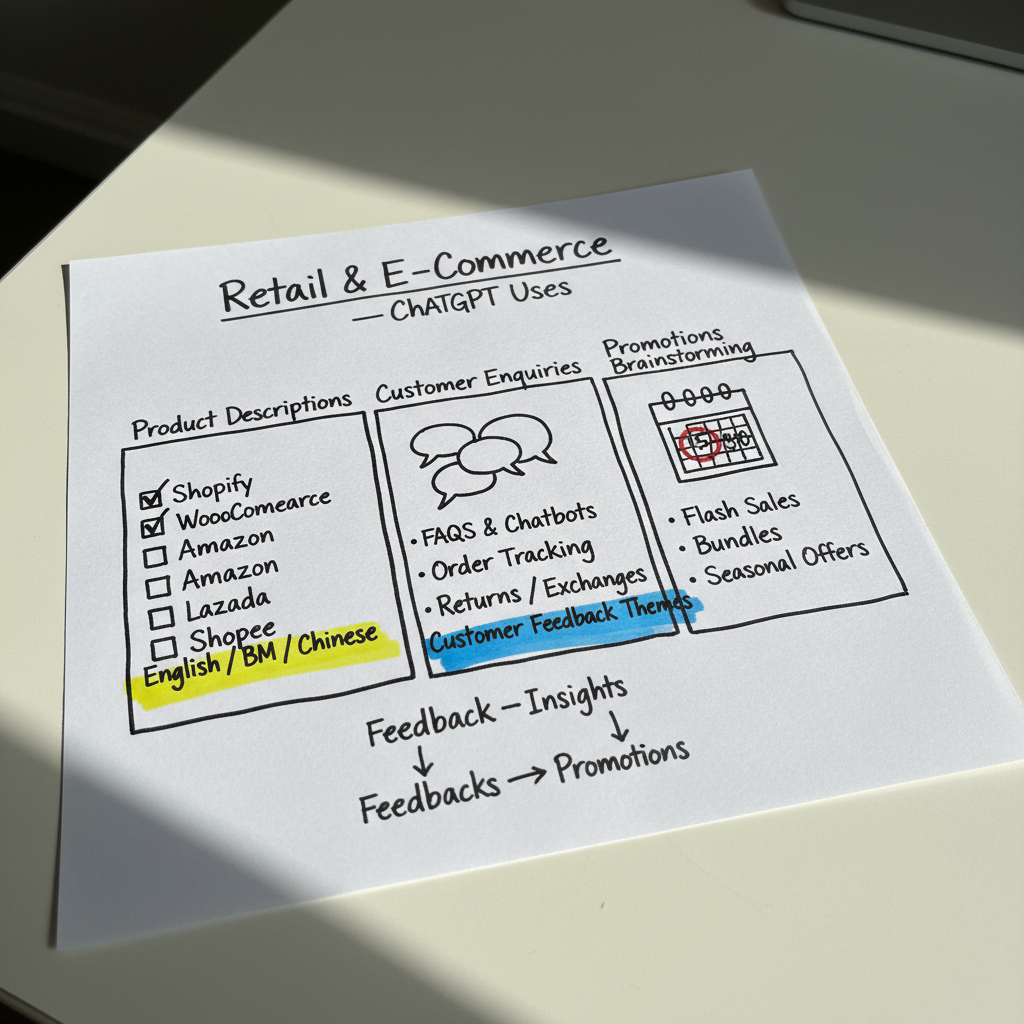
Retail ChatGPT use cases covering product descriptions, customer enquiries and promotion ideas.
Organisations scaling customer service across complex product lines or policies may find a custom AI chatbot useful for handling tier-one enquiries while routing complex cases to human agents.
Content and Marketing Teams: Writing, Research and Content Planning
Marketing and communications teams were early adopters of ChatGPT, and for good reason. Much of the daily work involves drafting, editing, researching, and planning — tasks where ChatGPT can serve as a capable assistant.
Practical ChatGPT use cases for marketing teams:
- Drafting social media posts — Generate multiple variations of a post for LinkedIn, Facebook, Instagram, and X, adapted for each platform's tone.
- Brainstorming content topics — Input your industry, audience, and content goals. ChatGPT can suggest article angles, video concepts, or campaign themes.
- Summarising competitor content — Paste articles or web pages and request a structured summary of key claims, offers, and positioning.
- Drafting email newsletters — Create first drafts of weekly or monthly newsletters based on bullet points from the team.
- Editing and proofreading — Ask ChatGPT to check for clarity, grammar, tone consistency, or overly long sentences.
Content teams should treat ChatGPT as a first-draft assistant, not a final publisher. Human editing, fact-checking, and brand voice alignment remain essential. Organisations that rely on AI-generated content without oversight risk publishing inaccurate, off-brand, or repetitive material.
Human Resources: Job Descriptions, Policy Summaries and Onboarding Materials
HR teams in Malaysia manage a wide range of written materials: job postings, offer letters, policy documents, onboarding guides, training materials, and internal communications.
Practical ChatGPT use cases for HR teams:
- Drafting job descriptions — Provide the role, level, and key responsibilities. ChatGPT produces a first draft that the HR team customises.
- Summarising company policies — Long employee handbooks can be condensed into quick-reference guides using ChatGPT.
- Drafting offer letters and HR correspondence — For standard letters, ChatGPT can generate drafts that follow your templates.
- Creating onboarding checklists — Generate structured onboarding plans for new hires based on role and department.
- Drafting internal announcements — Quickly draft memos about organisational changes, events, or policy updates.
HR teams handling sensitive employee data should never upload personal information into ChatGPT. All drafts should be reviewed against company policies before use.
For organisations building workforce AI capability, AIHQ's role-based AI training programmes can help HR teams develop practical, department-specific AI workflows.
Leadership Teams: Briefing Summaries, Strategy Drafts and Decision Support
Senior leaders and management teams use ChatGPT differently — less for operational tasks and more for synthesis, drafting, and research.
Practical ChatGPT use cases for leadership:
- Summarising long reports — Board papers, industry reports, and strategic documents can be condensed into executive summaries.
- Drafting presentation talking points — For town halls, all-hands meetings, or investor updates, ChatGPT can help structure key messages.
- Preparing meeting briefs — Before key meetings, input context and ask ChatGPT to draft a briefing note with agenda, objectives, and background.
- Brainstorming strategic options — ChatGPT can act as a thinking partner for generating options — though strategic decisions require human judgment and domain expertise.
Leadership teams exploring broader AI adoption beyond personal productivity often benefit from an executive AI briefing to align on strategy, risks, governance, and practical next steps.
Moving from Scattered Use to Structured ChatGPT Adoption
The most common challenge we observe in Malaysian organisations is not a lack of ChatGPT usage — it's inconsistent, unstructured usage across teams without shared guidelines.
Here are practical steps to move from scattered experimentation to structured adoption:
- Set clear usage guidelines — Define what types of data can be entered into ChatGPT, what must stay confidential, and how to review output before using it.
- Identify department-specific use cases — Ask each team to list three repetitive writing or analysis tasks where ChatGPT could help.
- Build a shared prompt library — Encourage teams to save effective prompts so others can reuse and improve them.
- Review output quality regularly — Periodically audit AI-assisted work to maintain standards.
- Provide role-based training — Generic ChatGPT training rarely sticks. Teams need practical exercises tied to their actual workflows.
Prompting is useful, but sustainable adoption requires role-based capability, workflow thinking, governance, and leadership alignment. This is why organisations working with AIHQ typically begin with a structured capability assessment rather than a one-day ChatGPT workshop.
When Off-the-Shelf ChatGPT Is Not Enough
ChatGPT is powerful for many tasks, but some organisational workflows require more than a general-purpose AI chatbot can provide. Common signs include:
- Your team needs the AI to access internal knowledge bases, SOPs, or customer data.
- You need consistent, branded responses across a high volume of customer enquiries.
- Your workflow requires multi-step automation beyond what prompting alone can achieve.
- Data privacy requirements prevent your team from using public AI tools with sensitive information.
In these situations, organisations benefit from custom AI solutions — including internal copilots, AI chatbots, and workflow automation — designed around specific processes and data sources.
Final Thoughts
ChatGPT can be a valuable assistant across nearly every department in a Malaysian organisation. The key is knowing when to use it, how to review its output, and where its limitations start.
The most effective ChatGPT adoption happens when teams move from "let's try this tool" to "let's identify where this tool actually helps our workflow." That shift requires practical use cases, clear guidelines, and a structured approach to building capability.
For teams ready to move beyond individual experimentation into structured AI adoption, AIHQ can help design a practical path forward — through role-based training, leadership alignment, or workflow-specific solutions.
FAQ
Is ChatGPT safe to use for Malaysian businesses?
ChatGPT can be used safely when organisations set clear guidelines. Avoid entering confidential customer data, financial records, or personally identifiable information into public ChatGPT versions. Enterprise-grade AI tools with data privacy protections are available for organisations handling sensitive information. Every output should be reviewed by a human before use.
Can ChatGPT handle Bahasa Malaysia for customer communications?
Yes, ChatGPT supports Bahasa Malaysia and can draft, translate, and summarise content in the language. However, output quality should be reviewed by a native speaker for accuracy, tone, and cultural appropriateness — especially for customer-facing communications.
What industries in Malaysia benefit most from ChatGPT?
Finance, retail, logistics, customer service, marketing, HR, and content teams all benefit from ChatGPT use cases. The key is matching the tool to specific, repetitive writing or analysis tasks where ChatGPT's drafting and synthesis capabilities save time.
Can ChatGPT replace human employees in Malaysia?
No. ChatGPT can support employees by reducing repetitive work, improving drafting speed, and strengthening decision support when used responsibly. Human judgment, domain expertise, and oversight remain essential — especially for complex, sensitive, or high-stakes tasks.
How do I get my team to use ChatGPT consistently and safely?
Start with clear usage guidelines, identify department-specific use cases, build a shared prompt library, and provide role-based training rather than generic workshops. Organisations that invest in structured AI adoption see more consistent and responsible usage than those relying on self-learning alone.
When should my organisation consider a custom AI solution instead of ChatGPT?
When workflows require access to internal knowledge bases, SOPs, or customer data — or when your team needs consistent, branded responses at high volume — a custom AI chatbot, internal copilot, or workflow automation may be more suitable than a general-purpose tool.