General
ChatGPT Use Cases for Malaysian Businesses: Boosting Productivity with AI
· By AIHQ Team

Many Malaysian businesses have tried ChatGPT. Some teams use it to rewrite emails. A few have experimented with social media captions. But most organisations — from SMEs to listed companies — are still asking the same question: What can we actually use this for, day to day?
That gap between curiosity and practical application is where real value lives. This guide walks through concrete ChatGPT use cases for Malaysian businesses, organised by department and workflow. Whether you run a retail operation in KL, manage customer service for a property developer, or lead a finance team in Penang, there are grounded applications worth testing today.
Customer Service: Responding in Bahasa Malaysia, Chinese and English
Malaysian customer service teams handle enquiries across multiple languages — often in the same conversation. ChatGPT's multilingual capability, including its Bahasa Malaysia and Chinese language support, makes it useful for drafting, translating and standardising customer responses.
Practical applications
- Drafting responses in Bahasa Melayu: Customer service agents can use ChatGPT to draft polite, professional replies in Bahasa Malaysia for email, WhatsApp or live chat. The model understands local phrasing, though outputs should always be reviewed by a native speaker.
- Translating product or policy information: A customer enquiry in Mandarin can be answered using information from an English SOP. ChatGPT can translate the response while maintaining the original meaning.
- Standardising tone across a team: Create a brief style prompt — "reply in a friendly but professional tone in Bahasa Malaysia" — and agents can use it as a starting point for consistent communication.
What to watch for
Customer service outputs involving confidential information, pricing or commitments should always be reviewed by a human before sending. ChatGPT is a drafting assistant, not a final sign-off.
Retail and E-Commerce: Product Descriptions, Social Content and Customer FAQs
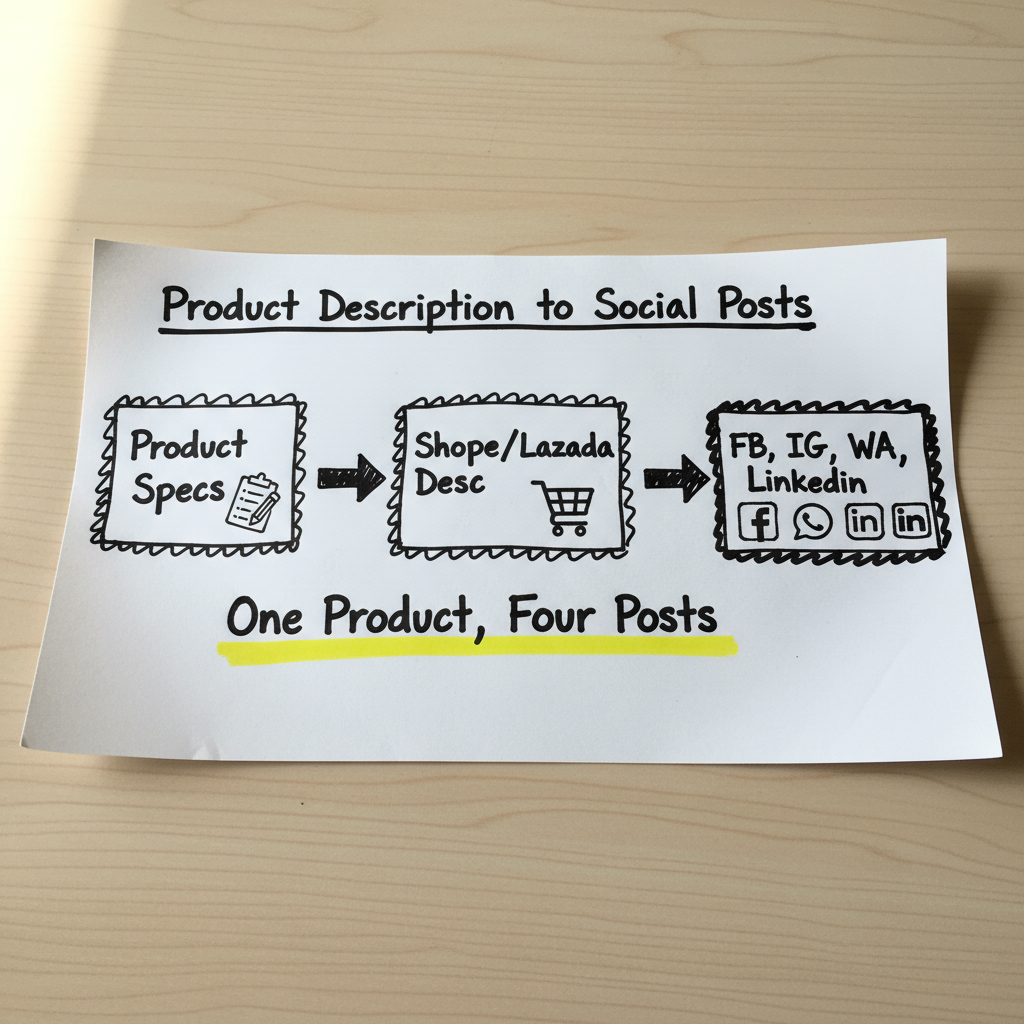
Retail teams use ChatGPT to repurpose product details across multiple e-commerce and social platforms
Retail businesses in Malaysia manage large product catalogues, multiple sales channels and frequent content updates. ChatGPT helps teams produce consistent product copy, social media posts and FAQ responses faster.
Practical applications
- Writing product descriptions at scale: Provide ChatGPT with product specifications — material, size, care instructions — and ask for a description suitable for Shopee, Lazada or your own website. Adjust the tone for your brand voice.
- Generating social media captions: A single product update can be repurposed into a Facebook post, an Instagram caption, a WhatsApp broadcast message and a LinkedIn update. ChatGPT can adapt the same information for each platform.
- Building a customer FAQ: If your team answers the same five questions daily — "How long does delivery take?", "What is your return policy?" — ChatGPT can help draft clear, consistent answers that team members can copy, paste and adapt.
Local context
Include specific details in your prompts: "This product ships within West Malaysia, 3-5 working days. Returns accepted within 14 days for unused items." The more context you provide, the more useful the output.
F&B Operations: Menu Updates, SOPs and Supplier Communication
The F&B industry in Malaysia runs on speed and consistency. ChatGPT helps restaurant managers, kitchen teams and operations staff reduce the time spent on repetitive writing tasks.
Practical applications
- Drafting menu descriptions: A new nasi lemak variant or a seasonal beverage deserves a description that sounds as good as it tastes. ChatGPT can draft options based on ingredients, preparation method and price point.
- Writing kitchen SOPs: If a new team member needs to learn the standard operating procedure for opening the kitchen, ChatGPT can help turn notes or voice recordings into a clear, step-by-step guide.
- Supplier email templates: Regular communication with suppliers — order confirmations, delivery changes, invoice follow-ups — can be templated in ChatGPT and adapted in seconds.
Finance and Accounting: Drafting Reports, Summaries and Data Narratives
Finance teams handle sensitive data, tight deadlines and heavy documentation. While ChatGPT should not process confidential financial figures without proper data governance, it can still support administrative and explanatory workflows.
Practical applications
- Drafting commentary for management reports: After running your numbers in Excel or your accounting system, use ChatGPT to draft the narrative section — explaining variances, trends or assumptions — as a starting point.
- Summarising policy documents: When a new MFRS standard or Bank Negara guideline is released, ChatGPT can help draft a one-page summary for your team to review.
- Creating email templates for collections or reconciliations: Standard follow-up emails can be written once, stored as prompts, and adapted per client without starting from scratch each time.
Important caveat
Finance teams should never paste sensitive data — customer names, account numbers, transaction amounts — into public AI tools without organisational guardrails in place. Use ChatGPT for structure, drafting and summarisation of non-sensitive material.
Human Resources: Job Descriptions, Onboarding Guides and Internal Announcements
HR teams in Malaysian organisations juggle recruitment, onboarding, employee communications and policy documentation. ChatGPT helps reduce the time spent on first drafts.
Practical applications
- Drafting job descriptions: Provide the role title, key responsibilities and requirements, and ask ChatGPT to draft a structured job description. Adjust for your organisation's culture and language preferences.
- Writing onboarding checklists: A simple prompt — "List the first-week onboarding steps for a new marketing executive in a Malaysian company" — produces a structured starting point that your team can customise.
- Creating internal announcements: New hire introductions, policy updates or company event notices can be drafted quickly and adjusted for tone, then shared across email, Slack or WhatsApp groups.
Marketing and Content: Brainstorming, Outlines and First Drafts
Marketing teams in Malaysia produce content across multiple platforms — blogs, social media, email newsletters, WhatsApp broadcasts and printed materials. ChatGPT helps move faster from idea to first draft.
Practical applications
- Brainstorming content topics: Ask ChatGPT for "10 blog post ideas about AI adoption for Malaysian SMEs" and use the output as a starting point for your editorial calendar.
- Outlining articles or presentations: Instead of staring at a blank page, ask for an outline first. A structured outline is faster to review and approve than a full draft.
- Writing email marketing copy: ChatGPT can draft a promotional email, a welcome sequence or a follow-up message. Always adapt the tone to match your brand and review before sending.
Bahasa Malaysia and Local Language Support
One of the most practical ChatGPT use cases for Malaysian businesses is its ability to work across languages. The model understands and generates Bahasa Malaysia reasonably well, though users should review for local nuance.
Tips for Bahasa Malaysia prompts
- Write prompts in Malay when the output should be in Malay. For example: "Tulis penerangan produk untuk baju kurung moden yang sesuai untuk hari raya. Sertakan maklumat tentang kain, saiz dan harga."
- Specify the dialect or region when it matters. For local expressions or market-specific content, add context like "for the Malaysian market, not Indonesian."
- Review for natural phrasing. ChatGPT's Malay is generally correct but can sound slightly formal or direct. A quick read-through by a native speaker ensures the tone matches your audience.
For Chinese language support, similar principles apply. ChatGPT handles Simplified and Traditional Chinese. Specify which variant your audience uses — Malaysian Chinese readers often expect Simplified Chinese with locally relevant phrasing.
From Experimentation to Structured Capability
Most teams start with individuals experimenting in ChatGPT. That is normal and useful. But sustained productivity comes when teams move from isolated prompts to structured workflows — where ChatGPT becomes a consistent part of how work gets done, not a novelty.
This shift requires three things:
- Role-based understanding — Different teams use AI differently. A finance assistant does not need the same training as a customer service agent.
- Practical workflow thinking — The question should not be "What can ChatGPT do?" but "Which part of my current workflow would benefit from a faster first draft or a better summary?"
- Responsible use habits — Teams need to know what is safe to share, what needs human review, and how to verify outputs.
Organisations that invest in building this capability across their teams tend to see stronger, more sustainable adoption than those that leave it to individual experimentation.
Where Off-the-Shelf Tools Reach Their Limits
ChatGPT is powerful, but it is not the answer to every workflow problem. Some tasks require more than a chat interface:
- Repeated, high-volume tasks — If your team answers the same 50 customer questions daily, a custom AI chatbot integrated into your website or WhatsApp may serve you better.
- Internal knowledge access — If employees spend too long searching for SOPs or policy documents, an internal copilot trained on your documents might be more useful.
- Complex automation — If a process involves multiple steps, approvals and data sources, a structured automation workflow may be needed.
For organisations at this stage, exploring custom AI solutions designed around specific workflows can unlock more value than general-purpose tools alone.
Getting Started: Three Actions This Week
If you are responsible for AI adoption in your organisation, here are three practical steps to begin with:
- Ask each department for one use case. Pick a single repetitive task — drafting emails, summarising reports, writing product descriptions — and have one team member test ChatGPT on it for a week.
- Set a basic usage guideline. Clarify what information should not be entered into public AI tools. A simple "no customer data, no financial figures, no confidential strategy" rule is a good start.
- Share one win across the team. When someone finds a practical use case that saves time, share it. Adoption spreads faster through examples than through policies.
Building Structured AI Capability with Your Teams
Experimenting with ChatGPT is a strong starting point. Moving from individual use to organisation-wide capability takes more deliberate effort — role-based training, workflow design and governance awareness.
AIHQ helps organisations make that transition. With over 9,000 professionals trained across corporate, public sector and regulated environments, AIHQ designs role-based AI training that helps teams apply AI to their actual work. For organisations ready to go further, custom AI solutions can address workflow gaps that off-the-shelf tools cannot fill.
FAQ
Can ChatGPT handle Bahasa Malaysia well for business use?
Yes, ChatGPT can generate and understand Bahasa Malaysia reasonably well, including local business contexts. However, outputs should be reviewed by a native speaker to ensure natural phrasing and cultural appropriateness, especially for customer-facing content.
Is it safe for my team to use ChatGPT with company data?
It depends on your data governance policies. As a general rule, avoid entering confidential customer information, financial figures, trade secrets or personally identifiable data into public AI tools. Organisations should set clear guardrails for responsible AI use before encouraging team-wide adoption.
What is the difference between using ChatGPT and building a custom AI chatbot?
ChatGPT is a general-purpose tool useful for drafting, summarising and brainstorming. A custom AI chatbot is trained on your specific data — product catalogues, SOPs, policy documents — and integrated into your website, WhatsApp or internal portal. Custom solutions are better suited for high-volume, repeatable enquiries.
Which Malaysian industries benefit most from ChatGPT?
Retail, F&B, customer service, finance, human resources, marketing and education all benefit from ChatGPT's ability to draft content, summarise information and support multilingual communication. The key is identifying specific repetitive tasks within each department.
Do I need technical skills to use ChatGPT for my business?
No. ChatGPT is designed for conversational use. No coding or technical background is required. However, learning how to structure clear prompts and verify outputs improves results significantly. Role-based training can help teams build these skills efficiently.
Can ChatGPT replace my customer service team?
No. ChatGPT can support customer service teams by drafting responses, standardising tone and reducing time spent on repetitive enquiries. However, human judgment is essential for handling complex, sensitive or escalated issues. AIHQ's position is that AI supports employees — it does not replace them.