General
Enterprise AI Adoption Challenges in Southeast Asia: Key Roadblocks and How to Overcome Them
· By AIHQ Team

Organisations across Southeast Asia — from Kuala Lumpur to Singapore to Jakarta — are exploring how AI can improve workflows, support decision-making and strengthen productivity. Yet many find that adoption is slower and more complex than expected.
It is not because the tools are not available. The challenge lies in how organisations prepare their people, processes and governance before introducing AI at scale.
This article breaks down six of the most common enterprise AI adoption challenges in Southeast Asia and what a structured path forward can look like.
1. The AI Talent Gap: More Than Just a Hiring Problem
One of the most frequently cited enterprise AI adoption challenges in Southeast Asia is the shortage of skilled professionals. According to regional surveys, a significant portion of organisations report difficulty finding talent with practical AI experience.
But the gap is not just about hiring data scientists or machine learning engineers. For most enterprises, the real gap is workforce-wide AI literacy — the ability of everyday professionals to use AI tools safely, effectively and responsibly in their actual roles.
How to approach this:
- Start with role-based AI training that helps different departments apply AI to their real workflows — not generic workshops
- Build internal AI champions who can model good usage habits
- Pair capability building with clear governance so employees know what is safe to do
A structured AI training programme helps teams move from curiosity to confident, practical usage.
2. Data Readiness and Infrastructure Limitations
AI tools are only as useful as the data they access. Many Southeast Asian enterprises face data scattered across spreadsheets, legacy systems, PDF files and departmental silos. Before AI can provide useful answers, organisations need to know where their data lives and whether it is structured enough for AI to process.
Common data-related roadblocks:
- Data is stored in unstructured formats (emails, scanned documents, chat logs)
- No central knowledge base or document management system
- Privacy concerns about uploading sensitive or confidential information to public AI tools
- Inconsistent data quality across departments
How to approach this:
- Conduct a workflow audit to identify where data lives and how it flows
- Establish clear guidelines for what data is safe to use with off-the-shelf tools versus what requires secure, internal solutions
- When data complexity is high, explore whether a custom AI solution like an internal copilot or knowledge system is more appropriate than public AI tools
3. Cultural Resistance and Change Fatigue
Employees often react to AI adoption with either fear — "will this replace my job?" — or skepticism — "another tool I have to learn." Both responses can slow adoption significantly.
In Southeast Asian organisations, where hierarchy and consensus-based decision-making are common, top-down AI mandates without proper change management can create resistance rather than enthusiasm.
How to approach this:
- Frame AI as a tool that supports human decision-making, not replaces it
- Involve team leads and department heads early in the adoption conversation
- Start with small, visible wins — one workflow, one team — and build momentum from success stories
- Provide leadership alignment sessions so senior management communicates a consistent, reassuring message
AIHQ's approach centres on human-centred capability building. AI can support employees by reducing repetitive work and improving workflows when used responsibly.
4. Governance Uncertainty and Responsible Use Concerns
Many enterprises are unsure where to start with AI governance. Should they write a policy first? Train employees first? Block tools until guidelines are ready?
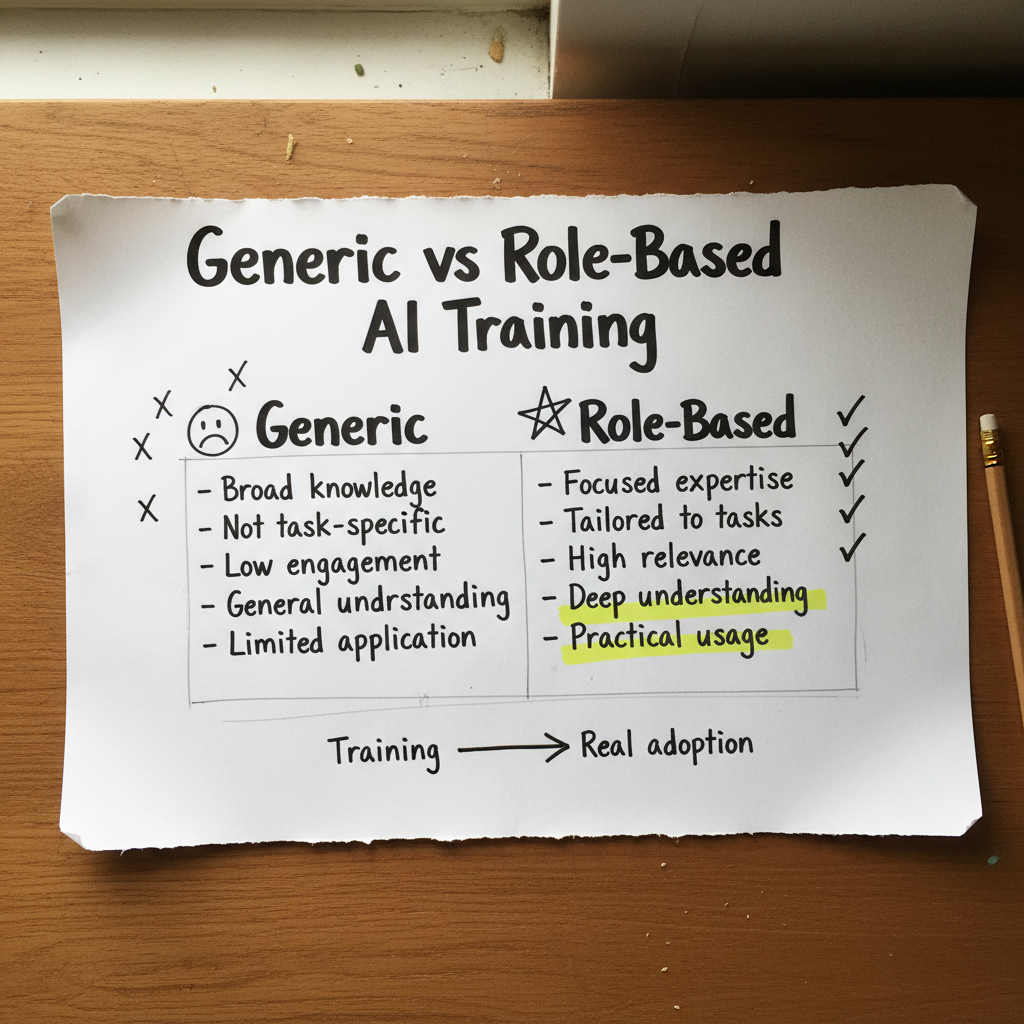
Why role-based AI training creates stronger workplace adoption than generic one-size-fits-all workshops.
The risk of waiting: Employees are already using ChatGPT, Gemini and Copilot — often on company devices and with company data — whether or not the organisation has a policy. This creates blind spots around data privacy, accuracy and accountability.
How to approach this:
- Start governance early, even with a simple "do's and don'ts" guide
- Provide responsible AI training so employees understand safe usage boundaries
- Establish clear guardrails for confidential or sensitive information
- Treat governance as a learning journey, not a one-time policy document
5. Fragmented Tool Experimentation Without a Strategy
A common pattern across Southeast Asian enterprises: one team uses ChatGPT, another uses Copilot, a third is experimenting with Gemini or Claude. Each team has its own login, its own use cases and its own level of oversight. The result is wasted subscription costs, inconsistent results and difficulty measuring impact.
How to approach this:
- Map which tools are already being used across departments
- Consolidate around a manageable set of approved tools
- Build a central AI adoption roadmap that aligns tool usage with business priorities
- Use an AI innovation bootcamp to identify and prioritise use cases worth piloting
Off-the-shelf tools are useful for many tasks, but some workflows require custom AI solutions, automation or structured implementation support.
6. Lack of Clear Business Use Cases and Measurable Outcomes
Many organisations jump into AI adoption without first clarifying what problem they are trying to solve. This leads to tool adoption without workflow impact — employees learn how to use ChatGPT but cannot describe how it improves their actual work.
How to approach this:
- Start with use-case discovery: identify specific, repetitive or time-consuming workflows that could benefit from AI support
- Prioritise use cases by feasibility and potential value
- Define what "better" looks like — faster response time? fewer manual steps? more accurate reporting?
- Measure outcomes at the workflow level, not just activity level
Moving from Awareness to Structured Adoption
The enterprise AI adoption challenges in Southeast Asia are real, but they are not unique to any single organisation. The most successful adoptions share a common pattern: structured, phased, human-centred approaches that combine capability building, governance and practical implementation.
AIHQ has worked with over 9,000 professionals across corporate organisations, government agencies, professional bodies and regulated sectors in Malaysia and Singapore. The company's approach moves organisations through a clear pathway:
- Interest — Build awareness and AI literacy
- Capability — Develop role-based skills
- Practical Usage — Apply AI to real workflows
- Measurable Outcomes — Track workflow-level impact
- Optional Implementation — Build custom solutions where off-the-shelf tools are not enough
Frequently Asked Questions
What is the biggest barrier to enterprise AI adoption in Southeast Asia? The most commonly reported barrier is the AI talent gap — not just hiring specialists, but building workforce-wide AI literacy so everyday professionals can use AI tools safely and effectively in their roles.
How can Malaysian enterprises overcome AI adoption challenges? A structured approach combining role-based training, leadership alignment, clear governance guidelines and use-case prioritisation helps organisations move from fragmented experimentation to practical, measurable adoption.
Is AI governance necessary before employees start using AI tools? Yes. Many employees already use AI tools at work. Establishing clear guardrails early — even a simple responsible-use guide — helps protect company data and build safe usage habits.
Can off-the-shelf AI tools like ChatGPT meet all enterprise needs? Off-the-shelf tools are useful for many general tasks, but some workflows — especially those involving company-specific data, complex processes or sensitive information — may require custom AI solutions or structured implementation.
How long does enterprise AI adoption typically take? Timelines vary based on organisational readiness, data infrastructure and scope. A phased approach — starting with awareness, then capability building, then targeted implementation — often produces more sustainable results than a large-scale rollout.
What sectors face the most AI adoption challenges in Southeast Asia? Regulated sectors such as banking, insurance, healthcare and government face additional challenges around data privacy, compliance and governance. However, structured training and responsible use frameworks can address these concerns.
FAQ
What is the biggest barrier to enterprise AI adoption in Southeast Asia?
The most commonly reported barrier is the AI talent gap — not just hiring specialists, but building workforce-wide AI literacy so everyday professionals can use AI tools safely and effectively in their roles.
How can Malaysian enterprises overcome AI adoption challenges?
A structured approach combining role-based training, leadership alignment, clear governance guidelines and use-case prioritisation helps organisations move from fragmented experimentation to practical, measurable adoption.
Is AI governance necessary before employees start using AI tools?
Yes. Many employees already use AI tools at work. Establishing clear guardrails early — even a simple responsible-use guide — helps protect company data and build safe usage habits.
Can off-the-shelf AI tools like ChatGPT meet all enterprise needs?
Off-the-shelf tools are useful for many general tasks, but some workflows — especially those involving company-specific data, complex processes or sensitive information — may require custom AI solutions or structured implementation.
How long does enterprise AI adoption typically take?
Timelines vary based on organisational readiness, data infrastructure and scope. A phased approach — starting with awareness, then capability building, then targeted implementation — often produces more sustainable results than a large-scale rollout.
What sectors face the most AI adoption challenges in Southeast Asia?
Regulated sectors such as banking, insurance, healthcare and government face additional challenges around data privacy, compliance and governance. However, structured training and responsible use frameworks can address these concerns.