General
The Enterprise AI Adoption Framework: A Consultant's Playbook for Deploying AI at Scale
· By AIHQ Team

Most enterprises do not fail at AI because the technology is weak. They fail because adoption is treated as a tool rollout rather than a structured, organisation-wide change. Teams experiment with ChatGPT, run a few isolated pilots, celebrate a dashboard or two—and then struggle to turn any of it into reliable, production-scale workflow impact.
A proven AI adoption framework for enterprises changes that. It gives leaders a repeatable path from readiness assessment to full-scale deployment, with clear waypoints for use-case prioritisation, governance, change management and measurement. Here is the playbook consultants use, broken down in practical terms.
Why a Framework Matters Before the Technology
Before discussing models or vendors, it helps to agree on the real problem. The obstacle is rarely "which AI tool do we buy." It is usually one of four things: unclear strategy, fragmented experimentation, weak governance or missing capability.
A framework exists precisely to address these. It connects business priorities to AI decisions, surfaces the workflows worth automating and establishes the guardrails employees need before they use AI at scale. In short, it helps organisations move from AI awareness into structured capability and real workflow impact.
Stage 1: Readiness Assessment
The first stage is honest self-assessment. Leaders should understand where the organisation stands today before committing to anything large.
Practical readiness questions include:
- Strategic clarity — Do we know which business outcomes AI is meant to support?
- Data readiness — What data do we hold, how clean is it, and what is sensitive or confidential?
- Capability baseline — What do our teams already know about AI, and where are the gaps?
- Leadership alignment — Are senior stakeholders aligned on priorities, risks and decision rights?
- Tooling and policy — What tools are already in use, and what employee guidance exists?
Assessment is not a one-time checklist. It produces a snapshot that informs every later decision, from which use cases to pilot to how training should be structured.
Stage 2: Use-Case Prioritisation
Not every workflow is a good AI candidate. The goal of this stage is to separate genuinely valuable opportunities from distractions.
A practical filter scores candidate use cases on three dimensions:
- Value — How much does the workflow matter to revenue, cost, risk or speed?
- Feasibility — Do we have the data, tools and access needed to make it work?
- Adoptability — Will employees actually use it, and does it fit how the team operates?
Focus on a small set of high-scoring use cases rather than spreading effort across twenty possibilities. A structured AI innovation bootcamp is a common way to run this: teams audit workflows, identify pain points, prioritise use cases and plan which pilots are worth pursuing.
Stage 3: Governance and Responsible Use
Governance should be designed early, not bolted on after rollout. The aim is not a dusty policy document but practical guidance employees can actually follow.
Key governance decisions include:
- What data types can and cannot be entered into AI tools
- How AI output is reviewed before it is used in decisions or customer-facing work
- Who owns decision rights for deploying AI in each function
- How confidentiality and privacy risks are managed
- How incidents or misuse are reported and corrected
Early alignment on responsible use is especially important in regulated sectors, where data handling and oversight carry heavier consequences. Responsible AI training and governance workshops help teams use AI safely and appropriately rather than leaving guidance to discretion.
Stage 4: Capability Building and Change Management
This is where adoption most often stalls. A generic all-staff workshop does not create workplace usage. Capability building has to be role-based, practical and connected to the actual workflows people perform every day.
What works better:
- Role-based training that shows HR, finance, operations and marketing teams how AI applies to their reporting, documentation and analysis
- Practical exercises built around real company processes, not abstract examples
- Change management that addresses why a team should change, not just how
- Champions who model good usage and help colleagues adopt new habits
AIHQ's experience underscores this. Over 9,000 professionals have been trained across corporate, public sector, professional and regulated environments, with programmes designed to help teams apply AI to real workflows and move toward measurable outcomes—never framed as guaranteed productivity.
Stage 5: Pilot, Measure, Scale
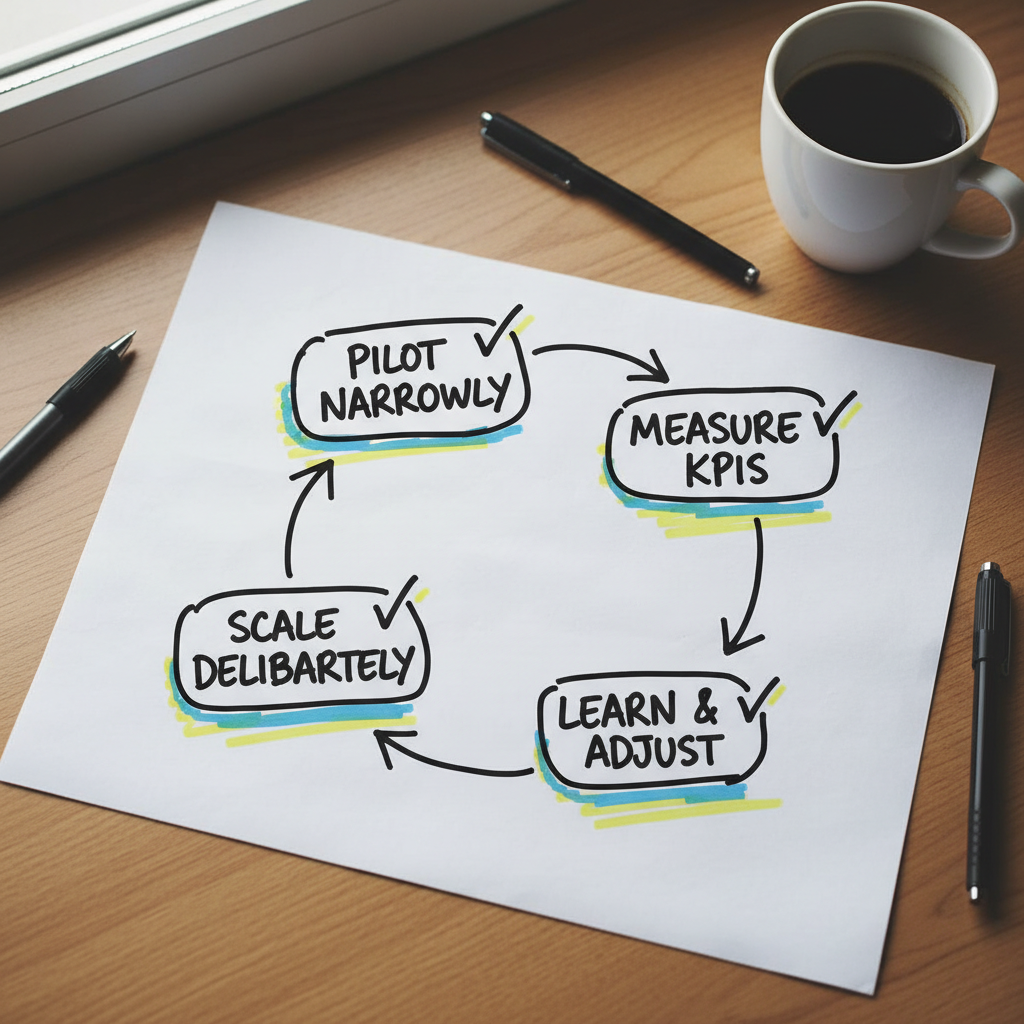
Move from a narrow pilot to a deliberate, measured scale-up.
The final stage is disciplined implementation. A common failure point is rushing from a successful pilot straight to a full rollout. A better path is iterative.
- Pilot narrowly on a prioritised use case with a defined team.
- Measure against agreed KPIs — cycle time, error rate, adoption rate, cost or output quality.
- Learn and adjust the tooling, training or workflow based on what the pilot reveals.
- Scale deliberately to broader teams only after the pilot has shown practical value.
Measurement matters. Track both operational metrics and adoption metrics (how often the tool is used, where teams disengage). Where off-the-shelf tools cannot meet the workflow, a custom AI solution such as an internal copilot, chatbot, dashboard or automation flow may be the right next step.
Common Failure Points to Avoid
Every stage has predictable traps. Knowing them helps you plan around them.
- Skipping readiness and assuming maturity, then discovering data or governance gaps mid-rollout
- Prioritising hype over value, piloting flashy use cases that nobody actually needs
- Treating governance as paperwork, leaving employees without practical usage boundaries
- Buying one generic training session and expecting sustained adoption
- Scaling on emotion, expanding a pilot because it felt impressive rather than because metrics supported it
- Ignoring change management, then wondering why teams quietly stop using the tool
None of these are technical problems. They are adoption and leadership problems—which is exactly why a framework exists.
Adapting the Framework Across Industries
The same structure flexes across sectors. A manufacturer might prioritise quality inspection and document handling; a bank might prioritise compliance review and internal knowledge access; a media company might focus on content workflows with strong editorial oversight. The stages stay the same even as the use cases, risks and governance requirements change.
The principle that does not change: adoption is a people and process journey as much as it is a technology project.
Building a Roadmap That Works for Your Organisation
An AI adoption framework for enterprises gives structure, but structure alone does not create outcomes. The value comes from how it is applied to your workflows, your data and your people.
If you are ready to move beyond scattered experimentation, a structured starting point helps. Speak to AIHQ about an adoption roadmap discussion, a leadership alignment session or an AI innovation bootcamp to prioritise the use cases worth pursuing in your organisation.
FAQ
What is an AI adoption framework for enterprises?
An AI adoption framework is a structured, step-by-step approach for taking AI from scattered experimentation to full-scale deployment. It typically covers readiness assessment, use-case prioritisation, governance, capability building, change management and measurement.
Why do enterprise AI pilots fail to scale?
Pilots usually stall because of missing strategy, fragmented experimentation, weak governance, generic training that does not change behaviour, and scaling on hype rather than measured results. These are adoption and leadership issues, not technology failures.
How do you choose which AI use cases to prioritise?
Score candidate workflows on value, feasibility and adoptability. Focus on a small set of high-scoring use cases that matter to revenue, cost or risk, where the data is available and where employees will actually use the solution.
When should AI governance start?
Governance should be designed early, before employees use AI at scale. Practical guardrails—covering data types, output review, decision rights, privacy and incident reporting—are more useful than a policy document that exists only on paper.
Is training enough to create AI adoption?
No. Generic training rarely changes behaviour. Sustainable adoption requires role-based capability, workflow thinking, governance and leadership alignment. A single workshop can build awareness, but structured ability building is what moves teams toward practical, consistent use.