General
Enterprise AI Strategy: What Malaysian Businesses Need to Know Beyond the Chatbot Hype
· By AIHQ Team

Most Malaysian enterprises have tried ChatGPT by now. Some have set up pilot projects. A few have rolled out internal AI guidelines. But very few have a real enterprise AI strategy — one that moves beyond chatbot experiments and connects AI usage to actual business outcomes.
This guide is for leaders who want that strategy. It covers the core building blocks of an enterprise AI approach, common gaps that keep organisations stuck, and practical next steps for moving toward structured, measurable AI adoption.
Why Most Malaysian Enterprises Are Stuck at the Experimentation Stage
Many organisations in Malaysia began their AI journey the same way: someone bought a ChatGPT subscription, teams started experimenting, and soon employees across departments were using AI tools — inconsistently, without guidelines, and without connection to business priorities.
Three patterns keep organisations stuck:
- Tool-first thinking: Decisions driven by which tool to buy rather than what business problem to solve
- No role-based capability: Teams receive generic AI awareness sessions, not training tied to their actual workflows
- Missing governance: Employees use AI without clear boundaries on data privacy, accuracy checks or responsible use
The result is fragmented usage that feels productive in small ways but never adds up to real strategic value.
An enterprise AI strategy changes that. It connects every AI initiative — from training to tools to governance — to the organisation's broader business goals.
From Tool Experiments to Business-Led AI Strategy
An AI strategy built for enterprise impact starts with four questions:
- Where does AI create value for our business? — Not "what can AI do," but "what does our business need that AI can support?"
- What capability do our people need? — Not generic awareness, but role-specific skills tied to daily workflows
- What guardrails must be in place? — Governance, data privacy, human review and responsible use policies
- How do we measure progress? — Adoption rates, workflow improvements, quality changes, not just tool usage
These questions shift the conversation from "which AI tools should we use" to "how do we build organisational readiness for AI."
Why Leadership Alignment Comes First
Many Malaysian companies start AI adoption by buying tools or sending staff to training. Both can be useful. But without leadership alignment on the purpose and boundaries of AI use, adoption remains fragmented.
Leadership alignment means:
- Agreeing on where AI should and should not be used
- Setting decision rights for AI procurement and deployment
- Defining how success will be measured
- Establishing a risk appetite for AI usage across departments
AIHQ supports this through AI leadership briefings that help senior teams align on strategy, governance and practical next steps before rolling out AI across the organisation.
The Building Blocks of an Enterprise AI Strategy
A practical AI strategy rests on four interconnected layers. Each one supports the next.
1. Leadership Alignment and Strategic Clarity
Leadership alignment is not a one-hour meeting. It is a structured process where the executive team agrees on:
- Which business areas AI should support first
- How AI fits into existing digital transformation priorities
- What level of risk the organisation is comfortable with
- Who owns AI adoption across the organisation
Without this foundation, AI initiatives drift. Teams adopt tools independently. Spending becomes uncoordinated. And the organisation never builds momentum toward measurable outcomes.
For organisations at this stage, an AI leadership briefing can help align the C-suite around a shared strategy.
2. Workforce Capability Building
Enterprise AI strategy fails when training is treated as a one-off event. Sustainable capability requires a structured approach that moves employees through four stages:
- Awareness: Understanding what AI can and cannot do
- Capability: Learning to use AI tools for specific work tasks
- Practice: Applying AI to real workflows with guidance
- Adoption: Embedding AI into daily routines with governance
Role-based training is essential here. A finance team needs different AI workflows than a customer service team. HR teams use AI differently than engineers. Generic training creates awareness but rarely changes how work gets done.
AIHQ designs role-based AI training programmes that connect directly to department workflows — from HR and finance to operations, marketing and customer service.
3. Governance, Data Privacy and Responsible Use
Governance is not an afterthought in enterprise AI strategy. It is a foundation that should be built early, especially for regulated industries, public sector organisations, and any company handling sensitive data.
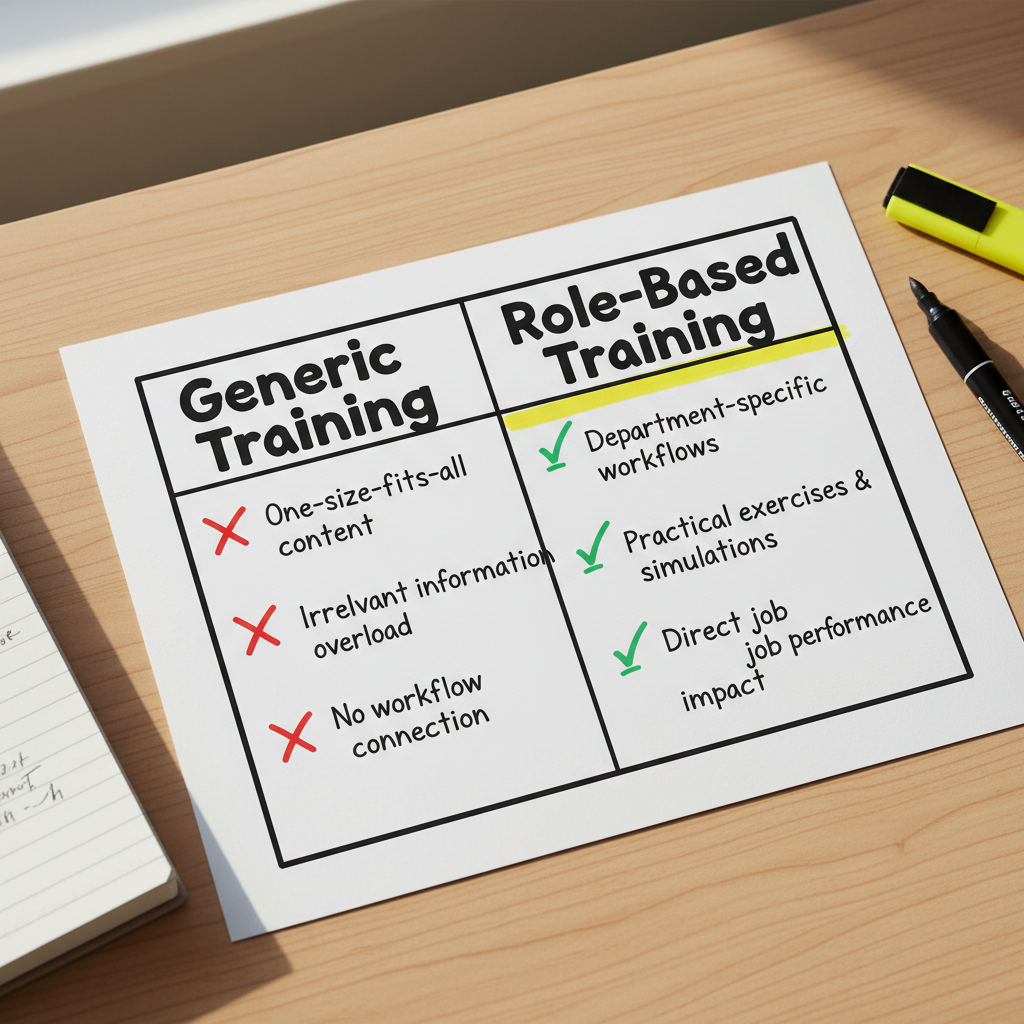
Generic awareness sessions rarely change how work gets done. Role-based training connects directly to daily workflows.
Key governance elements include:
- Clear policies on what data can be entered into AI tools
- Human review processes for AI-generated content
- Guidelines for transparency — when and how AI is used
- Regular audits of AI tool usage and outcomes
- Escalation paths for AI-related incidents
AIHQ offers responsible AI and governance training to help organisations move from policy documents to practical employee behaviour.
4. Practical Implementation and Workflow Integration
Once leadership is aligned, teams are capable, and governance is in place, organisations can move toward implementation. This is where AI moves from tool usage into actual workflow improvement.
Implementation may involve:
- Custom AI chatbots for customer or employee enquiries
- Internal copilots for SOPs, policies and knowledge access
- Workflow automation for repetitive tasks
- Dashboards and knowledge systems for operational visibility
Not every organisation needs custom solutions. But when off-the-shelf tools fall short — as they often do for complex or regulated workflows — custom AI solutions can bridge the gap.
Common Gaps in Enterprise AI Strategy (and How to Fix Them)
Gap 1: No clear ownership of AI adoption
When no one owns AI strategy, it becomes everyone's side project. The fix: assign a senior owner — a Chief AI Officer, Head of Digital Transformation, or a dedicated AI steering committee — with clear decision rights.
Gap 2: Training is disconnected from business workflows
One-day workshops create awareness but rarely change behaviour. The fix: build training programmes around role-based use cases, with follow-up sessions and practical exercises tied to real work.
Gap 3: Governance is treated as a blocker
Some organisations avoid AI governance because it feels restrictive. The fix: frame governance as an enabler. Clear guardrails give employees confidence to use AI safely and reduce risk for the organisation.
Gap 4: No measurement framework
Without metrics, AI adoption becomes a leap of faith. The fix: define leading indicators — such as adoption rates, task completion times, error reduction and employee confidence — alongside business outcomes.
Case in Point: A Structured AI Capability Journey
Consider how one Malaysian organisation approached this. Over a 12-month period, AIHQ supported Media Prima through a structured AI capability journey that progressed from awareness to fundamentals, intermediate skill-building and advanced application workshops.
Results from that programme included 98% satisfied participants, 90% increased practical knowledge and skills, and 92% finding training relevant and applicable to their work.*
This is not about a single training event. It is a structured, progressive approach to building AI capability across an organisation — exactly what an enterprise AI strategy requires.
*These figures refer specifically to the Media Prima programme and are not a general guarantee of outcomes.
Building Your Enterprise AI Strategy: A Practical Path
If your organisation is ready to move beyond chatbot experiments, here is a structured approach:
Phase 1: Assess and Align (1–2 months)
- Conduct a leadership AI alignment session
- Audit current AI usage across departments
- Identify priority business areas for AI support
- Define risk appetite and governance principles
Phase 2: Build Capability (2–4 months)
- Design role-based AI training for priority departments
- Launch AI literacy programmes for the wider workforce
- Establish AI champions in each department
- Create practical use-case guides for common workflows
Phase 3: Implement and Govern (ongoing)
- Roll out governance policies and employee guidelines
- Pilot custom AI solutions where off-the-shelf tools are insufficient
- Measure adoption, usage quality and workflow impact
- Adjust strategy based on real outcomes
AIHQ can support your organisation at any stage of this journey — from leadership alignment and role-based training to governance workshops and custom AI solutions.
Beyond Chatbots: The Real Enterprise AI Opportunity
The organisations that benefit most from AI are rarely the ones with the flashiest tools. They are the ones with a clear strategy, capable teams, responsible governance and a practical path from experimentation to adoption.
An enterprise AI strategy is not a document. It is an ongoing capability — one that connects leadership decisions, workforce skills, responsible practices and real workflows into a coherent approach to AI adoption.
Starting is simpler than it seems. The first step is not buying better AI tools. It is bringing the right people together to ask better questions about what the organisation actually needs.
FAQ
What is an enterprise AI strategy?
An enterprise AI strategy is a structured plan that connects AI usage to business priorities. It covers leadership alignment, workforce capability building, governance and responsible use, and practical workflow integration — moving beyond isolated tool experiments toward coherent, measurable AI adoption across the organisation.
How is enterprise AI strategy different from just using ChatGPT?
Using ChatGPT is a tool-level decision. An enterprise AI strategy addresses which problems AI should solve, how people should be trained to use it responsibly, what governance guardrails are needed, and how success will be measured. It shifts the focus from 'which tool' to 'how AI supports business outcomes.'
Where should Malaysian enterprises start with AI strategy?
Start with leadership alignment: agree on the purpose, boundaries and priorities for AI use before purchasing tools or rolling out training. From there, build role-based capability for priority departments, establish governance guardrails, and then move toward implementation where off-the-shelf tools are insufficient.
What role does governance play in enterprise AI strategy?
Governance ensures AI is used responsibly, safely and consistently. It covers data privacy, human review processes, transparency guidelines, acceptable use policies and incident escalation. For regulated industries and public sector organisations, governance is especially critical before scaling AI usage.
Can AIHQ help my organisation build an AI strategy?
Yes. AIHQ supports organisations at every stage — from leadership alignment briefings and role-based training to responsible AI governance workshops and custom AI solutions. AIHQ has trained over 9,000 professionals across corporate, public sector and regulated environments in Malaysia.