General
Enterprise AI Transformation: Lessons from the Field
· By AIHQ Team

Enterprise AI transformation is not a technology rollout — it is a capability-building journey that touches strategy, people, workflows, governance, and measurement.
Many organisations begin with subscriptions to ChatGPT, Copilot, or Gemini. Teams experiment. A few become power users. But months later, most find themselves asking: We have the tools — so why hasn't anything really changed?
This article shares lessons from organisations that have moved beyond experimentation into structured enterprise AI transformation. These are not theoretical frameworks. They are field observations from working with corporate teams, public sector agencies, professional bodies, and regulated organisations.
Lesson 1: Start with Leadership Alignment, Not Tool Rollout
Enterprise AI transformation often stalls because leadership treats it as a software deployment. The real starting point is shared understanding at the top.
When senior leaders hold different assumptions about what AI can do — and what it should not do — adoption becomes fragmented. One department moves fast. Another waits. A third runs unauthorised experiments.
Organisations that navigate this better begin with an executive AI briefing or leadership alignment session. The goal is not consensus on every detail. It is shared language, a clear governance approach, and agreement on where AI should have space to create value — and where guardrails are needed.
What this looks like in practice
- A board or EXCO session that separates AI value from AI hype
- Clear decision rights: who authorises pilots, who owns data risk, who sets usage policy
- A transformation roadmap that is realistic about organisational readiness, not just technology potential
Lesson 2: Training Must Be Role-Based, Not Generic
The most common mistake in enterprise AI transformation is running a one-size-fits-all workshop and expecting adoption to follow.
A marketing team needs different AI workflows than a finance team. A customer service agent needs different support tools than a compliance officer. Generic training raises awareness but rarely creates daily usage.
Organisations that see real adoption invest in role-based AI training — programmes designed around actual workflows, reporting tasks, decision-support needs, and the specific tools each department already uses.
Signs your training approach needs a change
- Employees attended a workshop but returned to old workflows
- Only a handful of people in the organisation regularly use AI tools
- Teams cite fear of making mistakes or sharing sensitive data as a reason for not adopting
Lesson 3: Change Management Is the Engine of Transformation
Enterprise AI transformation is a change management initiative that happens to involve AI. This distinction matters.
When organisations treat AI adoption as purely technical, they underestimate cultural resistance, workflow disruption, and the very real concern employees feel about being replaced or made irrelevant.
Organisations that manage this well do three things:
1. Frame AI as workflow support, not replacement. Teams adopt AI faster when they see it reducing repetitive work — meeting notes, report drafting, data summarisation — rather than threatening their role.
2. Build AI champions within departments. Instead of relying only on a central IT or innovation team, organisations identify one or two people per department who can model practical usage, answer questions, and celebrate small wins.
3. Create space for safe experimentation. Employees who fear punishment for mistakes will not adopt AI openly. Clear guardrails and responsible use policies — rather than blanket bans — encourage measured adoption.
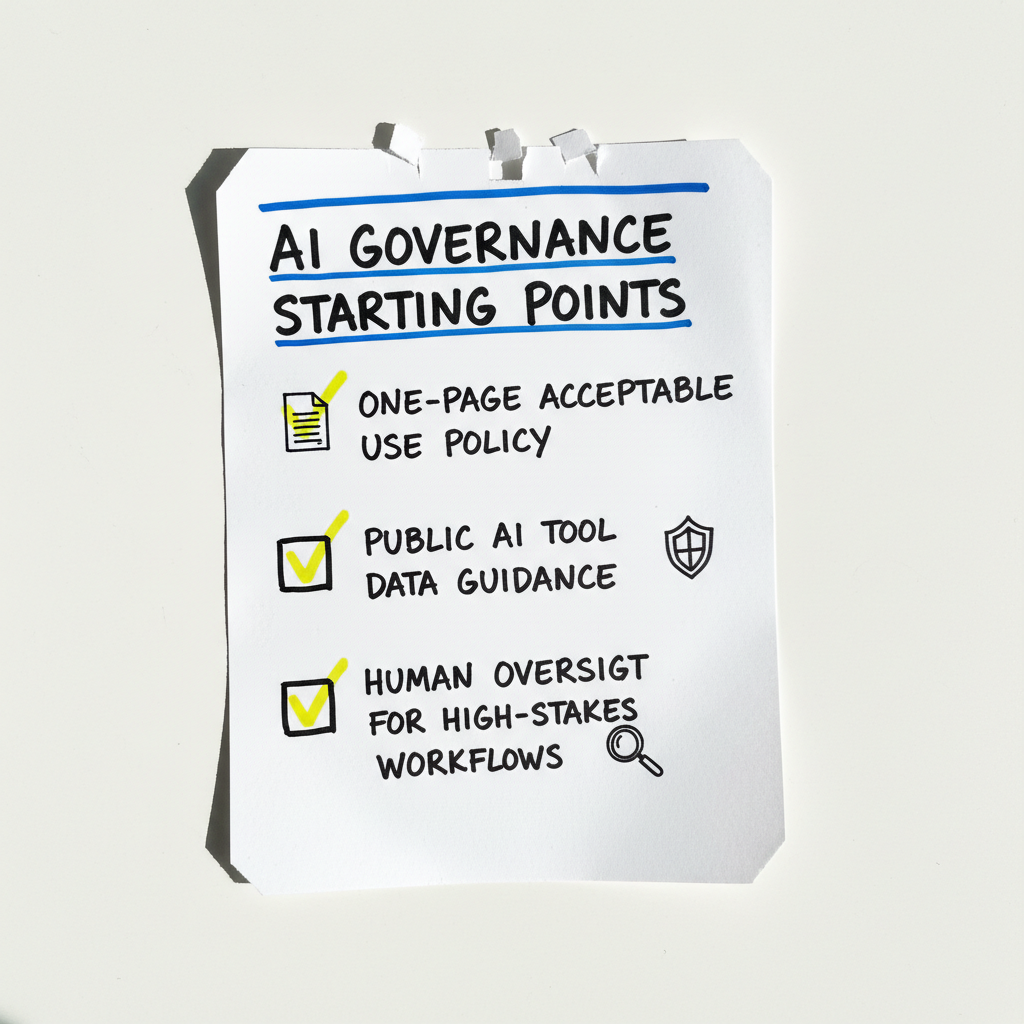
AI governance should begin as a simple one-page policy, not a lengthy compliance document.
Lesson 4: Governance Should Start Early, Not After Rollout
One of the most overlooked lessons in enterprise AI transformation is timing. Many organisations wait until adoption is widespread before building governance — by which point behaviour is already entrenched.
Data security remains a top concern. Employees may be using free-tier tools with public processing. Confidential information may be shared unknowingly. Without clear guardrails, organisations create risk even while pursuing productivity gains.
Organisations that lead on this invest in responsible AI training and governance workshops early. The goal is not to slow adoption, but to make it safe enough to scale.
Practical governance starting points
- A one-page AI acceptable use policy, not a 40-page compliance document
- Clear guidance on what data can and cannot be used with public AI tools
- A review process for output accuracy in high-stakes workflows
- Human oversight requirements for automated or agentic workflows
Lesson 5: Measure Progress Beyond Tool Usage
When asked about enterprise AI transformation outcomes, many leaders cite usage statistics — number of active users, prompts per day, or tools deployed. These metrics describe activity, not impact.
Organisations making real progress measure differently. They track:
- Time saved on specific workflows. Does report generation take 40% less time? Are meeting summaries created in minutes instead of hours?
- Quality improvements. Has AI-assisted work reduced errors in documentation? Has decision-support improved the speed of data-informed choices?
- Adoption breadth. Are teams across multiple departments using AI consistently, or is usage concentrated in one or two areas?
Not every benefit will be quantifiable immediately. But setting early baselines — even rough ones — helps organisations distinguish genuine transformation from enthusiastic experimentation.
Lesson 6: Custom Solutions Matter When Off-the-Shelf Tools Fall Short
ChatGPT, Copilot, and Gemini are powerful general-purpose tools. But enterprise AI transformation often encounters workflows that off-the-shelf tools cannot handle well — proprietary knowledge bases, complex internal processes, or domain-specific terminology.
Organisations that succeed at scale do not abandon general-purpose tools. They layer on custom AI solutions where needed: internal copilots trained on company SOPs, AI chatbots for customer or employee queries, and workflow automation for repetitive approval chains.
When to consider a custom approach
- Your teams spend significant time searching internal documents for answers
- Your customer service team answers the same questions repeatedly
- Your organisation has specialised knowledge that general AI tools do not handle well
- You need AI to operate within your data environment, not send data externally
The Real Path to Enterprise AI Transformation
Enterprise AI transformation is not about finding the perfect tool or rolling out training to everyone at once. It is a structured journey through five stages:
- Interest – Curiosity and scattered experimentation
- Capability – Building foundational understanding and role-based skills
- Practical Usage – Embedding AI into daily workflows
- Measurable Outcomes – Tracking impact beyond activity metrics
- Optional Implementation – Custom solutions for workflows that off-the-shelf tools cannot serve
Organisations that move through these stages deliberately — with leadership alignment, role-based capability building, early governance, and outcome-focused measurement — are the ones leading enterprise AI transformation today.
The journey requires patience, structure, and a willingness to treat AI adoption as a people and process challenge, not just a technology investment.
Moving Forward
If your organisation is moving beyond AI experimentation and looking for a structured approach, speak to AIHQ about designing a roadmap that fits your context — starting with leadership alignment, role-based training, or a practical AI use-case discovery session.
FAQ
What is enterprise AI transformation?
Enterprise AI transformation is the process of embedding AI capabilities across an organisation — beyond individual experimentation — through leadership alignment, workforce upskilling, workflow integration, governance, and measurement. It is a structured capability-building journey, not a single tool rollout.
How long does enterprise AI transformation take?
Timelines vary by organisation size, readiness, and complexity. Many organisations begin seeing workflow-level impact within 3 to 6 months of structured capability building, while organisation-wide adoption typically unfolds over 12 to 18 months. The key is steady progression through awareness, capability, usage, and outcomes.
What is the biggest mistake companies make in AI transformation?
Treating AI transformation as a software deployment rather than a people and process change. Common errors include generic training without role-specific workflows, skipping leadership alignment, and delaying governance until after adoption is widespread.
Do organisations need custom AI tools for transformation?
Not always. Many workflows can be improved with off-the-shelf tools like ChatGPT or Copilot when paired with proper training and governance. Custom AI solutions become valuable when workflows involve proprietary knowledge, complex internal processes, or data that cannot be sent to external platforms.
How do you measure enterprise AI transformation success?
Beyond usage statistics, leading organisations measure time saved on specific workflows, quality improvements in outputs, breadth of adoption across departments, and whether AI-assisted work supports better decision-making. Setting early baselines helps distinguish activity from impact.
What role does governance play in enterprise AI transformation?
Governance ensures AI adoption is safe enough to scale. Practical starting points include clear acceptable use policies, data-sharing guardrails, output accuracy review processes, and human oversight requirements — especially for high-stakes or automated workflows.