General
Building a Generative AI Practice in Professional Services: A Revenue Playbook
· By AIHQ Team

Most professional services firms do not have a generative AI revenue problem. They have a packaging problem.
What the generic "how to start an AI practice" pieces leave out is this: a generative AI practice only becomes a revenue line once it is productised into three repeatable offers with named delivery roles, fixed scopes and published price bands. Firms that sell "AI transformation" as an open-ended engagement keep re-selling the same discovery work at cost. Firms that productise ship the same offer twenty times and improve margin each time.
This is a question-led explainer for marketing and sales leaders in consultancies, agencies, advisory firms and professional services organisations. Every question below is one your buyers and your partners actually ask, answered briefly.
What counts as a generative AI practice (and what doesn't)
A practice means three things: repeatable offers, deliverable by named people, with a defined commercial outcome. Everything else is a capability, a side project or an experiment.
A generative AI practice is not:
- A page on your website saying you "leverage AI"
- One partner who is personally good with ChatGPT
- Internal productivity tools your team uses but you never sell
It is: scoped engagements you can quote in MYR or SGD, staffed by people whose roles you can describe, that clients renew or expand.
What are the three offers every AI practice needs?
Most successful practices converge on the same three-layer structure, because it maps to how buyers budget:
- Readiness and use-case discovery. A short diagnostic — typically 2 to 6 weeks — producing a prioritised use-case backlog, a data and governance read-out, and a pilot recommendation. This is the entry offer.
- Build and pilot. One to three use cases taken to production-adjacent pilot: an internal copilot, a workflow automation, a knowledge system or a customer-facing assistant. Priced per pilot.
- Capability and governance retainer. Role-based training plus policy and guardrail support, billed monthly or quarterly so AI usage stays safe and skills do not decay.
Layer three is what turns project revenue into recurring revenue. Firms that skip it win projects and then lose the client to whoever owns the ongoing enablement.
Which roles do you need to hire first?
You need four roles, not four hires. In most firms of 30 to 200 people, existing staff can cover two of them.
| Role | Sell or deliver | Hire or repurpose | Typical engagement band |
|---|---|---|---|
| AI solution lead | Sell and own scope | Senior consultant or partner-track | MYR 8,000–15,000 per month (retainer) |
| AI engineer / implementation specialist | Deliver the build | Hire or partner | MYR 12,000–20,000 per month (loaded) |
| AI governance and risk lead | Assurance and client comfort | Repurpose from risk, audit or legal | Project-based |
| Capability lead / trainer | Retainer layer | Repurpose from L&D or senior delivery | Day-rate or cohort-based |
Do not start by hiring a data science team. Generative AI delivery work leans on prompt and workflow design, retrieval setup, evaluation and change management — not model training.
How should you price generative AI work?
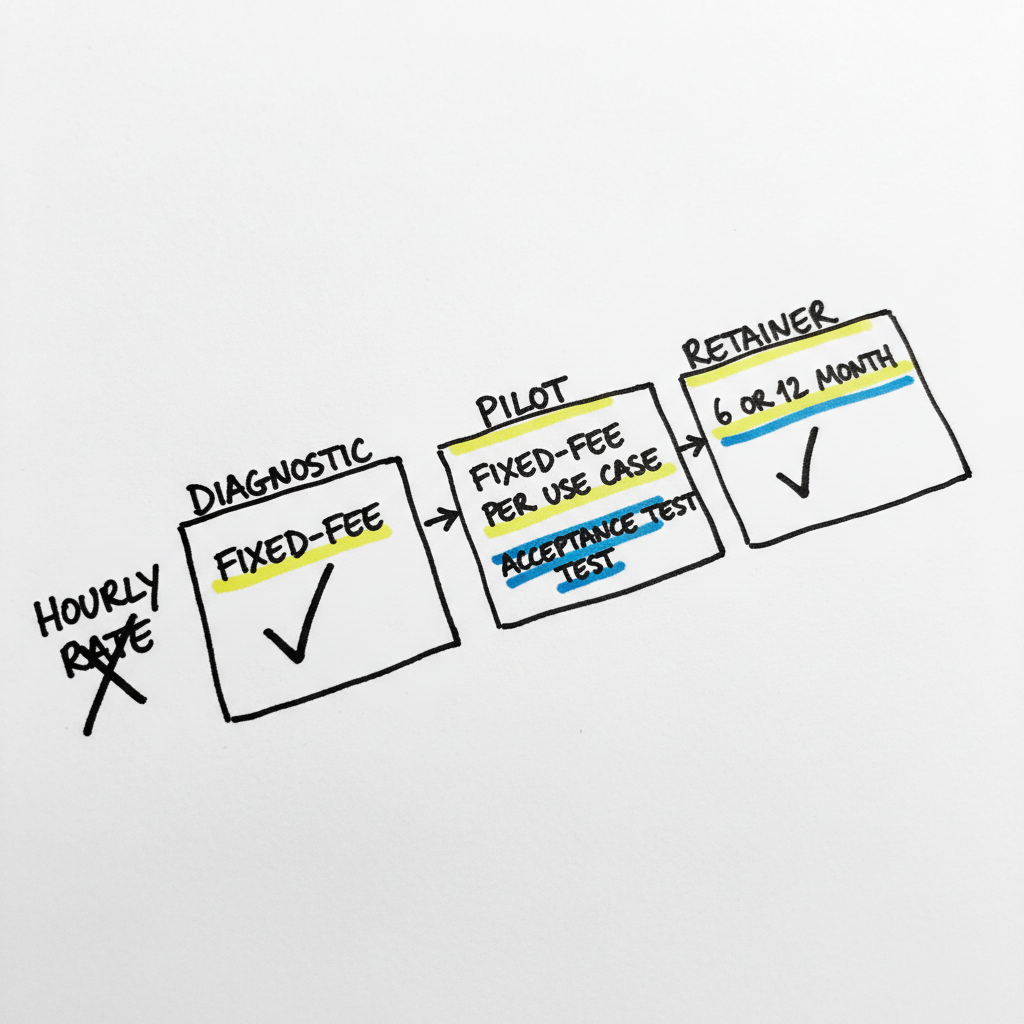
Three pricing models that work: fixed-fee diagnostic, fixed-fee pilot, and retainer.
Stop pricing AI work hourly. Three models work:
- Fixed-fee diagnostic. A defined 2 to 6-week scope with named deliverables. Low commitment, fast yes.
- Fixed-fee pilot. Priced per use case, with a defined acceptance test you agree in writing before starting.
- Retainer. Monthly capability and governance support, typically 6 or 12 months.
Day rates only make sense for the capability layer, where scope genuinely varies by cohort size and role mix.
The common mistake is discounting the diagnostic to win the pilot. The diagnostic is the offer that proves you understand the client's workflow — hold the price and use it as your qualification filter.
What actually stalls AI practice growth?
The stall points are commercial and organisational, not technical.
- Scope without an acceptance test. If you cannot state what "done" looks like, the engagement drifts and margin collapses.
- No proof artefact. Buyers want a reference, a case summary or a measurable outcome before signing. Firms with nothing to show keep giving away free discovery.
- No governance story. Regulated clients — financial services, healthcare, public sector — will not proceed without a clear position on data handling and human review.
- Sales and delivery not aligned. If the person who sold the work cannot describe how it will be delivered, the proposal will overpromise.
Which proof points do buyers actually want?
Three, in this order:
- A named, verifiable outcome from a similar engagement, with a metric.
- A live demonstration on the client's own data or document set, inside a safe environment.
- A named delivery team with relevant domain experience.
For reference, AIHQ supported Media Prima through a 12-month structured capability journey covering awareness, fundamentals, intermediate LLM skill-building and advanced application work. Reported programme outcomes included 98% satisfied participants, 90% increased practical knowledge and skills, and 92% finding training relevant and applicable to work. Use that kind of evidence as a template, not a claim to copy — your own numbers are what buyers will ask for.
Where does training fit into a services practice?
Training is not the poor relation of consulting. It is the most repeatable revenue layer you have.
A cohort-based programme can be delivered to twelve people or two hundred with the same curriculum, the same materials and the same trainer model. It renews annually as tools change. And it opens the door to the higher-margin build work, because you learn the client's real workflows while you teach.
If you are designing this layer, role-based AI training that maps exercises to actual departmental workflows outperforms generic tool training on completion and retention. The same logic applies to your own offers: sell outcomes for a role, not features of a tool.
What should Marketing and Sales own?
- Positioning. One sentence naming the buyer, the workflow and the commercial outcome. Not "AI-powered solutions."
- Proof assets. Two case summaries, one demo script, one pricing sheet. That is the minimum viable sales kit.
- Qualification. A short set of questions that separates buyers with a workflow problem from buyers with an AI curiosity.
- Pipeline rhythm. A quarterly campaign tied to a business trigger: a new regulation, a system migration, a cost programme.
Sales leaders should also own the "no" conversation. Firms that accept every AI request end up with ten bespoke projects and no practice.
What comes after the first three engagements?
Three moves, in order:
- Standardise. Turn your three best engagements into templates: proposal, scope, acceptance test, delivery checklist.
- Certify. Train a second and third delivery team so capacity is not dependent on one person.
- Extend. Add adjacent offers — custom AI solutions such as internal copilots, SOP knowledge systems or workflow automation — only when clients ask for them repeatedly, not because the market is talking about them.
That sequence keeps the practice anchored to demand rather than to enthusiasm.
Frequently asked questions
How long until a generative AI practice generates revenue?
With existing staff and a productised entry offer, most firms can sell a first diagnostic within one quarter. Recurring retainer revenue usually follows one or two successful pilots.
Do we need our own AI models or platform?
No. Most professional services AI work is built on commercial models and existing tooling plus retrieval, workflow integration and evaluation. Building models is rarely the value-add for a services firm.
How do we handle data privacy in client AI work?
Set clear guardrails before the first engagement: what data may enter which tools, what stays on client infrastructure, who reviews output, and how usage is logged. Confidential and sensitive information needs explicit handling rules, and clients will ask for them in writing.
Can AI training be HRDC claimable for our corporate clients?
Programmes can be structured to be HRDC claimable, subject to client eligibility, grant approval and HRD Corp submission requirements. Never present approval as automatic in a proposal.
Should we sell AI as a separate brand or under our existing firm?
Under your existing brand, in almost all cases. Your credibility, client relationships and delivery reputation are the assets buyers are paying for; a separate AI brand resets all three.
What is the biggest mistake firms make?
Selling capability instead of outcomes. Clients do not buy "AI expertise." They buy a faster reporting cycle, a reduced enquiry backlog, a shorter onboarding process or a lower cost per proposal.
The bottom line
A generative AI practice is a packaging and capability exercise before it is a technology one. Define three offers, name the roles that deliver them, price them in fixed scopes, and build a proof asset after every engagement. Do that, and AI moves from a topic in your proposals to a line in your revenue.
FAQ
How long until a generative AI practice generates revenue?
With existing staff and a productised entry offer, most firms can sell a first diagnostic within one quarter. Recurring retainer revenue typically follows one or two successful pilots with a clear acceptance test.
Do we need our own AI models or platform to offer AI services?
No. Most professional services AI work is built on commercial models and existing tooling plus retrieval, workflow integration and evaluation. Building your own models is rarely the value-add for a services firm.
How do we handle data privacy in client AI engagements?
Set guardrails before the first engagement: what data may enter which tools, what stays on client infrastructure, who reviews output, and how usage is logged. Confidential and sensitive information needs explicit written handling rules, and clients will ask for them.
Which roles should we hire first for an AI practice?
Start with an AI solution lead who owns scope and an implementation specialist who delivers the build. Governance and capability roles can usually be repurposed from risk, audit, legal or L&D before you hire externally.
Should we sell AI under a separate brand?
In almost all cases, sell under your existing firm brand. Your credibility, client relationships and delivery reputation are the assets buyers are paying for, and a separate AI brand resets all three.
What is the most common mistake when building an AI practice?
Selling capability instead of outcomes. Clients buy a faster reporting cycle, a reduced enquiry backlog or a shorter onboarding process — not "AI expertise" in the abstract.