General
How to Choose the Right AI Business Consultant for Your Company
· By AIHQ Team

The decision to bring in an AI business consultant is usually not a question of whether AI matters anymore — it is a question of who you can trust to guide you through adoption without overpromising. Across Malaysia and Singapore, more organisations are appointing AI consultants, but the quality of those engagements varies dramatically. Some consultants are technical specialists who struggle to connect with business outcomes. Others are strong at selling vision but weak at delivering capability that sticks.
This guide is a practical buyer's framework. Use it to evaluate candidates, separate credible partners from hype-driven vendors, and walk into conversations with the right questions.
Start With Your Business Problem, Not the Tool
Before you evaluate any consultant, be clear about what you are actually trying to solve. AI is a means, not the outcome. A credible consultant will spend your first conversation asking about workflows, pain points, data, governance and team readiness — not pitching a specific vendor tool in the first ten minutes.
Ask yourself:
- Which processes are repetitive, manual or error-prone?
- Where does your team spend time that adds little value?
- What decisions could benefit from better-informed data?
- What guards do you need around sensitive or confidential information?
If a consultant immediately recommends a particular product before understanding your operations, treat that as a signal. Off-the-shelf tools are useful in many cases, but some workflows need structured implementation, custom AI solutions or automation — and the right consultant will explain the difference rather than defaulting to one option.
Check the Mix: Strategic and Technical Depth
Strong AI consultants rarely sit at one extreme. A credible partner should be able to move between business strategy and practical implementation. You need someone who can translate boardroom priorities into concrete workflow changes — and also understand enough of the technology to challenge assumptions and scope work realistically.
Look for evidence of both:
- Strategic capability: Can they help your leadership align on adoption priorities, governance and decision rights?
- Technical depth: Can they design role-based training, advise on tool selection, or build custom solutions when needed?
- Change management: Do they understand that adoption depends on people, not just software?
AIHQ, for example, pairs capability building with solution delivery precisely because the two are intertwined. Training helps teams use tools well; custom solutions help when off-the-shelf tools are not enough. A consultant who only does one of these may leave gaps in your adoption.
Demand Real Industry Experience
Generic AI knowledge is increasingly common. What separates a useful consultant from a convincing one is whether they have worked in environments like yours — regulated sectors, corporate operations, public sector, professional services, or fast-moving SMBs.
Across Malaysia, AIHQ has engaged professionals across corporate, government, public sector, professional institutions, regulated environments and leadership audiences. That cross-sector exposure means our teams understand that a bank faces different adoption realities than a media group or a township developer. The right consultant for your company should be able to point to relevant experience — not just flashy case studies from unrelated industries.
Ask how many engagements they have delivered in your sector, and what patterns they observed. A consultant who has seen repeated adoption challenges across organisations is more likely to help you avoid common pitfalls.
Understand the Different Pricing Models
AI consulting engagements are priced in a few common ways. Knowing how each works helps you compare fairly and avoid surprises.
- Daily or hourly rates: Common for advisory, training and short assessments. Useful when the scope is clear and bounded.
- Fixed project pricing: Good for defined deliverables like a training programme, an adoption roadmap or a custom chatbot build. Make sure the scope is written down.
- Retainer agreements: Suitable for ongoing support, governance and gradual rollout over months. Confirms commitment on both sides.
- Outcome-based pricing: Tempting, but treat with caution. Genuine outcomes depend on your data, adoption, governance and follow-through — no consultant can honestly guarantee measurable ROI.
Clarity about pricing is itself a quality signal. A consultant who is vague about cost, deliverables and timelines early in the conversation is unlikely to become clearer later.
Watch for These Red Flags
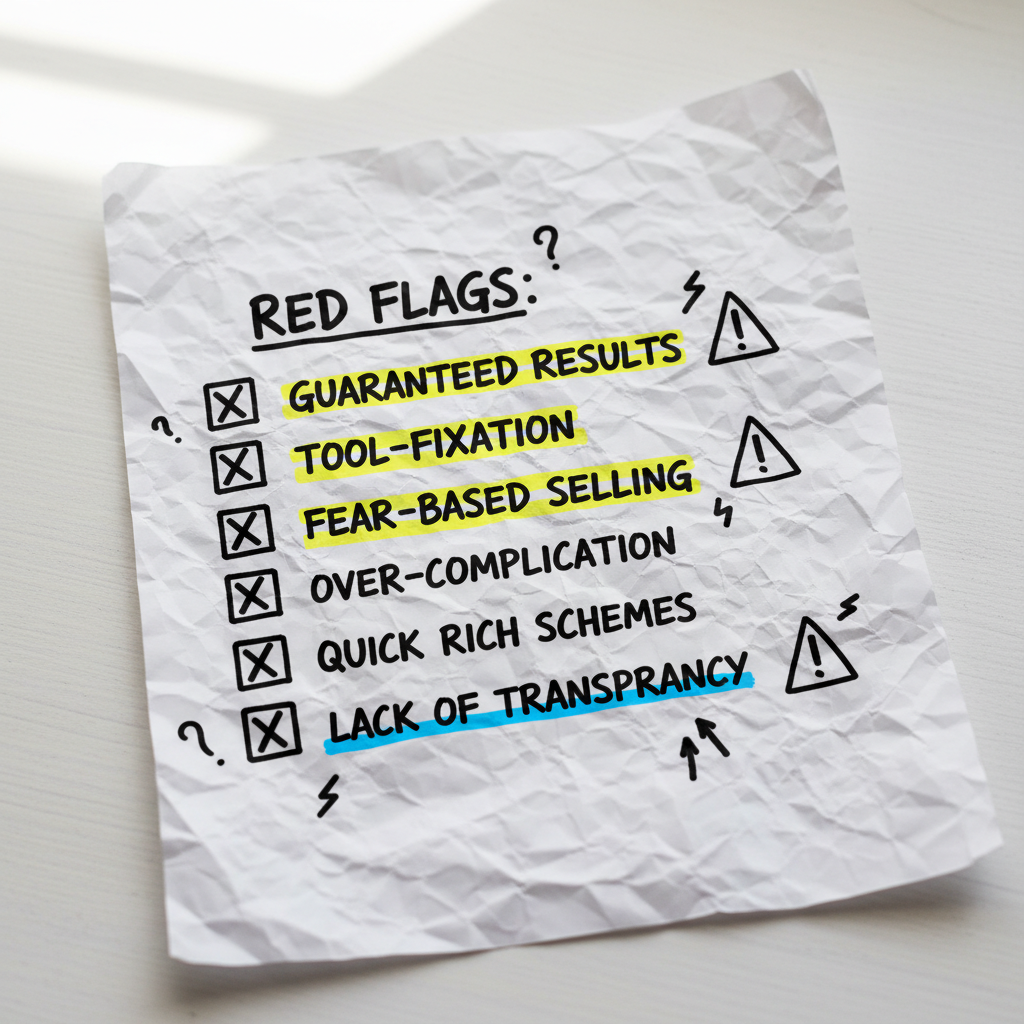
Some warning signs should end the conversation early.
Some warning signs should end the conversation early:
- Guaranteed results: No credible consultant guarantees ROI or transformation. Anyone who does is overpromising.
- Tool-fixation: A single product cannot solve every workflow problem. Watch for consultants who treat one vendor as the answer to everything.
- Fear-based selling: If their pitch is that "AI will replace your workforce," they are selling anxiety, not capability. Responsible consultants frame AI as supporting employees, not replacing them.
- No governance discussion: If a consultant never raises data privacy, responsible use or human oversight, they are not thinking about your long-term risk.
- Vague methodology: If you cannot describe, after the first meeting, how they actually work, that is a problem.
Questions to Ask Before You Sign
Bring this checklist to your shortlist conversations:
- What specific workflows or business problems will this engagement address?
- How will you adapt your approach to our sector, roles and current maturity?
- What does success look like in measurable terms, and how will you track it?
- How do you handle data privacy, confidentiality and responsible AI use?
- Is training part of the approach, or only advisory work?
- What happens when off-the-shelf tools are not enough — do you build custom solutions?
- Who will actually deliver the work, and what is their experience?
- What are the deliverables, timeline and costs in writing?
A confident, credible consultant welcomes specific questions. A vague one will deflect them.
Build for Capability, Not Just a Project
The best outcome of an AI consulting engagement is not a single deliverable — it is an organisation that continues to improve after the consultant leaves. That means the engagement should build durable capability: trained people, sensible workflows, clear governance and visible usage. If your team cannot apply what was delivered once the consultant is gone, the engagement created activity, not adoption.
AIHQ's perspective is deliberately structured: move beyond awareness into practical usage, and consider custom solutions only where they genuinely add value. We help organisations identify practical use cases, adopt them responsibly, and build the training and governance foundations that make adoption last.
As you evaluate candidates, keep your decision anchored to the north star that matters for your organisation — real workflow impact, not impressive-sounding roadmap slides.
FAQ
How much does an AI business consultant charge in Malaysia?
Pricing varies by engagement type. Advisory sessions and training are often billed daily or hourly, while fixed deliverables like adoption roadmaps or custom chatbots use project pricing. Retainers suit ongoing rollout and governance. Always ask for scope, deliverables and timelines in writing — and be wary of any consultant who guarantees outcomes based on pricing alone.
What is the difference between an AI consultant and an AI training provider?
An AI consultant typically advises on strategy, governance, tool selection and implementation, while a training provider builds workforce capability. The strongest partners do both, because adoption depends on people and workflows as much as strategy. AIHQ pairs consultancy-style advisory with role-based training and custom solutions.
Should I hire an AI consultant with technical or business expertise?
Ideally both. A purely technical consultant may struggle to connect AI to business outcomes, while a purely business-focused consultant may not challenge unrealistic technical assumptions. Look for evidence of strategic capability, technical depth and change management experience in real organisations.
Can an AI consultant guarantee ROI on their engagement?
No credible consultant can guarantee ROI. Actual outcomes depend on your data, adoption, governance, workflows and follow-through. A responsible consultant will help you define measurable success metrics and a tracking approach, but will not promise figures they cannot control.
How do I know if I need a custom AI solution or just better training?
Start with training and workflow analysis for most use cases. If your team is using off-the-shelf tools well but still hits workflow gaps — for example, repetitive processes, scattered knowledge or a need for automation — a custom AI chatbot, internal copilot or workflow may be justified. A good consultant helps you determine this rather than selling you a solution you do not need.