General
HRDC Claimable Data & AI Certifications: A Funding Guide for Malaysian Employers
· By AIHQ Team
What a finance leader actually needs to decide before approving data and AI certification spend
Your finance team approves a laptop refresh in an afternoon and then spends three weeks on a data analyst certification because nobody can confirm whether the fee will come back through the HRD Corp levy. That asymmetry is worth fixing. Under the Pembangunan Sumber Manusia Berhad Act 2001, registered employers pay a monthly human resources development levy, and part of that money can be reclaimed for approved training — but only when the programme, the provider and the paperwork line up.
Most "claimable certification" lists answer the wrong question. They tell you what is popular. They do not tell you what will survive a claim review, what portion of the fee is actually reclaimable, or who inside your company is accountable when the submission stalls.
This comparison puts five realistic routes to data and AI certification side by side against the criteria a claim genuinely depends on, then tells you which route suits which team.
The five claim criteria that decide whether a certification is fundable
Before comparing options, it helps to agree on the filter. In practice, a finance leader should confirm five things.
- Registered training provider. The provider must be registered with HRD Corp. AIHQ is a registered HRD Corp training provider, and programmes can be structured to be 100% HRDC claimable — subject to client eligibility, grant approval and HRD Corp submission requirements.
- Employer eligibility and levy standing. Your company must be registered and current on levy contributions. Claimable amount is capped against what you have paid in.
- Course content and duration fit. The programme must map to an approved training category and meet the applicable structure requirements for the scheme being used.
- Claimable fee components. Not everything on a quotation is claimable. Tuition is typically the core claimable element; travel, accommodation, some assessment fees and non-training items often are not. Ask for the quotation split line by line before approval.
- Evidence trail. Attendance records, participant confirmation, invoices, receipts and post-training documentation must exist in a reviewable form. This is where most claims quietly fail.
If you want the broader employer-side explanation of how this works in practice, see HRDC claimable AI training.
Head-to-head: five routes to data and AI certification
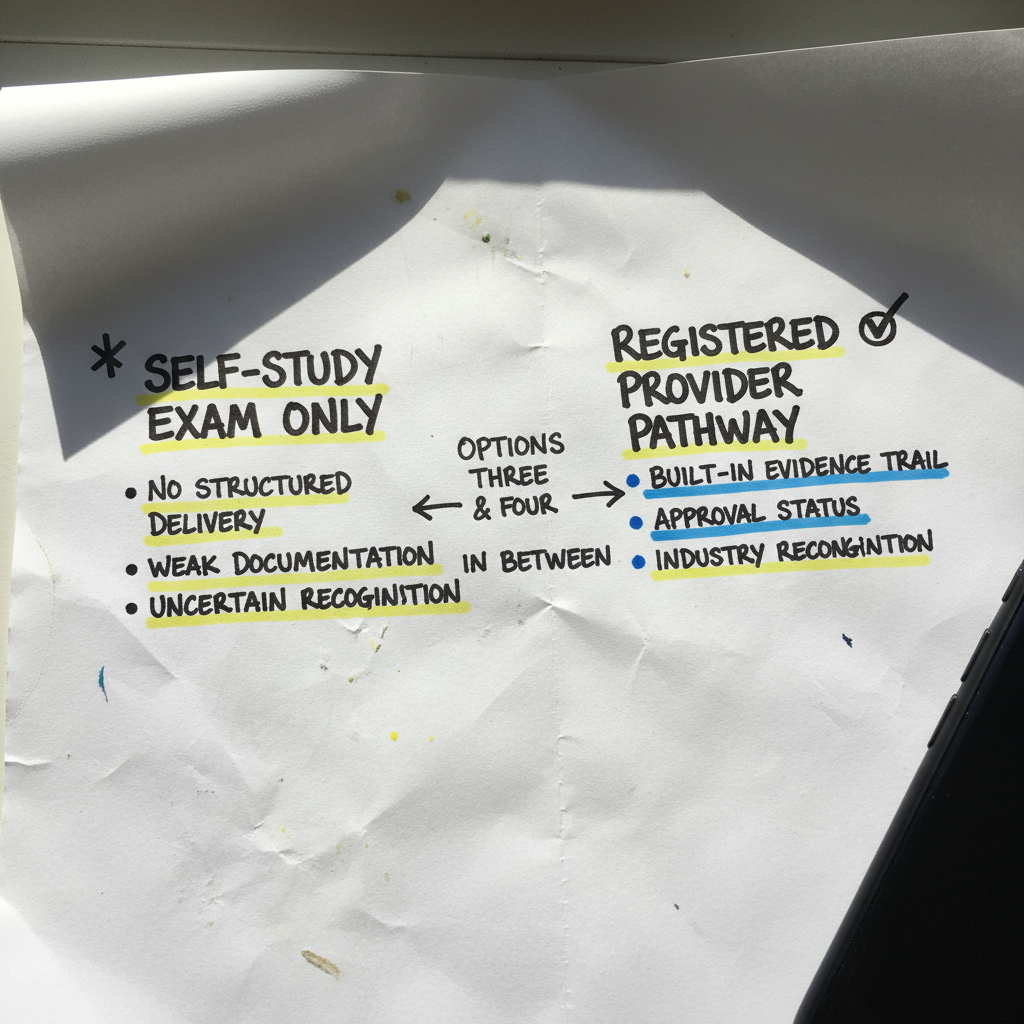
Self-study exam routes usually cannot be claimed as training, while registered provider pathways carry a built-in evidence trail.
Option 1 — Independent certification vendor (vendor-issued, globally recognised)
Usually a paid exam plus optional prep course. The credential carries external recognition and travels well between employers.
Claim status: claimable only if the preparatory course is bought from an HRD Corp registered provider and structured as approved training. A self-study exam booked directly with the vendor is generally not a training claim.
Cost profile: exam fees are moderate; prep course fees vary widely, and exam components may fall outside the claimable portion.
Best for: individual specialists who need a portable credential on their CV.
Option 2 — Registered local training provider with a bundled certification pathway
A Malaysian provider delivers the training and aligns it to a certification outcome. This is the pattern AIHQ uses: role-based delivery, assessment-linked, and structured so the paperwork is built during the programme rather than reconstructed afterwards.
Claim status: the cleanest route, because the provider handles registration-side requirements and issues the evidence trail in the format HRD Corp expects.
Cost profile: higher per-head than self-study, but the effective cost after a successful claim is materially lower.
Best for: employers funding cohorts and wanting both the credential and defensible documentation.
Option 3 — Public university or professional body programme
Strong signal on rigour and governance. Often part-time and longer in duration.
Claim status: claimable where the institution is registered for the relevant scheme; confirm the specific programme, not just the institution.
Cost profile: mid to high; scheduling is less flexible.
Best for: regulated teams where an academic or professional-body credential carries internal weight.
Option 4 — In-house custom programme with optional external certification
Training built around your own workflows, with an external certification bolted on for those who want it.
Claim status: the training element is claimable if delivered by a registered provider; add-on exams sold separately may not be.
Cost profile: front-loaded design cost, lower marginal cost per head at volume.
Best for: teams of 20 or more with role-specific content needs. Where off-the-shelf tools and generic curricula stop fitting the workflow, this shades into custom AI solutions and implementation support.
Option 5 — Self-study with certification exam only
Cheapest cash outlay, lowest documentation burden, highest internal inconsistency.
Claim status: generally not claimable as training, because there is no structured training delivery to reclaim.
Cost profile: lowest nominal cost; the real cost is failed exams and unused licences.
Best for: motivated individuals with a clear personal study plan and no funding dependency.
Decision table: criteria against options
| Criterion | Vendor-only exam | Registered local provider | University / professional body | In-house custom + certification | Self-study |
|---|---|---|---|---|---|
| Likely HRDC claimable | No | Yes (subject to eligibility/approval) | Yes, if programme registered | Yes for the training element | No |
| Evidence trail quality | Weak | Strong, built-in | Strong | Strong | Weak |
| Cost per head | Low–mid | Mid–high | Mid–high | High upfront, low at volume | Low |
| Time to first cohort | Fast | 4–8 weeks | 8–16 weeks | 6–12 weeks | Immediate |
| Role relevance for finance | Generic | High | High | Highest | Variable |
| Documentation owner needed | Yes | Yes | Yes | Yes | No |
Read the third row carefully. The cheapest option per head is also the one that generates the least retrievable value, because there is no claim and no structure. Cost-per-head comparisons that ignore the levy recovery are the single most common budgeting error in this category.
A 12-week claim timeline with named owners
The claim is not an administrative footnote. Treated as a project, it looks like this.
Weeks 1–2 — Funding position and scope. Owner: Finance Manager (FP&A). Confirm levy standing, remaining claimable balance and the total budget ceiling for the financial year. Decide the cohort size and the roles being certified.
Weeks 3–4 — Provider and programme shortlist. Owner: L&D Manager. Verify registered provider status, confirm which fee lines are claimable, and request a line-item quotation rather than a lump sum.
Weeks 5–6 — Approval and submission. Owner: L&D Manager with Finance sign-off. Submit the application ahead of the course start date. Do not let a programme begin before submission is confirmed.
Weeks 7–14 — Delivery. Owner: Programme Lead. Attendance records captured per session. Certificates or completion records issued within the programme window, not weeks later.
Weeks 15–18 — Claim submission. Owner: Finance Manager. Assemble invoices, receipts, attendance, participant confirmations and completion evidence. Submit within the scheme's stated window.
Weeks 19–24 — Review response and reconciliation. Owner: Finance Controller. Respond to any clarification requests, then post the recoverable amount against the original budget line so the actual training cost is visible in the accounts.
One caution worth stating plainly: HRD Corp approval is never automatic. Eligibility, grant approval and submission requirements all sit outside your control. Budget the training as an expense and treat recovery as a forecastable inflow, not a certainty. To discuss how a structured programme fits that timeline, you can speak to AIHQ about your specific cohort.
Who should pick what
Pick the vendor-only exam if you are funding one or two specialists and the credential itself is the deliverable. Accept that you are paying full price.
Pick the registered local provider route if you are funding a cohort of 8–40 people and you want the claim, the evidence trail and the certificate from one engagement. This is the default for most Malaysian employers.
Pick the university or professional body route if your sector's auditors, regulators or clients recognise that specific credential, and you can absorb the longer schedule.
Pick the in-house custom route if your roles are specialised enough that a generic curriculum wastes seats. Build the pathway around real job tasks, then add the external certification as a marker of completion. Teams that have already run a broader literacy phase tend to arrive here naturally — the practical roadmap for learning AI tools covers that earlier stage.
Pick self-study only if the individual is self-directed, the budget genuinely does not exist, and you accept there is nothing to claim.
Three things to check before you sign
Check the quotation structure. Ask the provider to separate tuition, assessment, materials and any travel component. If they cannot split the lines, you cannot estimate your recovery.
Check who holds the evidence. Attendance and completion records should reach you as a matter of routine, not on request three months later.
Check the internal owner. A claim without a named owner in L&D and a named owner in Finance will sit unfinished. Two names, on the approval document, before the first session runs.
FAQ
Is every data and AI certification claimable? No. Claimability depends on provider registration, employer eligibility, the programme structure and which fee components are involved. Treat any blanket "claimable" label as a prompt to verify, not a conclusion.
Can we claim the full course fee? Often not in full. Tuition is generally the core claimable element, while travel, accommodation and certain assessment or exam fees may fall outside it. Request a line-item quotation and allow for this in the budget.
What if the claim is only partially approved? Recognise the shortfall against the same budget line immediately, and decide whether the programme continues at full cost before the next cohort is scheduled rather than after.
Do employees need to complete the certification to keep the claim? Completion and attendance evidence is normally part of the submission, so a high dropout rate creates both a capability gap and a documentation gap. Track completion during delivery, not after.
Can we run the programme before approval comes through? It is a common shortcut and a common source of rejected claims. Sequence the submission ahead of the start date.
Who should own the claim internally? L&D owns the programme and evidence; Finance owns the submission, reconciliation and budget posting. Assigning both before kickoff is the single most reliable predictor that the claim gets filed.
Turning the approval into capability
Recovering levy money is the easy half. The harder question is whether the certified people can change how work gets done afterwards. Certification marks the end of a course and the start of a workflow habit, and the employers who get value from data and AI credentials are the ones who plan the second part before approving the first. If you want help structuring cohorts, claim documentation and post-training application together, contact AIHQ to map it against your roles, systems and budget cycle.
FAQ
Is every data and AI certification claimable under HRD Corp?
No. Claimability depends on the provider being registered, your employer eligibility and levy standing, the programme structure and which fee components are involved. AIHQ programmes can be structured to be HRDC claimable, subject to client eligibility, grant approval and HRD Corp submission requirements.
Can a Malaysian employer claim the full data and AI certification fee?
Often not in full. Tuition is typically the core claimable element, while travel, accommodation, certain assessment or exam fees and non-training items may fall outside the claimable portion. Ask for a line-item quotation and budget accordingly.
How long does the HRDC claim process take for a certification cohort?
A practical planning window is 12 to 24 weeks from scope to reconciliation: two weeks for funding position, four for provider selection, two for submission, then delivery, claim submission and review response. Timelines vary by scheme and volume.
Which certification route suits finance and data teams best?
For cohorts of roughly 8 to 40 people, a registered local training provider with a bundled certification pathway usually gives the best combination of claim documentation, role relevance and cost after recovery. Individual specialists who need a portable credential may prefer a vendor-issued exam.
Who should own the HRDC claim inside the organisation?
Split it deliberately. L&D owns programme design and the evidence trail (attendance, completion, certificates). Finance owns the submission, review response and budget reconciliation. Two named owners, confirmed before the first session.
Does self-study count as claimable training?
Generally no. A directly booked certification exam without structured training delivery does not create the training record a claim requires. It is the lowest-cost option in cash terms but carries no levy recovery.