General
Malaysia's GPT Moment: Why Local AI Models Matter
· By AIHQ Team
Malaysia's GPT moment is a procurement decision, not a technology preview
A Malaysian agency drafting an AI paper this year will likely be asked one question it cannot answer confidently: if we run a GPT-class assistant over our own documents, does the data stay here?
That question is now being asked in board rooms, not just IT departments. The Digital Ministry has been openly positioning Malaysia as a regional AI hub, the National AI Office (NAIO) was established in 2024 to coordinate national AI policy, and agencies are increasingly expected to justify why a model is hosted offshore or onshore before they approve spend. For public sector and GLC decision makers, "which AI model" is no longer a technical question. It is a sovereignty, cost and audit question.
Where local and regional models actually stand
It helps to separate three things that get bundled together under "local AI":
- Sovereign hosting. The model may be a global one, but running inside Malaysian infrastructure under your control.
- Language and context tuning. A model fine-tuned or prompted on Bahasa Malaysia, local policy language and Malaysian document formats.
- Locally developed models. Malaysia has its own efforts in this space, and regional models from across Southeast Asia are increasingly viable for Bahasa-heavy work.
An agency that needs answers to hold up under audit usually needs the first two far more urgently than the third. Sovereign hosting plus language tuning covers most public sector use cases — policy Q&A, SOP retrieval, citizen enquiry triage — without betting on a domestically trained frontier model that may not yet match global capability on complex reasoning.
That distinction matters because the decisions are different. Hosting can be governed today. Frontier-model development is a multi-year national investment with a different risk profile.
What the numbers look like in ringgit
Directional MYR bands help frame an internal business case. Treat these as planning ranges, not quotations — actual figures move with model choice, data volume and how much integration you need.
- Sovereign hosting of a GPT-class model on Malaysian cloud: typically tens of thousands of ringgit per month once you include GPU capacity, storage, networking and the managed service layer. A modest pilot can start well below that.
- Fine-tuning or heavy language adaptation for Bahasa Malaysia: a one-off project usually in the six-figure ringgit range, depending on corpus size and data cleaning effort.
- An internal copilot or policy-assistant build (retrieval, guardrails, evaluation, integration with your document stores): commonly a six-figure ringgit build for a single department, plus a recurring run-rate.
- Workforce capability alongside the technology: budget for role-based training, not a one-off awareness session. This is the line item most often cut and most often the reason pilots stall.
Two cost realities are worth putting in front of any approving committee. First, the model licence is rarely the largest line — data preparation, integration and evaluation usually are. Second, sovereign hosting has a floor cost. If only 30 people will use it lightly, an onshore deployment may be harder to justify than a governed offshore service with clear data-handling terms.
A 16-week rollout sequence with named owners
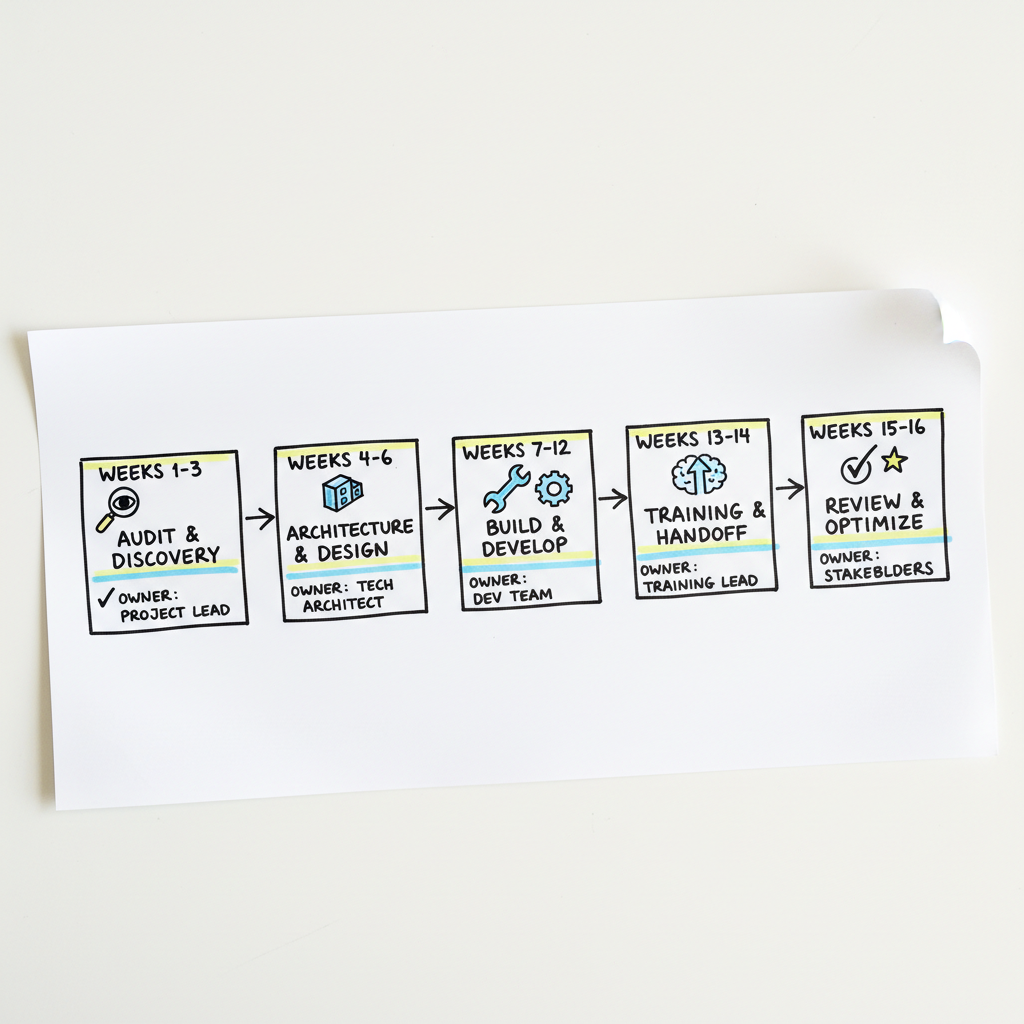
A 16-week sequence: mandate, audit, architecture, build, role-based training, then governance handover.
This is a practical sequence for an agency or GLC moving from decision to a governed pilot. Week numbers are elapsed, not effort.
Weeks 1–2 — Mandate and decision rights (owner: Chief Digital Officer or equivalent). Confirm which use cases are in scope, who signs off on data classification, and who owns the model once it is live.
Weeks 3–5 — Use-case and data audit (owner: Head of Transformation with departmental leads). Pick at most three workflows. Inventory the documents, systems and data classifications each one touches, and flag anything sensitive before a model sees it.
Weeks 6–8 — Architecture and host decision (owner: CIO or Head of IT). Choose sovereign hosting, governed offshore, or a hybrid. Document the reasoning in writing — this is the artefact your auditors will ask for.
Weeks 9–11 — Build and baseline (owner: technical delivery lead). Stand up retrieval over your document estate, set guardrails, and record baseline accuracy and handling-time figures so improvement can be shown later.
Weeks 12–14 — Role-based training (owner: HR or L&D lead, with subject-matter leads). Train by role, not by tool. The people who will use the assistant daily need practice on their own documents and a clear escalation path.
Weeks 15–16 — Pilot review and governance handover (owner: pilot sponsor). Review results, decide scale or stop, and hand the operating rules to whoever owns responsible use.
If you want a structured way to run weeks 3–5 and 12–14, an AI innovation bootcamp is designed exactly for that use-case discovery and pilot-planning work.
The governance questions that decide whether this is defensible
Sovereignty is not only about where the servers are. Four questions tend to surface in review, and each has a practical answer.
Who can access the data, and under what agreement? Hosting location is necessary but not sufficient. You need contractual clarity on access, retention and deletion.
What is the human review point? Any assistant that touches public communication, legal interpretation or citizen entitlement should have a named human check before output is used.
How is accuracy measured? Define it before you launch. A weekly sampled evaluation of, say, 50 queries reviewed by a subject-matter lead is more useful than a one-off accuracy claim.
What happens when the model is wrong? Document the escalation route, and rehearse it during the pilot rather than after an incident.
For teams that need to translate these into operating rules, responsible AI training can be run alongside the technical build rather than after it. The order matters — policy written after rollout becomes damage control rather than governance.
Where local models help, and where they still do not
Being honest about limits is what keeps a sovereignty argument credible.
Where local and tuned models earn their place: Bahasa Malaysia and mixed-language service queries, retrieval over Malaysian policy and regulatory documents, structured internal knowledge access, and any workload where data residency is non-negotiable.
Where they remain weaker: complex multi-step reasoning, long-document synthesis at frontier quality, and code-heavy or highly specialised technical work. For those, a governed offshore service may still deliver better output per ringgit — with the data-handling terms that make it acceptable.
The hybrid answer is usually the right one. Keep the sensitive, Bahasa-heavy, internally facing work on sovereign or tuned infrastructure. Use governed global services for the analytical and creative workloads where capability gap is widest and data sensitivity is lower. That is a defensible position to put in front of an approving authority, and it is honest about cost.
If the underlying workflows need something beyond an off-the-shelf tool, custom AI solutions are often the layer that makes a sovereign deployment usable inside existing systems rather than a parallel experiment.
What the numbers mean for your team
Three conclusions are worth carrying into your next internal paper.
First, language capability and data residency are the two arguments that will survive scrutiny. "It is a local model" on its own will not.
Second, the cost centre is rarely the model. Data preparation, integration and evaluation will dominate your budget, and capability building will determine whether the spend produces usable behaviour.
Third, governance written before rollout is cheaper than governance written after. The 16-week sequence above exists mainly to force those decisions early, when they are still design choices.
AIHQ has trained and engaged over 9,000 professionals and worked across corporate, government, public sector, professional and regulated environments. Programmes can be structured to be HRDC claimable, subject to client eligibility, grant approval and HRD Corp submission requirements. For agencies building their first structured AI programme, the ChatGPT Malaysia enterprise deployment guide covers the operational decisions that sit alongside a hosting choice.
If you are still at the stage of deciding whether you need a local model at all, AI adoption in Malaysian enterprises sets out the wider sequence, and a wider look at AI consulting Malaysia options can help you benchmark your approach against peers before committing budget.
FAQ
Do Malaysian agencies and GLCs need a locally developed model, or is local hosting enough?
For most public sector use cases, sovereign hosting combined with Bahasa Malaysia tuning covers the requirement. Locally developed frontier models are a longer-term national investment with a different risk profile. The decision usually comes down to which workloads genuinely need full model development versus which need data residency and language quality.
How much should we budget for a sovereign AI pilot in Malaysia?
Directional planning ranges are useful: six-figure ringgit for a single-department copilot or policy-assistant build, plus a recurring run-rate for hosting and support. Bahasa fine-tuning is typically a separate one-off project. Data preparation, integration and evaluation usually cost more than the model licence itself.
How long does it take to move from decision to a governed pilot?
Around 16 weeks is a realistic elapsed sequence: two weeks for mandate and decision rights, three for use-case and data audit, three for architecture and host decision, three for build and baseline, three for role-based training, and two for pilot review and governance handover. Effort varies with integration complexity.
Where do local or tuned models still fall short?
They remain weaker on complex multi-step reasoning, long-document synthesis at frontier quality, and highly specialised technical work. A hybrid approach — sovereign or tuned models for sensitive, Bahasa-heavy, internally facing work, and governed global services where the capability gap is widest — is usually the most defensible position.
What should be in the governance paper before rollout?
Four things: who can access the data and under what agreement, where the human review point sits, how accuracy is measured on an ongoing basis, and the escalation route when the model is wrong. Defining these before launch makes them design choices rather than incident responses.