General
Top AI Accounting Courses in Malaysia: Upskill Your Finance Team for 2026
· By AIHQ Team

Finance teams across Malaysia are turning to AI to handle reconciliation, reporting, and compliance work faster. But with so many training options available, how do you separate practical, workflow-relevant courses from generic overviews?
This listicle covers the top AI accounting courses in Malaysia for finance professionals who want to build real capability — not just watch tool demonstrations. Whether your team is new to AI or already experimenting, these programmes offer structured paths toward more efficient, accurate financial workflows.
1. AI for Finance Teams — Role-Based Training (AIHQ)
AIHQ's role-based AI training for finance teams is designed specifically for Malaysian accountants, finance managers, and analysts. The programme covers:
- Automated reconciliation using AI to match transactions, flag discrepancies, and reduce manual spreadsheet work
- AI-assisted reporting for faster month-end close, variance analysis, and management reporting
- Compliance workflow support — using AI to review regulatory checklists and audit trails while keeping human oversight
- Responsible use of AI with financial data — understanding data privacy, confidentiality, and tool-specific guardrails
This course moves beyond generic ChatGPT tips. Participants work through real finance scenarios — trial balance reviews, invoice matching, and cash flow commentary — using AI tools under guided instruction.
AIHQ has trained over 9,000 professionals across corporate, public sector, and regulated environments, with a practical, business-first approach.
Best for: Finance teams wanting role-specific AI capability rather than general AI awareness.
2. ACCA's AI and Digital Finance Modules
ACCA has integrated AI and digital topics into its professional qualification and continuing professional development (CPD) offerings. These modules are useful for accountants who want a recognised credential alongside practical AI knowledge.
Topics include:
- AI's impact on audit, tax, and financial reporting
- Data analytics for finance professionals
- Ethical considerations in AI-assisted accounting
These courses work well for finance professionals who already hold or are pursuing ACCA qualifications. However, they focus more on strategic understanding than hands-on tool usage.
Best for: ACCA members and students seeking CPD-accredited AI awareness.
3. University Short Courses — AI in Finance (Local Institutions)
Several Malaysian universities and private colleges offer short executive programmes on AI in finance. Examples include courses from:
- Asia School of Business (ASB) — executive programmes covering AI strategy in finance
- Taylor's University — short courses on data analytics and AI for business
- Universiti Malaya (UM) — professional certification in AI applications
These are academically grounded and useful for understanding the theory behind AI models, but they may not translate directly into daily workflow improvements. Teams often need supplementary hands-on training to apply concepts practically.
Best for: Finance leaders who want a theoretical foundation before practical training.
4. AI Automation for Accounting Workflows (International Platforms)
Platforms like Coursera, Udemy, and LinkedIn Learning offer AI accounting courses taught by international instructors. Popular options include:
- "AI for Accounting" by University of Illinois (Coursera)
- "ChatGPT for Accountants" (Udemy)
- "AI in Finance" (LinkedIn Learning)
These are affordable and flexible, but they lack local context — Malaysian tax regulations, SST considerations, HRDC claimable structures, and Bahasa Malaysia or multilingual financial reporting are usually not covered.
Best for: Self-paced learners who want a low-cost introduction before committing to structured training.
5. Custom AI Adoption for Finance — AIHQ Innovation Bootcamp
For finance teams that have completed foundational training and want to identify higher-value automation opportunities, AIHQ offers an AI innovation bootcamp. This structured workshop helps teams:
- Audit existing finance workflows for AI-ready tasks
- Prioritise use cases — from invoice processing to compliance checks
- Plan a pilot that aligns with business priorities and risk tolerance
This is not a standard course. It is a facilitated discovery session designed to move teams from capability into structured implementation.
Best for: Finance teams ready to move beyond training into practical workflow change.
6. AI-Powered Audit and Risk Courses (Professional Bodies)
Organisations like the Institute of Internal Auditors Malaysia (IIA Malaysia) and the Malaysian Institute of Accountants (MIA) offer courses on AI in audit, risk, and compliance. These are valuable for finance professionals in regulated environments.
Topics typically cover:
- Using AI for continuous monitoring and anomaly detection
- Automating audit evidence collection
- Maintaining professional scepticism with AI-generated findings
These courses emphasise governance and oversight — critical for finance teams handling sensitive data.
Best for: Audit, risk, and compliance finance professionals.
How to Choose the Right AI Accounting Course
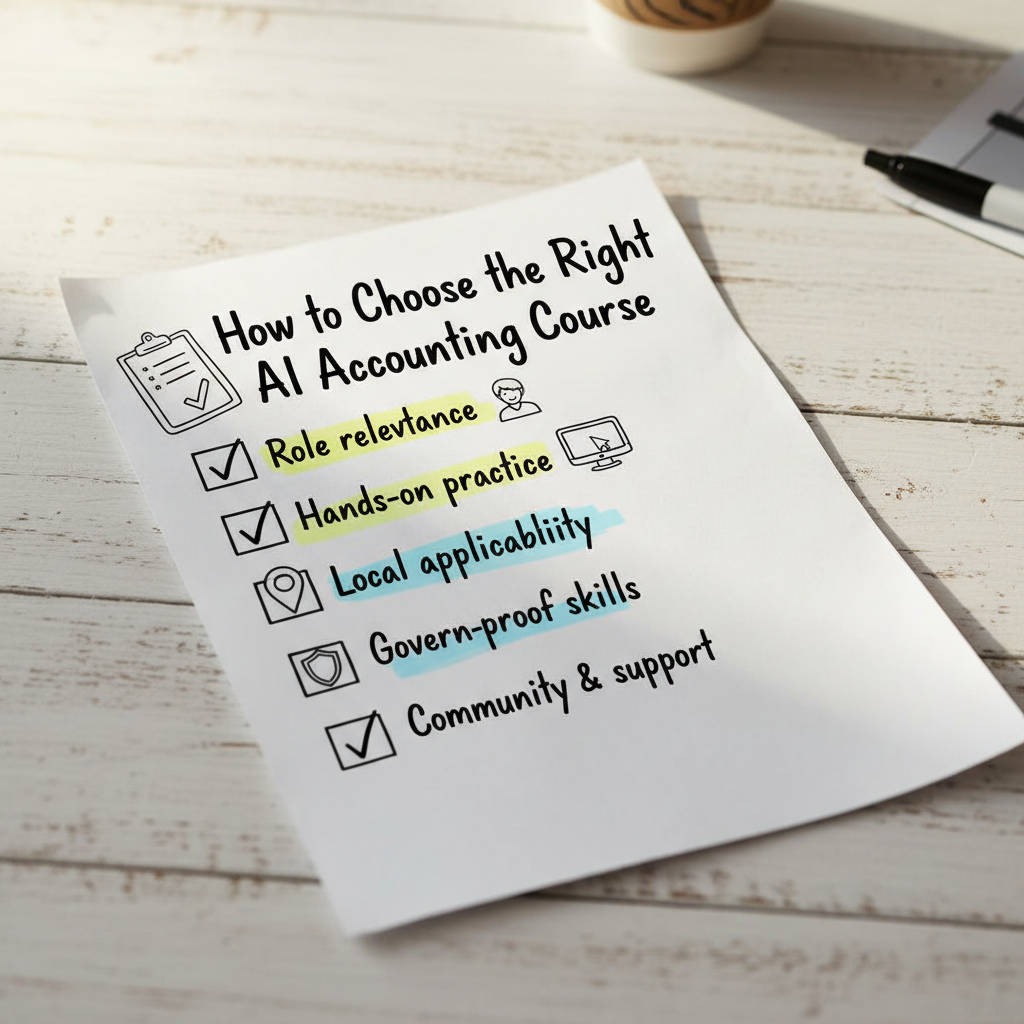
Use this checklist to evaluate whether an AI accounting course matches your team's needs.
Not every course suits every team. Consider these factors:
| Factor | What to Look For |
|---|---|
| Role relevance | Does the course use finance-specific scenarios (reconciliation, reporting, compliance)? |
| Hands-on practice | Do participants use AI tools during the session, or only watch demonstrations? |
| Local applicability | Does it cover Malaysian regulations, SST, and local business context? |
| Governance coverage | Does it address data privacy, confidentiality, and responsible AI use? |
| Flexibility | Can it be delivered online, in-person, or as a hybrid programme? |
| HRDC claimable | Can the cost be structured as HRDC claimable, subject to eligibility? |
Build Finance AI Capability That Sticks
Finance teams that adopt AI effectively share one trait: they invest in structured, role-based capability building — not just tool access. The best AI accounting courses in Malaysia are those that connect AI skills to real workflows, teach responsible use, and prepare teams for the automation demands of 2026 and beyond.
If your finance team is ready to move beyond experimentation into practical, workflow-aligned AI capability, structured training can help close the gap.
FAQ
What are the best AI accounting courses in Malaysia?
The best options include role-based finance AI training from AIHQ, ACCA's AI and digital modules, university short courses from local institutions, and hands-on bootcamps that focus on reconciliation, reporting, and compliance workflows.
Can AI accounting courses in Malaysia be HRDC claimable?
Yes. Programmes like AIHQ's role-based finance training can be structured to be HRDC claimable, subject to client eligibility, grant approval, and HRD Corp submission requirements.
Do I need a technical background to take an AI accounting course?
No. Most practical AI accounting courses are designed for finance professionals without programming experience. The focus is on using AI tools for reconciliation, reporting, and compliance — not on building AI models.
How is role-based AI training different from generic AI courses?
Role-based training uses finance-specific scenarios — trial balances, invoice matching, cash flow commentary — while generic courses often cover broad AI concepts without connecting to daily workflows.
What should I look for when choosing an AI accounting course in Malaysia?
Look for role relevance (finance-specific scenarios), hands-on practice, local context (Malaysian regulations), governance coverage, delivery flexibility, and whether the programme can be structured as HRDC claimable.
How long does it take to see practical results from AI accounting training?
Outcomes vary by organisation, adoption, and measurement. However, teams that follow structured, role-based training with workflow practice often identify automation opportunities within weeks of completing the programme.