General
What an AI Consultant Actually Does: Roles, Value, and When to Hire vs. Build In-House
· By AIHQ Team

What Does an AI Consultant Actually Do?
Ask five people what an AI consultant does and you will get five different answers. Some will say they write prompts. Others will say they build chatbots. A few will say they sit in boardrooms and talk about strategy. The truth is that an experienced AI consultant spans all of these — and a lot more besides.
At its core, the AI consultant role is about helping an organisation move from scattered, uncertain AI experimentation toward structured, practical adoption. That means matching what AI can realistically do against the workflows, people and risks inside a specific business. It is part translator, part strategist, part capability builder and part implementation guide.
This guide breaks down what an AI consultant actually does day to day, where the real value shows up, and how to decide whether to hire external expertise or build an in-house AI team.
The Four Core Workstreams of an AI Consultant
Most consultants work across four connected areas. Each one answers a different part of the adoption problem, and skipping any of them is a common reason AI initiatives stall.
1. Strategy and Use-Case Discovery
The first job of an AI consultant is not to talk about models or tools. It is to understand the business — how it operates, where the manual work sits, what repeats, what gets checked, and what decisions people make every day.
From there, the consultant helps identify the handful of use cases actually worth piloting, rather than chasing every shiny application. They will often run a structured workflow audit or discovery session to surface high-value, low-risk opportunities that connect to genuine pain points.
This stage matters because most organisations do not lack AI ideas. They lack a way to prioritise them against business value, effort and risk.
2. Capability Building and Change
Tools only create value when capable people use them well. A good consultant spends a meaningful share of their time on workforce readiness — helping leadership align, building role-based skills, and shaping the habits that turn occasional experiments into repeatable workflows.
This is where generic one-off workshops fall short. An AI consultant focused on real adoption thinks in terms of a progression: from awareness, to fundamentals, to practical role-based usage, and only then to advanced or implementation work. They structure training around how specific teams actually work, not just how to prompt a chatbot.
3. Implementation and Workflow Design
Once use cases and capability are in place, the consultant helps turn ideas into working workflows. That can mean integrating AI into existing processes, designing how humans and AI hand off to each other, or setting up the measurement that shows whether anything moved.
For some organisations, off-the-shelf tools are enough. In other cases — where data is scattered, the process is complex, or a generic tool cannot meet the workflow reliably — the consultant helps define whether a custom solution is warranted.
4. Governance and Responsible Use
A mature AI consultant also spends time on governance. That means helping organisations set clear guardrails for what can be shared with AI tools, who is accountable for output quality, and how to review and correct AI work.
This is especially important where confidential or sensitive information is involved. Responsible AI is not a policy document that sits in a drawer; it translates into practical employee behaviour and clear escalation paths.
Where the Value of an AI Consultant Shows Up
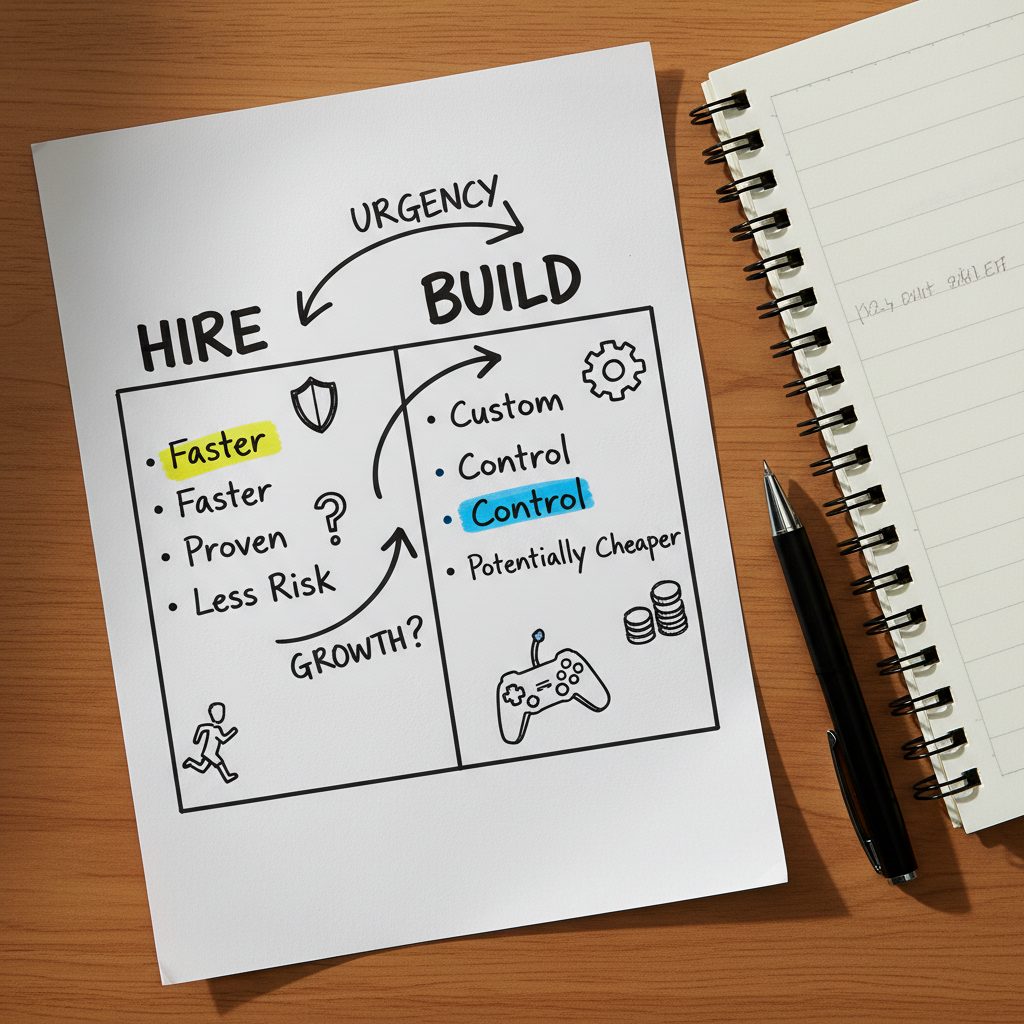
A simple decision framework helps leaders weigh external expertise against internal capacity.
It is reasonable to ask what measurable value a consultant provides. The honest answer is that value shows up in a few distinct places — and rarely overnight.
Faster, more focused decisions. A consultant shortens the path from 'we should do something with AI' to a shortlist of realistic, prioritised opportunities. Without that, teams can spend months exploring tools before anything valuable happens.
Avoided missteps. Many AI projects fail not because the technology is bad, but because the right problem was never defined, the change was not managed, or governance was bolted on too late. A consultant helps de-risk this.
Workforce capability that outlasts a project. AIHQ has trained and engaged over 9,000 professionals in AI and Generative AI programmes, working across corporate organisations, government agencies, professional institutions, regulated sectors and leadership audiences. The point of capability building is that skills stay with the team after the engagement ends.
Structured pathway to outcomes. A consultant helps you define the measurements that matter — usage, workflow improvement, time saved on specific tasks — so you can track progress rather than guessing at impact.
It is worth being clear about what a consultant does not do. Nobody can honestly guarantee ROI or transformation in advance; those depend on your context, adoption, data and follow-through. What a good consultant does is structure the work so you can move toward measurable outcomes with confidence.
When to Hire an External AI Consultant
External help tends to make sense in four situations:
- You are early and unsure where to start. If there is no clear strategy, no prioritised use cases and no governance, an external perspective can prevent expensive trial and error.
- You need to move faster than you can build capacity. Hiring and training an internal team takes time. A consultant can compress the timeline while you build longer-term capability.
- You need specialist skills you do not have in-house. Examples include responsible AI and governance, role-based training design, or custom implementation.
- You need an objective view. A consultant brings cross-industry experience — including seeing what works and what does not across sectors — which is hard to replicate internally.
When to Build an In-House AI Team
Bringing capability in-house becomes attractive when AI is central to your long-term operations and you have the appetite to sustain it. That usually looks like:
- A clear recurring workload. If AI supports a large, ongoing volume of work, an internal team can be justified economically.
- Sensitive or highly specific workflows. In-house teams can build deeper context on your proprietary data and processes.
- A sustained adoption programme. Organisations serious about continuous improvement often build a small internal capability that owns adoption beyond initial pilots.
Hire vs. Build: A Practical Decision Framework
| Question | Lean toward external | Lean toward internal |
|---|---|---|
| How clear is your AI strategy right now? | Unclear | Already defined |
| How urgent is the timeline? | Urgent | Can build slowly |
| Is this a one-off project or an ongoing function? | One-off | Ongoing |
| Is AI strategically central to your business? | Secondary | Core |
| Do you have in-house AI skills today? | No | Yes |
The two are not mutually exclusive. Many organisations start with external support to define strategy and build early capability, then gradually internalise the work as their teams mature through structured training and adoption.
Making the AI Consultant Engagement Work
Whichever direction you choose, a few practices make the engagement perform better:
- Start with leadership alignment before scaling anything. When executives agree on goals, risk appetite and decision rights, adoption runs far more smoothly. AIHQ supports executive briefings for exactly this reason.
- Define the problem, not the tool. Bring a business problem or workflow pain point, not a demand for 'a ChatGPT project.'
- Plan for capability, not just a deliverable. The best engagements leave your team more capable, not dependent on the consultant.
- Agree on what you will measure. Decide the workflow or task-level metrics up front so both sides know what progress looks like.
The Bottom Line
The AI consultant role is broader than most people assume. It covers strategy, capability building, implementation and governance — and it earns its keep mostly by helping organisations make better decisions faster and avoid costly missteps.
The real question is not 'should we use AI?' but 'what does practical, responsible adoption look like for us?' A good consultant helps you answer that with structure and clarity — and helps your own team build the skills to carry it forward.
If you are weighing how to approach AI adoption in your organisation, the most useful next step is a conversation about your current stage, priorities and risks.
FAQ
What does an AI consultant actually do day to day?
An AI consultant works across four areas: strategy and use-case discovery, workforce capability building, implementation and workflow design, and governance and responsible use. The day-to-day balance depends on the client, but the common thread is helping organisations move from scattered experimentation to structured, practical adoption.
How much value can an AI consultant really deliver?
Value typically shows up in faster, better-focused decisions; avoided missteps; workforce capability that outlasts the engagement; and a structured pathway to measurable outcomes. No consultant can honestly guarantee ROI in advance, since outcomes depend on your context, adoption, data and follow-through.
Should we hire an AI consultant or build an in-house AI team?
External help suits early, uncertain stages, urgent timelines, specialist skills you lack, and the need for an objective view. In-house capability makes sense when AI is strategically central and recurring. Many organisations start external, then internalise as their teams mature through structured training.
What should I bring to a first AI consultancy discussion?
Bring a business problem or workflow pain point rather than a demand for a specific tool. Leadership alignment on goals, risk appetite and decision rights matters most. Agreeing on what you will measure also helps both sides understand what progress looks like.
Does the AI consultant role include AI training and upskilling?
For adoption-focused consultants, yes. Capability building is central, because tools only create value when capable people use them well. This typically means role-based training tied to real workflows, not generic one-off workshops.