General
What Is AI Business Consulting? A Practical Guide for Malaysian SMBs and Enterprises
· By AIHQ Team

If your organisation is seriously exploring AI, you have probably come across the term "AI business consulting" — and felt more confused than confident about what it actually means.
Is it a salesperson pitching the latest tools? Is it a technical team building chatbots? Is it an analyst who reads AI news and gives opinions?
The short answer: AI business consulting is none of those on its own. Done well, it is a structured, business-first discipline that helps organisations understand where AI creates real value, build the capability to use it well, and adopt it responsibly.
This guide breaks down what AI business consulting actually involves, how it connects to training and implementation, and how Malaysian SMBs and enterprises can decide whether it is right for their current stage.
What AI business consulting really is
AI business consulting is the practice of helping organisations translate AI from a broad buzzword into practical decisions that fit their workflows, people and goals.
A good consultant does not assume AI is automatically the answer. They start by understanding your business context: your processes, your pain points, your data, your people's skills and your priorities. Only then do they help you sort realistic opportunities from hype.
At AIHQ, we describe the work around five stages: interest, capability, practical usage, measurable outcomes, and optional implementation. Consulting typically supports several of these at once — especially when moving from awareness into structured adoption.
In practical terms, AI business consulting usually involves:
- Leadership alignment — helping the management team agree on what AI should (and should not) do for the business
- Workflow and use-case discovery — identifying the tasks where AI genuinely helps, rather than applying it everywhere
- Training needs analysis — understanding what skills people actually need for their roles
- Adoption roadmaps — sequencing realistic steps from pilot to broader rollout
- Governance and responsible use — setting guardrails so AI is used safely, especially with sensitive data
What an AI consultant does versus who they are not
To avoid disappointment, it helps to be clear about the boundaries of the role.
A capable AI business consultant typically:
- Diagnoses where AI can add value by examining real workflows
- Educates leadership and teams so they can make informed decisions
- Prioritises use cases by business impact and feasibility
- Plans practical next steps, including pilots and training
- Connects strategy to capability building and, where relevant, implementation
An AI consultant is not simply:
- A software vendor pushing a single tool
- A "prompt engineer" who promises results after a half-day workshop
- A guarantee that AI will transform your business
- A replacement for the human judgment in your organisation
This does not mean off-the-shelf tools are irrelevant — far from it. Tools like ChatGPT, Gemini and Copilot are genuinely useful. The point is that they work best as part of a structured approach, not as a magic solution on their own.
The difference between consulting, training and implementation
One of the most common sources of confusion is how consulting differs from AI training and from custom solution building. In practice, they reinforce each other.
AI consulting is about direction: what to do, where the value sits, what to prioritise, how to govern adoption. It answers the question of what and why.
AI training is about capability: helping people build the skills to use AI competently in their roles. It answers how people will use it. Role-based AI training tends to create far stronger workplace adoption than one-size-fits-all workshops, because it connects directly to daily work.
Implementation (custom solutions) is about turning capability gaps into finished systems — for example a custom AI chatbot to handle customer enquiries, an internal copilot to help employees find SOPs, or a dashboard to surface the right information. This answers how the organisation runs better.
For many organisations, an effective sequence is: consult to identify value → train to build capability → implement where a custom AI solution truly beats an off-the-shelf tool. Skipping the consulting step often leads to buying tools that nobody uses.
When should Malaysian SMBs and enterprises consider AI consulting?
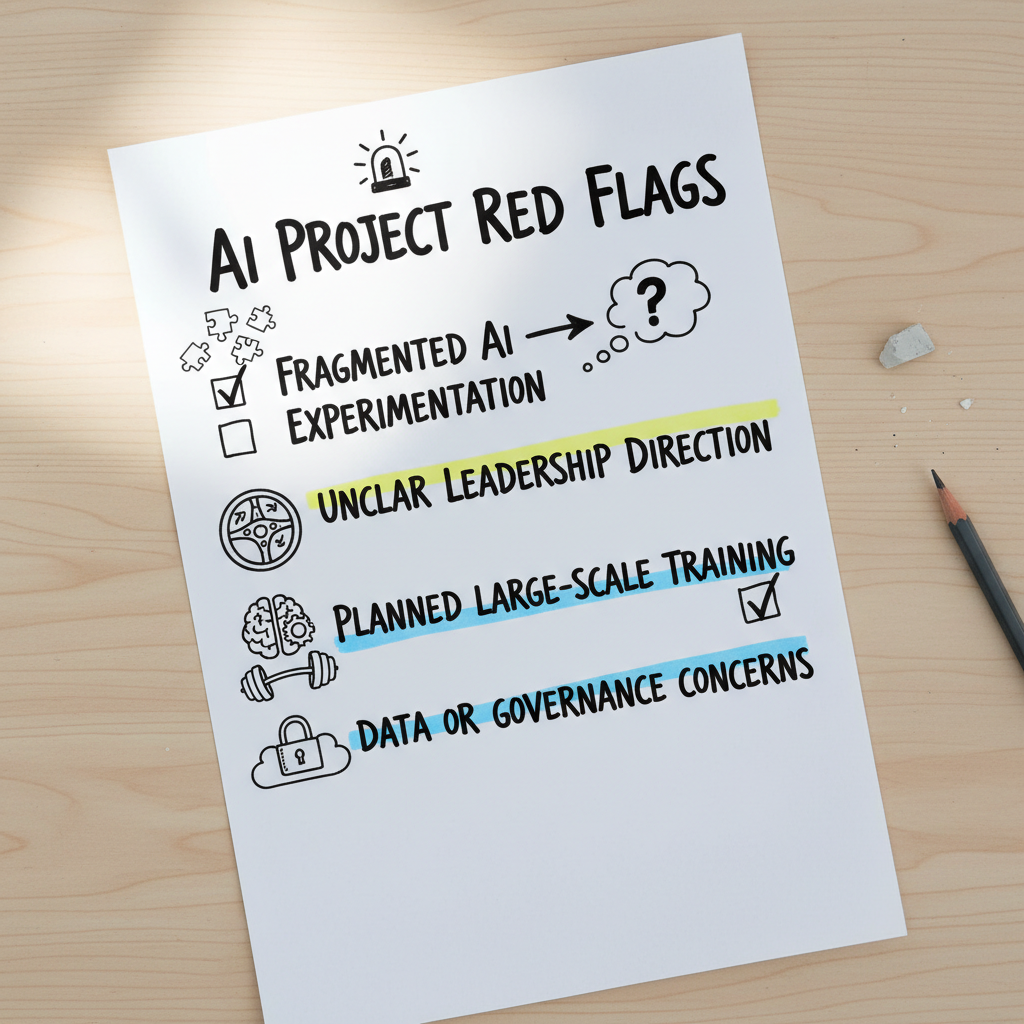
AI consulting adds the most value when experimentation is fragmented or leadership direction is unclear.
AI consulting is not every business's first step. Here are the situations where it tends to add the most value.
1. You have fragmented AI experimentation
If different departments are each trying different tools with no coordination, a focused consulting engagement can consolidate this into a coherent, governed plan. Teams often embrace AI faster when there is a clear direction.
2. Leadership is unsure where AI really creates value
When the management team cannot separate genuine opportunities from vendor hype, an AI leadership briefing or adoption roadmap discussion brings strategic clarity. Leadership alignment before large-scale rollout is a recurring theme in successful adoption.
3. You are planning large-scale training
If you are about to invest in organisation-wide AI training, a training needs analysis first will help you design programmes matched to roles and workflows, rather than delivering generic workshops that do not stick.
4. You face data or governance concerns
For organisations handling confidential or sensitive information — finance, healthcare, legal, public sector — understanding responsible AI and guardrails before employees use AI at scale is important.
5. You suspect a workflow needs more than an off-the-shelf tool
When a process is repetitive, high-volume and manual, a structured workflow audit or use-case discovery can reveal whether a custom solution is worth it.
Conversely, if you only have one small, clearly scoped task and a modest budget, a full consulting engagement may be overkill. Consider starting with targeted training or a pilot first.
A practical framework to evaluate AI consulting
When you are considering working with an AI consultant, run every proposal through these questions.
Does it start with your business problem?
The consultant should ask about your workflows, pain points and goals — before recommending anything. If the first conversation is mostly about a specific tool's features, treat it cautiously.
Does it address people and capability?
AI value does not appear just because software is installed. The approach should include building your people's skills and embedding habits, not only deploying technology.
Does it encourage responsible use?
A credible engagement should address data privacy, human oversight and governance. Beware anyone who implies every AI tool is automatically safe with company data.
Does it sequence realistically?
Watch for plans that promise instant transformation or guaranteed ROI. Sustainable adoption moves from awareness to capability, use and outcomes — not overnight change. Adding a use-case discovery workshop helps teams prioritise what is worth piloting before committing significant resources.
What a typical AI consulting engagement looks like
While every engagement differs, a structured approach usually follows this shape:
- Understand — the consultant spends time inside your workflows to understand context, constraints and opportunities.
- Prioritise — together, you narrow the field to a small number of high-value, feasible use cases.
- Align — leadership agrees on goals, scope and success measures.
- Build capability — teams receive role-based training matched to the chosen use cases.
- Pilot — a small, measurable pilot validates the approach.
- Scale and govern — what works is extended; guardrails and monitoring are in place.
The human-centred reality of AI adoption
A recurring misconception is that AI will replace employees. In practice, the most successful adoption uses AI to reduce repetitive work, improve workflows and strengthen decision support — with people retaining judgment and oversight.
This is why a capability-first mindset matters. AI business consulting, at its best, is about helping your teams work better, not replacing them. The goal is structured capability, practical adoption and real workflow improvement — not hype.
Is AI consulting right for your organisation?
If your organisation has moved past curiosity and is ready to consider structured adoption — whether through leadership alignment, capability building or a specific workflow — AI consulting can provide the clarity and sequencing you need.
At AIHQ, we have trained and engaged over 9,000 professionals across corporate, public sector, professional and regulated environments. Our approach pairs leadership alignment, role-based training and custom AI solutions where off-the-shelf tools are not enough.
Frequently asked questions
What exactly does an AI business consultant do?
An AI business consultant helps organisations identify where AI creates value, build team capability, sequence adoption realistically, and put guardrails in place for responsible use. They work across strategy, capability and implementation — rather than simply recommending a tool.
Is AI consulting different from AI training?
Yes. Consulting is primarily about direction and strategy — what to do and where value sits. Training is about capability — helping people build the skills to use AI in their roles. Both are often needed, and consulting frequently reveals the training priorities.
How much does AI business consulting cost in Malaysia?
Costs vary widely depending on scope — from focused discovery workshops to multi-month adoption programmes. Instead of a fixed price, it is more useful to define the specific outcome you want and ask for a structured proposal matched to your stage and goals.
When should I choose consulting over just buying an AI tool?
If you have a single, clearly scoped task and a small team, buying a tool and training people may be enough. Consulting adds the most value when you have fragmented experiments, unclear priorities, data or governance concerns, or are planning large-scale rollout.
Can AI consulting help with HRDC-claimable training?
A registered HRD Corp training provider can structure programmes to be claimable, subject to client eligibility, grant approval and HRD Corp submission requirements. Consulting engagements can inform a training needs analysis that shapes those programmes.
Does an AI consultant guarantee results?
No credible consultant should guarantee outcomes such as ROI or transformation. Real value depends on context, adoption, governance and measurement. A good consultant helps you structure adoption so you can pursue measurable outcomes — but the results depend on execution.
Moving from awareness to structured adoption
AI business consulting is not about one dramatic breakthrough. It is about making deliberate, well-sequenced choices — understanding your workflows, building your people's capability, adopting responsibly and improving how work actually gets done.
If that resonates with where your organisation is now, the next step is a conversation about your specific context.
FAQ
What exactly does an AI business consultant do?
An AI business consultant helps organisations identify where AI creates value, build team capability, sequence adoption realistically, and put guardrails in place for responsible use. They work across strategy, capability and implementation rather than simply recommending a tool.
Is AI consulting different from AI training?
Yes. Consulting is primarily about direction and strategy — what to do and where value sits. Training is about capability — helping people build the skills to use AI in their roles. Both are often needed, and consulting frequently reveals the training priorities.
How much does AI business consulting cost in Malaysia?
Costs vary widely depending on scope, from focused discovery workshops to multi-month adoption programmes. Instead of a fixed price, define the specific outcome you want and ask for a structured proposal matched to your stage and goals.
Can AI consulting help with HRDC-claimable training?
A registered HRD Corp training provider can structure programmes to be claimable, subject to client eligibility, grant approval and HRD Corp submission requirements. Consulting engagements can inform a training needs analysis that shapes those programmes.
Does an AI consultant guarantee results?
No credible consultant should guarantee outcomes such as ROI or transformation. Real value depends on context, adoption, governance and measurement. A good consultant helps you structure adoption so you can pursue measurable outcomes.