General
Why Malaysian Businesses Should Choose a Local ChatGPT Partner Over Going Direct
· By AIHQ Team

If your team has started exploring generative AI, you have probably faced a common decision: should you sign up for ChatGPT directly, or work with a local partner to set it up? For many Malaysian SMBs, the direct route can look like the fastest and cheapest option on the surface. But procurement is only one part of the picture.
Sustainable AI adoption is about more than an account. It is about how the tool connects to your workflows, how your people learn to use it responsibly, and who you call when something is not working.
This guide compares the two routes honestly, so you can decide which is the better fit for your organisation.
What Going Direct Actually Involves
Going direct means creating an account on the ChatGPT platform, choosing a plan, and paying in a way that suits you. It is straightforward for individual users and small teams.
The value of this route is real: you get fast access, you control your own billing, and there is no middle layer between you and the tool. If your team is experimenting with writing, research, summarisation and light analysis, direct access may be enough.
However, direct access also means you are responsible for your own onboarding, internal training, data guardrails and troubleshooting. For a small business that wants to move quickly, those responsibilities can quietly become bottlenecks later.
What a Local ChatGPT Partner Adds
A local partner such as AIHQ brings structured capability and practical adoption support around the tool. Instead of handing you a login, a partner helps you deploy ChatGPT in a way that matches your real workflows.
The difference is not about the tool itself — the underlying ChatGPT is the same. It is about everything around it.
Localised Support in Your Timezone
When a tool issue or an adoption question comes up during your workday, a Malaysia-based partner can respond in business hours rather than on a ticket queue in another timezone.
The value is practical: fewer delays when your team is blocked, and someone who understands your local business context when you need guidance.
Billing and Procurement in MYR
For many Malaysian organisations, procurement is easier when invoices and payment expectations fit local processes. A partner can provide billing that aligns with how your finance team already operates, removing some of the friction of cross-border subscription payments.
Onboarding That Goes Beyond the Login
A partner does not just create your account. A structured onboarding session helps your team understand the tool's strengths, its limits and how to use it within your own policies.
This matters because adoption usually succeeds when employees receive role-based guidance, not just a generic walkthrough. Off-the-shelf tools are useful, but sustainable usage comes from capability building and clear workflows.
Navigating Malaysian Data and Privacy Considerations
Data handling is where the direct-versus-partner decision often gets serious.
When employees use ChatGPT, the way data is treated depends on tool settings, subscription type, data policies and the nature of the information being shared. Organisations should set clear guardrails for responsible AI use, especially around confidential or sensitive information.
Working with a partner does not remove your responsibility for data governance — no responsible partner would claim otherwise. But a partner can help you understand the practical implications, set sensible internal rules and decide what belongs in the tool and what does not.
For organisations that fall under Malaysia's Personal Data Protection Act (PDPA) obligations, thinking about this before rollout is far easier than playing catch-up afterwards.
Use-Case Deployment and Role-Based Guidance
The most common reason AI projects stall is not the tool — it is clarity about what to do with it. Teams that are given an account without direction tend to experiment lightly and then trail off.
A role-based AI training approach helps different departments see how ChatGPT fits their daily work: HR teams drafting policies and interview questions, finance teams summarising reports with human review, marketing teams planning content, and customer service teams drafting consistent responses.
This is where a partner differs from a software vendor. The aim is not just to sell you access, but to help your people apply AI to real workflows and move toward measurable outcomes.
Ongoing Troubleshooting and Adoption Support
Software changes quickly. Plans update, features shift and policies evolve.
With a direct subscription, staying current is on you and your team. With a partner, there is a wider support net for practical questions: what settings to change, which guardrails to adjust, and how to help new employees get up to speed.
For leadership, this ongoing support also matters because it keeps adoption aligned. If one department uses AI heavily while another avoids it, a partner can help you think about consistency and governance across the organisation.
When Going Direct Still Makes Sense
This comparison is not intended to dismiss the direct route. In several situations, it is the right call:
- You are an individual professional or a very small team experimenting on your own.
- Your use cases are light and you are comfortable managing your own account and billing.
- You are still in the curiosity stage and want low commitment.
- You already have strong internal AI capability and do not need external guidance.
Going direct can be a sensible first step. The question is what happens when you want to move from individual experimentation to structured, organisation-wide adoption.
A Practical Comparison: Direct vs Local Partner
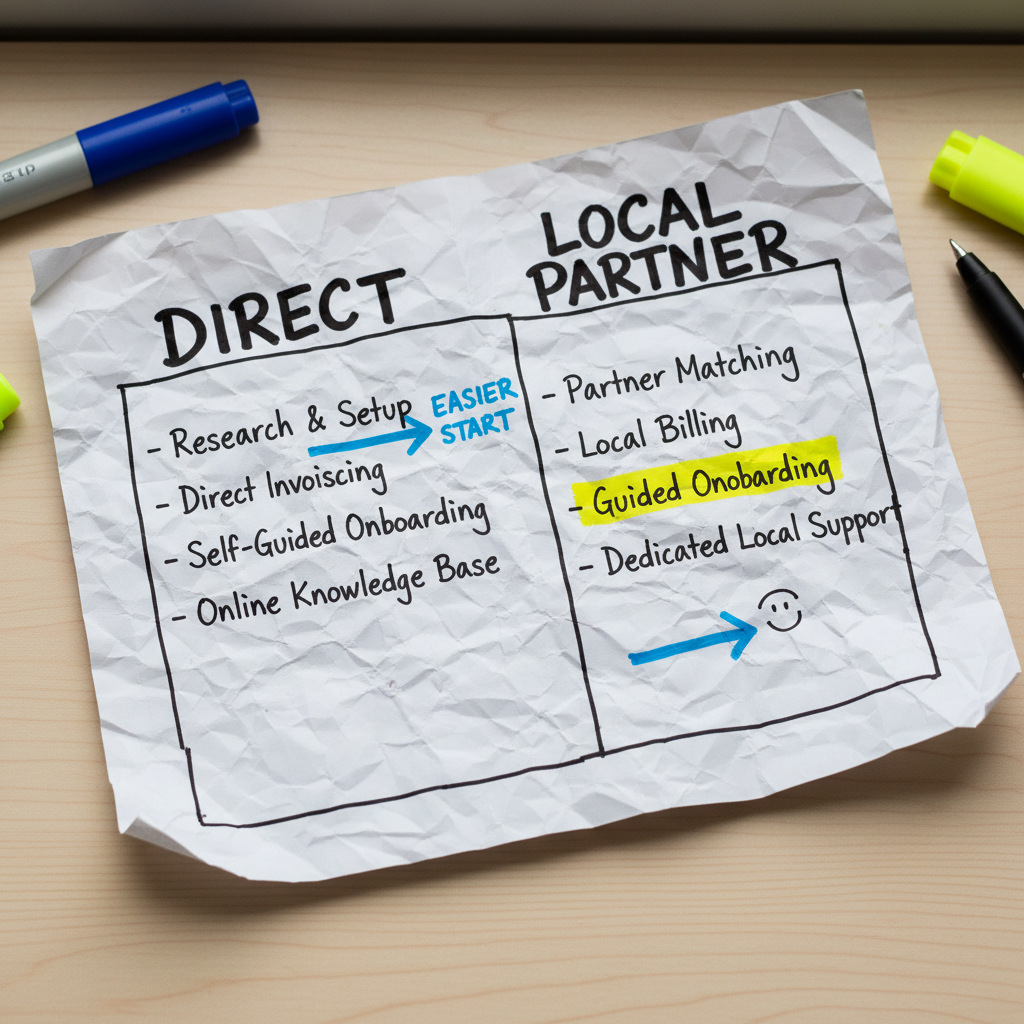
A practical comparison of direct subscriptions versus a local partner.
| Factor | Going Direct | Local Partner (e.g. AIHQ) | | --- | --- | --- | | | Getting started | Fast, self-service | Guided onboarding | | Billing | Cross-border, self-managed | Local/MYR alignment with finance | | Support | Ticketing, other timezones | Local business-hours support | | Data guardrails | Self-managed | Guidance and internal policy help | | Training | DIY or separate | Role-based capability building | | Use-case fit | Generic | Workflow-aligned | | Troubleshooting | Self-service | Ongoing partner support |
Choosing the Lower-Risk Route for Your Business
If your organisation is serious about using ChatGPT well, the practical question is not whether the tool is capable — it is how you adopt it responsibly and sustainably.
A local partner can help you structure that adoption: setting guardrails around data, equipping teams with role-based skills, aligning use cases with real workflows and staying on top of changing tool capabilities.
That is why many organisations treat a local partner as the lower-risk route for adoption that actually sticks, rather than a subscription that quietly goes unused after the first month.
Working with a Structured Capability Partner
AIHQ has trained and engaged over 9,000 professionals and supported organisations across corporate, public sector, professional and regulated environments. The focus is practical: building AI capability that connects to real workflows, and providing custom AI solutions where off-the-shelf tools are not enough.
If you are weighing whether to go direct or bring in local support, starting with a conversation can clarify what your team actually needs.
FAQ
Is going direct with ChatGPT cheaper than using a local partner?
Direct access may have a lower upfront subscription cost, but the full picture includes your internal time for onboarding, training, data guardrails and troubleshooting. For teams that need structured adoption support, a local partner can offer better value even if the headline price is higher.
Does a local ChatGPT partner handle our data compliance?
No partner can remove your responsibility for data governance. A responsible partner helps you understand tool settings, set internal policies and decide what is safe to share, so you can meet obligations such as those under Malaysia's PDPA more easily.
Are there authorised ChatGPT partners and resellers?
Yes. Some organisations work through authorised partners that provide procurement credibility, onboarding and support. Others work with local AI capability partners that help with training, adoption and workflow deployment around the same tools.
Does my team need training if we already use ChatGPT?
Many teams benefit from role-based training even after casual use. Training helps employees move from experimentation to repeatable workflows, apply responsible-use habits and use the tool more confidently for their specific job functions.
What happens when ChatGPT features change?
With a direct subscription, staying current is on your team. With a local partner, you have ongoing support to help you understand updates, adjust guardrails and keep adoption aligned across departments.
FAQ
Is going direct with ChatGPT cheaper than using a local partner?
Direct access may have a lower upfront subscription cost, but the full picture includes your internal time for onboarding, training, data guardrails and troubleshooting. For teams that need structured adoption support, a local partner can offer better value even if the headline price is higher.
Does a local ChatGPT partner handle our data compliance?
No partner can remove your responsibility for data governance. A responsible partner helps you understand tool settings, set internal policies and decide what is safe to share, so you can meet obligations such as those under Malaysia's PDPA more easily.
Are there authorised ChatGPT partners and resellers?
Yes. Some organisations work through authorised partners that provide procurement credibility, onboarding and support. Others work with local AI capability partners that help with training, adoption and workflow deployment around the same tools.
Does my team need training if we already use ChatGPT?
Many teams benefit from role-based training even after casual use. Training helps employees move from experimentation to repeatable workflows, apply responsible-use habits and use the tool more confidently for their specific job functions.
What happens when ChatGPT features change?
With a direct subscription, staying current is on your team. With a local partner, you have ongoing support to help you understand updates, adjust guardrails and keep adoption aligned across departments.