General
What Is AIHQ? Inside the AI Consulting, Training, and Transformation Firm
· By AIHQ Team

AIHQ in one paragraph
Most Malaysian agencies and GLCs reach a familiar point: a few officers are using ChatGPT quietly, one division has run a small pilot, and nobody can say what the organisation actually gets for the licences it is paying for. AIHQ works with agencies, GLCs and corporates at exactly that point — moving from scattered AI curiosity to structured capability, role-based usage and, where off-the-shelf tools fall short, custom solutions.
Formally, AIHQ is an AI capability and solutions company. Its work spans leadership alignment, workforce capability building, use-case discovery and custom implementation. The firm reports having trained and engaged over 9,000 professionals, and has worked across corporate organisations, government agencies, public sector bodies, professional institutions, regulated sectors and education environments.
That breadth matters for public-sector buyers because it means programmes have been delivered to both a ministry's policy team and an operations floor, not just to tech companies.
Who AIHQ is built for
AIHQ's client base clusters into four groups, and the entry point differs for each.
- Ministries, agencies and local authorities — typically need capability building at scale, governance-aware training and a defensible procurement story.
- GLCs and GLC-linked subsidiaries — usually need leadership alignment first, then department-level training, then implementation for workflows that off-the-shelf tools cannot cleanly handle.
- Professional institutions and regulated sectors — banking, insurance, audit, legal and healthcare-adjacent organisations where auditability and human review are non-negotiable.
- Corporate groups and education providers — where the issue is adoption consistency rather than initial awareness.
Selected organisations AIHQ has worked with include ACCA, Media Prima Group, Silverlake Group, Prudential BSN Takaful, Institute of Internal Auditors Malaysia, New Straits Times Press, Selangor State Government and local authorities, SME Corp Malaysia, MDEC and CIAST Shah Alam. Leadership briefings and strategy sessions have been run with organisations including Lion Group, MTD Group, Parkland Group and MUI Group.
If your organisation resembles the first two groups, the practical question is not "which tool?" but "which sequence?" — and that is the part most vendors skip.
What AIHQ actually delivers
Services fall into three connected layers. Buyers who understand the layering can procure the right piece instead of over-buying.
1. Advisory and leadership alignment
Executive and board-level sessions covering AI business implications, governance and decision rights, responsible adoption, privacy and risk, and where value actually sits versus where hype sits. Organisations that want a structured starting point often begin with an AI leadership briefing before committing to a wider programme.
2. Training and capability building
From broad AI literacy through to department-specific application. AIHQ runs a role-based AI training approach, on the reasoning that a finance officer, a frontline service officer and a policy analyst have almost nothing in common when it comes to useful AI tasks. AIHQ is a registered HRD Corp training provider, and programmes can be structured to be HRDC claimable, subject to client eligibility, grant approval and HRD Corp submission requirements.
3. Custom solutions and implementation
When a workflow needs more than a general-purpose chatbot, AIHQ designs custom AI solutions — internal copilots for SOPs and policy documents, enquiry chatbots, workflow automation and reporting dashboards. A custom AI chatbot is often the right answer for high-volume public enquiry handling, provided escalation to a human officer stays in the design.
The through-line is the firm's adoption sequence: interest, capability, practical usage, measurable outcomes, then optional implementation. Implementation is deliberately last — because building before capability exists tends to produce tools nobody uses.
What a structured 26-week rollout looks like for an agency or GLC
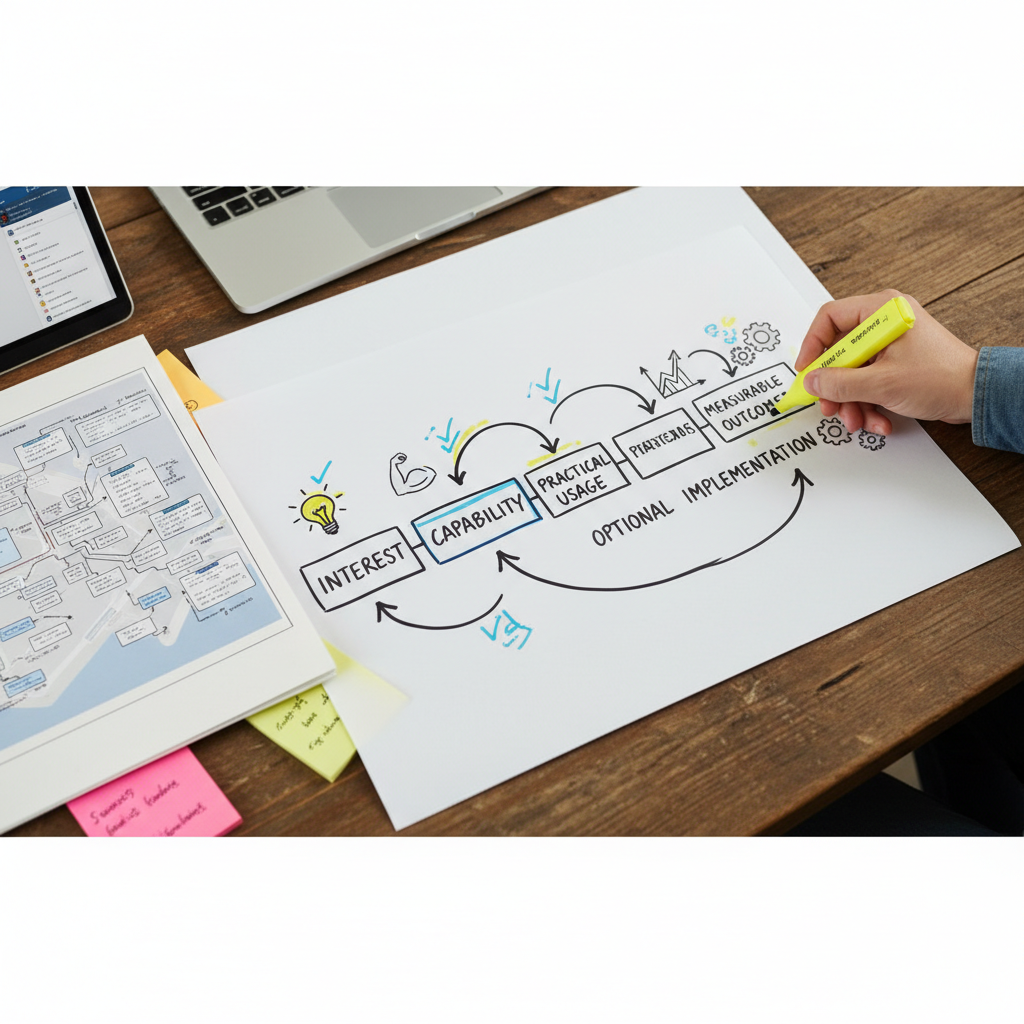
The AIHQ adoption sequence: interest, capability, practical usage, measurable outcomes, then optional implementation.
Below is a workable sequence for an organisation of roughly 300 to 1,500 staff, drawn from the shape of comparable public-sector engagements. Weeks are indicative; owners are the roles you need to name before the kick-off meeting.
| Phase | Weeks | What happens | Owner |
|---|---|---|---|
| Leadership alignment | 1–4 | Executive session on implications, risk and priorities; agreement on scope and decision rights | Secretary-General / CEO office, with CIO |
| Baseline and use-case discovery | 5–8 | Workflow audit across 4–6 departments; opportunity shortlist scored on volume, risk and effort | Transformation office, department heads |
| Capability building wave 1 | 9–16 | Role-based training for priority functions; internal champions identified per department | HR / L&D director |
| Guided usage period | 17–20 | Teams apply AI to real tasks with a usage standard and a human-review rule | Department heads |
| Governance and policy | 17–20 (parallel) | Responsible-use guidance, data classification rules, review and escalation paths | Risk / compliance, legal |
| Implementation decision | 21–24 | Go / no-go on custom build, based on the use cases that proved themselves | CIO / transformation office |
| Scale and measurement | 25–26+ | Wider rollout, adoption tracking, reporting to management | Transformation office |
Two design notes. First, governance runs in parallel with training, not after it — otherwise staff invent their own rules in the gap. Second, the implementation decision at week 21 is a gate, not a formality. The point of the earlier phases is to have evidence by then.
A general-purpose AI framework for businesses is useful here, but be aware that most published frameworks stall between assessment and pilot, usually on data access, ownership and measurement questions rather than on technology.
What it costs, in MYR
Public-sector and GLC buyers need budget figures early. The bands below are indicative planning ranges for Malaysian organisations, based on the scope typically involved. Final pricing depends on participant numbers, number of departments, customisation depth and whether a custom build is included.
| Engagement | Typical scope | Indicative MYR range |
|---|---|---|
| Executive / leadership briefing | Half-day to one-day session, up to 30 senior leaders | RM8,000 – RM20,000 |
| AI literacy programme | 1–2 days, 40–80 participants per cohort | RM15,000 – RM35,000 per cohort |
| Role-based department training | 2–3 days per function, customised to real workflows | RM25,000 – RM60,000 per function |
| AI innovation bootcamp | 2–3 day use-case discovery and pilot planning workshop | RM20,000 – RM50,000 |
| Governance and responsible AI workshop | 1–2 days, policy and risk audiences | RM12,000 – RM30,000 |
| Custom chatbot or internal copilot | Discovery, build, pilot, handover | RM40,000 – RM150,000+ |
Two funding mechanics are worth flagging to your finance team. HRD Corp levy contributions can be applied to registered training programmes, subject to eligibility, grant approval and submission requirements — AIHQ's HRD Corp registration is the relevant credential to cite. And where a programme falls under an existing digital transformation allocation, the training and the implementation acceptance criteria should be written into the same approval paper, not split across two budget cycles.
For a worked example of how scoping affects price and deliverable clarity, the AI consultant in Malaysia engagement guide sets out deliverables, decision rights and acceptance criteria in detail.
How to judge whether a provider is the right fit
Four tests work regardless of vendor, and they are worth applying to AIHQ as much as to anyone else.
- Ask for the capability-to-implementation handover. If training and building sit in separate organisations with no shared plan, expect the gap to be filled by nothing.
- Ask how HRDC claimability is documented. Any credible provider will describe eligibility conditions and approval steps rather than promise a claim.
- Ask who owns governance during the programme. If the answer is "the training provider", that is a warning sign — policy ownership belongs inside your organisation.
- Ask what evidence the pilot produces. Adoption rate, hours saved on a named process, error or rework rate. If a provider cannot name the metric before the pilot starts, it will not be measured after.
One honest limitation: no provider, AIHQ included, can guarantee transformation, ROI or a specific productivity gain for your organisation. Those outcomes depend on your data, your process ownership, how much staff actually use what they learn, and how you measure. What a structured programme can do is make those outcomes measurable, and give you the evidence to decide whether to continue, adjust or stop.
Lessons from a 12-month capability journey
The clearest evidence in AIHQ's own portfolio is a 12-month structured programme with Media Prima, which ran through awareness, AI fundamentals, intermediate LLM skill-building and advanced application workshops. Reported outcomes were 98% participant satisfaction, 90% reporting increased practical knowledge and skills, and 92% finding the training relevant and applicable to their work.
Treat those figures as specific to that programme rather than a benchmark for all training — that is what they are. The more transferable lesson is structural: the programme ran over a year, in layers, with advancing difficulty. Twelve months is closer to the real adoption timeline than the two-day workshops that most agencies start with.
For agencies and GLCs planning similar journeys, the enterprise AI framework for Malaysian agencies and GLCs covers the same sequencing with additional detail on stage gates and cost.
What the numbers mean for a Malaysian agency or GLC
Work backwards from the budget table. A single function trained at RM25,000–RM60,000 is a low-risk commitment that produces a testable result. A full multi-function programme with a custom build typically lands in the RM200,000–RM500,000 range across a financial year and should be staged behind a gate, so that the second tranche is earned by evidence from the first.
That staging discipline is the difference between a defensible AI programme and an unaccounted-for line item. It also means your first internal decision is small: pick one function, one workflow, one measurable outcome, and one owner. Everything else follows from whether that works.
If you are working through that first scoping decision, the useful next step is a conversation about your specific workflows, roles and governance constraints rather than a generic proposal. You can discuss your AI adoption needs with the AIHQ team directly.
FAQ
What is AIHQ and what does it do?
AIHQ is a Malaysia-based AI capability and solutions company. It runs leadership alignment sessions, role-based AI training, use-case discovery bootcamps and custom implementation work such as internal copilots, enquiry chatbots and workflow automation. Its stated approach runs from interest to capability, practical usage and measurable outcomes, with implementation as an optional later stage.
Has AIHQ worked with government agencies and GLCs?
Its portfolio includes work with the Selangor State Government and local authorities, SME Corp Malaysia, MDEC and CIAST Shah Alam, alongside corporate groups and professional institutions. Leadership briefings and strategy sessions have been delivered to organisations including Lion Group, MTD Group, Parkland Group and MUI Group, with senior leaders present.
Is AIHQ training HRDC claimable?
AIHQ is a registered HRD Corp training provider, and programmes can be structured to be HRDC claimable. Claimability is subject to client eligibility, grant approval and HRD Corp submission requirements — organisations should confirm their own eligibility before budgeting on that basis.
How much does an AI programme cost in Malaysia?
Indicative planning bands: RM8,000–RM20,000 for an executive briefing, RM15,000–RM35,000 per literacy cohort, RM25,000–RM60,000 per department for role-based training, and RM40,000–RM150,000+ for a custom chatbot or internal copilot. Final pricing depends on participant numbers, departments involved and customisation depth.
How long does it take before staff actually use AI in their work?
In practice, allow three to four months from leadership alignment to measurable usage, and up to twelve months for organisation-wide adoption. Short workshops rarely survive past the first busy quarter; staged programmes with a guided usage period and a named owner tend to hold.
Can AIHQ guarantee results or ROI?
No, and no provider credibly can. Outcomes depend on your data, process ownership, staff adoption and how you measure. What a structured programme can do is make those outcomes measurable and give management the evidence to decide whether to continue, adjust or stop.