General
AI Consultant in Malaysia: How to Scope an Engagement That Delivers Measurable Results
· By AIHQ Team

The scoping conversation most operations teams get wrong
A procurement officer at a Malaysian manufacturer opens three proposals for "AI consulting." One quotes RM18,000 for a two-day workshop. One quotes RM240,000 for a six-month transformation programme. One quotes RM65,000 for a discovery sprint with three named deliverables.
Only the third proposal tells the operations director what they will physically receive, what their own team must contribute, and how anyone will know whether it worked.
That is the entire problem with buying AI consulting in Malaysia right now. The market prices comparable services across a 13x range because scoping is inconsistent. Vendors sell hours, workshops, or ambition. Operations and process owners need something else: a bounded engagement with testable outputs.
This guide is about the scoping work that happens before you sign. It covers what deliverables you should demand, how to map decision rights so the engagement does not stall, what Malaysian cost bands look like, and how to write acceptance criteria your team can actually evaluate.
What you are actually buying when you hire an AI consultant
An AI consultancy engagement should produce one of four things. If a proposal does not clearly say which of these it produces, the scope is undefined.
A decision. A recommendation with reasoning your leadership will accept, usually covering which of five to fifteen candidate use cases to pursue. Output is normally a prioritisation document and a business case per shortlisted case.
A capability. Your team can do something they could not do before — write a working prompt pattern for a reports process, evaluate AI output against a quality bar, or draft a policy for what can be pasted into a public model. Output is trained people plus reusable artefacts.
A working system. A chatbot, an internal copilot over your SOP library, or an approval-flow automation running with real users. Output is a deployed tool with a defined owner and escalation path.
A governance position. A responsible-use position covering data classification, human review requirements, and which tools are permitted for which document types. Output is a policy and evidence that relevant staff were briefed.
The mistake most operations teams make is buying a blend and getting none of the four. "AI strategy and enablement" is not a deliverable. "Five prioritised use cases with effort, data dependencies and a 90-day pilot plan for the top two" is.
For a fuller picture of how enterprises sequence this work across an organisation, the framework for applying AI in the enterprise is worth reading alongside this piece, though it is written for marketing and sales leaders rather than process owners.
Deliverables to demand in the proposal
Push each of these into the written scope. Vague deliverables are where engagements go sideways.
| Deliverable | Weak version | Version worth paying for |
|---|---|---|
| Use-case inventory | "AI opportunities identified" | 12–20 candidate use cases, each with process owner named, frequency estimate, and data source listed |
| Prioritisation | "Recommended roadmap" | Scored table on impact, effort, data readiness and risk, with a stated scoring method you can re-run |
| Pilot design | "Proof of concept" | One pilot defined with baseline metric, target range, duration, users, and stop conditions |
| Capability transfer | "Training included" | Named modules by role, hours, and a post-session assessment format |
| Governance | "Best practice guidance" | Draft acceptable-use position mapped to your data classes and existing PDPA obligations |
| Handover | "Final report" | Documented processes, prompt or workflow library, and a named internal owner per artefact |
The table is deliberately unglamorous. Operations leaders should treat an AI engagement like any process improvement project: if you cannot name the artefact and its owner at handover, the benefit will not survive the engagement.
Decision rights: the unwritten cause of stalled engagements
Most AI engagements in Malaysian organisations do not fail on technology. They stall on who is allowed to approve what.
Before the kickoff, get four decisions named in writing:
- Who can approve a use case for piloting? Usually a department head plus whoever owns the data. If this is unclear, every shortlist sits for three weeks.
- Who can approve a tool for use with internal documents? This is normally split between IT security and whoever owns the data classification. Naming both avoids a fortnightly argument.
- Who signs off on the pilot's success criteria? It should be the process owner, not the vendor and not the project sponsor alone.
- Who can halt the pilot? Someone should be able to say stop if the quality bar is not met, without it being treated as a failed project.
Write these into the statement of work as named roles, not job titles alone. "Head of Order-to-Cash" is clearer than "operations management." This single paragraph prevents more schedule slippage than any technical decision you will make during the engagement.
Realistic timelines for a Malaysian engagement
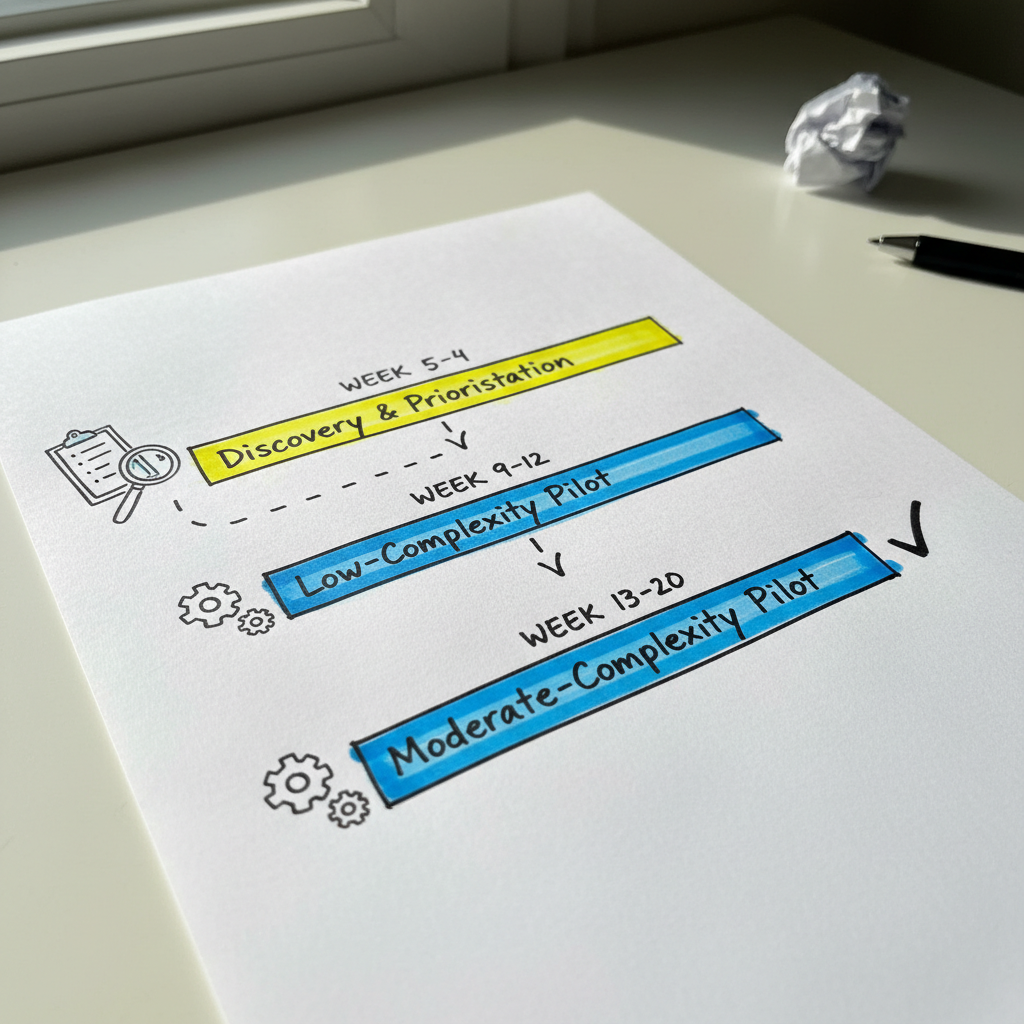
Discovery and prioritisation typically run 3-5 weeks; low-complexity pilots 6-10 weeks; moderate pilots 10-16 weeks.
Buyers get misled here more than anywhere else. A quick reference for typical shapes, assuming a cooperative data owner and a single business unit:
- Use-case discovery and prioritisation: 3–5 weeks. Includes interviews, process walkthroughs, scoring workshop, and a prioritised shortlist. Anything promising this in three days is producing a list of ideas, not a decision.
- Single pilot, low data complexity (document summarisation, drafting assistance, meeting notes over non-sensitive content): 6–10 weeks to a usable prototype with real users.
- Single pilot, moderate complexity (internal copilot over an SOP or policy library, enquiry triage): 10–16 weeks. Most of the time goes into content preparation and quality evaluation, not model work.
- Workflow automation with system integrations (approval flows, CRM or ERP-adjacent processes): 12–20 weeks. Integration and change management dominate.
- Organisation-wide capability programme: 9–15 months if it includes multiple departments, governance rollout and progressive training. Any organisation being told this takes six weeks is being sold training, not adoption.
Add two to four weeks to each band if your data owner is sharing capacity with three other initiatives, which is the normal case.
Cost bands in MYR, and what drives them
Malaysian buyers regularly get quoted wildly different figures. Here are the ranges you should expect to see, and the variables that legitimately move a quote up or down.
| Engagement shape | Typical MYR range | Main cost driver |
|---|---|---|
| Workshops and briefings (leadership or department level) | RM8,000 – RM35,000 | Seniority of facilitator, number of sessions, customisation to your processes |
| Use-case discovery and prioritisation (3–5 weeks) | RM25,000 – RM70,000 | Number of departments in scope, depth of data readiness assessment |
| Single pilot, low complexity | RM40,000 – RM90,000 | Content preparation volume, evaluation rigour, number of user groups |
| Single pilot, moderate complexity | RM80,000 – RM180,000 | Data preparation, integration count, governance requirements |
| Custom chatbot or internal copilot, production | RM120,000 – RM350,000 | Corpus size and quality, escalation design, hosting and compliance posture |
| Multi-department capability programme | RM200,000 – RM600,000+ | Headcount reached, number of role tracks, length of the programme |
Four variables legitimately move these numbers: the number of distinct user roles in scope, whether your source documents exist in usable digital form, whether any integration with an existing system is required, and how much of your own team's time is committed.
Two variables should not move them. The brand of the AI model behind the solution should not materially change the consulting fee — model access is a small fraction of the work. And the number of slides in the deliverable should never be a line item.
Where organisations have structured their capability-building to be supportable through HRD Corp, some training components can be HRDC claimable data AI certifications subject to eligibility, grant approval and HRD Corp submission requirements. Check this early, because the paperwork has lead time and it affects how you phase the engagement.
Role-by-role: who is affected and what they should expect
Scoping looks different from each seat in the room. This breakdown helps process owners predict where the friction will land.
| Role | What they contribute | What they receive | Common friction point |
|---|---|---|---|
| Process owner (you) | Process walkthroughs, baseline metrics, user access for testing | Prioritised use cases, pilot with measured baseline | Being asked for metrics that were never tracked |
| Data owner / IT | Data source inventory, access approvals, security review | Documented data flow and classification decisions | Access requests submitted after the pilot starts |
| Frontline team | Time to test outputs and report failures honestly | Working tool, clear guidance on when not to use it | Fear that reporting errors reflects badly on them |
| Risk, compliance, legal | Constraints, PDPA obligations, review thresholds | Draft acceptable-use position to critique | Being consulted after the tool is already in use |
| Finance | Budget approval, benefit tracking method | Costed proposal with defined measurement approach | Benefit claims that cannot be traced to a metric |
| Leadership sponsor | Priority calls, removal of blockers | Decision-ready options rather than a status update | Expecting a demonstration instead of a decision |
Read this table as a checklist of people to talk to before, not after, the proposal is written. The friction points listed are the ones that most reliably surface in the fourth week of an engagement.
Acceptance criteria you can write yourself
This is the part most buyers skip, and it is the single highest-leverage section of your statement of work. Write criteria as testable statements, not aspirations.
Weak: "The pilot will demonstrate improved efficiency."
Testable: "For the monthly management report pack, the drafting step will reduce from a median of 6.5 hours to under 3 hours across two consecutive cycles, with the finance manager confirming that no factual corrections were required in more than 20% of AI-drafted sections."
The second version names a metric, a baseline, a threshold, a measurement window, and the person who confirms. It also embeds a quality guardrail, which is essential — speed without accuracy is not a benefit in a reporting process.
Three rules for writing these:
- Measure something already tracked, or agree the baseline method first. If the drafting step has never been timed, agree how you will time it before the pilot begins, or the comparison is meaningless.
- Include a negative criterion. State what the solution must not do — leak document content outside permitted environments, produce outputs that no one has reviewed, or create a new manual step downstream.
- Set a review date, not just an end date. Agree that in week six of a twelve-week pilot, you will review progress and either continue, adjust scope, or stop. Engagements that only get reviewed at the end cannot be corrected.
Where off-the-shelf tools stop and custom AI solutions begin
A large share of scoping conversations end with a recommendation not to build anything. That is a legitimate outcome, and operations leaders should treat it as a good sign that the consultant is reasoning rather than selling.
A general assistant tool handles a surprising amount: drafting, summarising, rewriting, meeting notes over non-sensitive material, first-pass analysis. If the use case is individual productivity with no shared data and no integration, buy seats and train people properly.
Custom work becomes justified when one of these is true:
- The knowledge is internal and access must be controlled. SOP libraries, policy documents and service knowledge should not be pasted into a general model by every employee. A controlled internal copilot is the structured alternative.
- The workflow spans systems. If the process requires pulling from one system and writing into another, a general assistant cannot complete it. AI agents for business workflows begin to make sense here.
- Volume justifies automation. A task done 40 times a day by six people is a different case from the same task done twice a week.
- External users need to self-serve. Enquiry handling, FAQ resolution or student support at volume usually points toward a dedicated AI chatbot with escalation to humans rather than more email.
- Accuracy requirements are high and verifiable. In regulated processes, you need retrieval limited to approved sources and a logged review step, which off-the-shelf interfaces generally do not provide.
If none of those five apply, the honest answer is a tooling and training recommendation plus a written acceptable-use position. Buy that, and revisit in two quarters.
Lessons from how these engagements actually run
AIHQ has trained and engaged over 9,000 professionals across corporate, public sector, professional and regulated environments, which has produced a fairly consistent pattern in scoping conversations.
First, the use cases that survive scoping are almost always the ones with an existing pain metric. Teams that can already say "this reconciliation takes four days" get to a pilot faster than teams that say "this area feels manual."
Second, governance questions arrive earlier than buyers expect. Within two to three weeks, someone asks what may be entered into a model, whether outputs need review, and who is accountable if a wrong answer reaches a customer. Programmes that pre-empt this — for example by including a session on responsible AI training alongside the technical work — avoid a hard stop later. AIHQ can also support a leadership alignment session early so escalation paths and decision rights are settled before the pilot, rather than during it.
Third, and most consistently, the organisations that get value from an engagement are the ones that assigned an internal owner before the consultants arrived. Where no one internally owns the process after handover, the improvement decays within a quarter.
Malaysian employers looking to fund workforce components of these programmes should note that AIHQ programmes can be structured to be HRDC claimable, subject to client eligibility, grant approval and HRD Corp submission requirements.
The scoping checklist to bring to your next vendor meeting
Nine questions. If a vendor cannot answer six of them in the meeting, ask for a revised proposal.
- Which of the four outputs — decision, capability, working system, or governance position — does this engagement produce?
- Name the artefacts I will hold at handover, and who you expect to own each one internally.
- Which data sources must be accessible, and who needs to approve that access?
- What is the baseline metric, and how was it captured?
- What are the stop conditions for the pilot, and who can call them?
- Which roles receive training, how many hours, and in what form?
- How will the acceptable-use position account for our existing PDPA obligations and document classification?
- What does the review point at the midpoint of the engagement look like?
- If the pilot produces ambiguous results, what happens next — and is that covered in this fee?
Question nine is the one that separates a partner from a vendor. Engagements that anticipate an inconclusive result and define what happens next are structured for learning. Engagements that assume success and leave no path for a partial outcome tend to produce a positive final report regardless of what was found.
Hiring an AI consultant in Malaysia is a scoping exercise before it is a technology decision. Get the deliverables, decision rights, timelines and acceptance criteria right on paper, and the engagement has something to be measured against. Get them wrong, and you will be evaluating a slide deck.
For operations and process owners evaluating where their organisation sits, it can help to discuss your AI adoption needs with someone who has run these engagements across corporate, public sector and regulated settings before committing budget.
FAQ
How much does an AI consultant cost in Malaysia?
Typical ranges as of current market conditions: department or leadership workshops RM8,000–RM35,000; use-case discovery and prioritisation RM25,000–RM70,000; a single low-complexity pilot RM40,000–RM90,000; a moderate-complexity pilot RM80,000–RM180,000; a production chatbot or internal copilot RM120,000–RM350,000; a multi-department capability programme RM200,000–RM600,000 or more. Cost drivers are the number of user roles in scope, the state of your source documents, integration requirements, and how much internal time is committed.
How long should an AI consulting engagement take?
Use-case discovery normally runs 3–5 weeks. A low-complexity pilot takes 6–10 weeks to a usable prototype with real users, a moderate-complexity pilot 10–16 weeks, and workflow automation with system integrations 12–20 weeks. Organisation-wide capability programmes typically run 9–15 months. Add two to four weeks to any band if your data owner is not dedicated to the engagement.
What should an AI consultant deliver at the end of an engagement?
Insist on named artefacts rather than reports. Depending on the engagement shape, that means a scored use-case shortlist with a documented method, a pilot defined with baseline metric and stop conditions, a drafted acceptable-use position mapped to your data classes, a prompt or workflow library, and a named internal owner for each artefact. If the deliverable cannot be described as a document or a working system with an owner, it is not a deliverable.
How do I measure whether an AI engagement worked?
Agree acceptance criteria before the engagement starts, written as testable statements. Each should name a metric, a baseline, a threshold, a measurement window, and the person who confirms the result. Include at least one negative criterion — what the solution must not do — and set a midpoint review so scope can be corrected rather than judged only at the end.
When should we build a custom AI solution instead of using off-the-shelf tools?
Custom work is justified when the knowledge is internal and access must be controlled, when the workflow spans multiple systems, when volume justifies automation, when external users need to self-serve at volume, or when accuracy requirements are high enough that you need retrieval limited to approved sources and a logged review step. If none of those apply, a tooling and training recommendation is usually the better use of budget.
Is AI training related to AI consulting HRDC claimable?
Some training components can be structured to be HRDC claimable, subject to client eligibility, grant approval and HRD Corp submission requirements. AIHQ is a registered HRD Corp training provider, but approval is never guaranteed and the paperwork has lead time, so raise it during scoping rather than after the engagement is agreed.